Five things to be grateful for

photo-1447914178647-198e7e4a70b5

It’s past mid-November, and I have several reasons to celebrate it: it’s my 5-year business anniversary this month, today is Thanksgiving and the Holidays are just around the corner (as is my birthday right after them). And even a few months ago, I already had that lucky feeling of mission accomplished this year, when you feel the year can already end, because plenty of good things have already happened and you couldn’t be happier. I hope you know what I mean, because it certainly feels fantastic.

We do not celebrate Thanksgiving here in Brazil, but I think it’s a shame. People seem to take pleasure in complaining, but not in being grateful and acknowledging the good, instead of the bad. (And here I am, complaining about people who complain. It’s a vicious circle, you see?)

A Brazilian runner I follow on Instagram, Débora Aquino, once mentioned a Brazilian entrepreneur, Bel Pesce. Débora always talks about being grateful and not complaining, talking about other people behind their back and the like, and one of those times she mentioned Bel, saying people like this young entrepreneur do not have time to complain and talk about other people because they are always busy building something and innovating. (Obviously, I immediately started following Bel as well and can confirm she is indeed an amazing professional.)

Therefore, as a celebration of my 5-year business anniversary, I decided to list 5 things I’m grateful for this year:

  1. Having a job.
    Or even better: being able to do what I love and love what I do. After all, isn’t that a blessing?
    This end of the year, the project flow has been slower than usual. I could complain. Instead, I choose to focus my free time on other things that demand my attention and take the time to innovate, have new ideas, brainstorm, etc. Besides, I still have a “job” and I still get to do what I love.
  2. Choosing a healthy lifestyle.
    In fact, my lifetime decision to change to a healthy lifestyle was made last year: I completely changed from being a sedentary person who crazily ate absolutely everything it was in front of her to someone who started exercising and following a healthy diet. This year, however, I took everything to the next level: started running 10 km; playing tennis for good, including taking part in a competition (I’m currently in the semi-finals); and weight-lifting. Exercising and eating healthily are now part of my normal routine and it feels great.
  3. Friends and colleagues.
    It’s no secret my friends have always been like family to me. Having lived far from home for many years, they turned out to be my home-away family, so they do have a very special reserved space in my heart.
    And translation has brought me several wonderful colleagues, many of which I can now call friends. Many of them I only met online, some Brazilian ones I had already had the chance to meet in person, but some other international ones I had the great pleasure of meeting in person this year, at the IAPTI conference in Bordeaux, France, to name but a few: Chiara Bartolozzi, Emma Becciu, Marta Prieto, Mila Rapizo, Gala Amat (with whom I shared a flat), Rita Maia, Paula Arturo, Vanessa Marques. (Please forgive me if I haven’t mentioned your name, but you are all equally important.) Besides, one of the greatest things that the conference provided to me was to finally meet Marta Stelmaszak and Valeria Aliperta, my role models, in person and to attend one of their talks.
    After all, working as freelance, all by ourselves behind a computer at our (home) office is nothing without our colleagues, right?
  4. Being able to afford a comfortable lifestyle.
    I’m a wanderluster, and translation allows me to travel a lot, sometimes even more than once a year, as was the case this year: I had the chance of traveling to Fernando de Noronha island, one of the greatest (if not the greatest) beach destinations in Brazil with my wanderluster friends in April, and to Europe in September, also with a dear friend.
    I’m able to have a healthy and balanced lifestyle.
    I was able to move out and live by myself again.
    I can afford to buy things I love, and not simply wish I had them.
    I was finally able to buy my very first car.
    I know things and money do not equal happiness, but they certainly help.
  5. You!
    Yes, you! If it weren’t for all my followers, supporters and blog readers, I wouldn’t be compelled to keep passing on what I know and increasingly wanting to learn more to do so. You keep me going and motivate me to innovate and always help. Thank you! 🙂

Reflecting on our accomplishments and writing them down make them feel real and avoid us from taking them for granted. We all have gifts in life, lessons learned and achievements every year, and I think it’s important to acknowledge them and be thankful before moving on and setting new goals and resolutions. Also, reward yourself on your achievements and reflect upon what didn’t go right in order to change and innovate, instead of keeping the same old mistakes. The time is now. I can already feel Christmas approaching. How about you?

P.S.: I love you!

Just kidding! LOL I couldn’t miss the joke.

Now, seriously, I’ve just received 200 likes on the blog with this post, so there’s something else to be grateful for. Thank you! And I guess I do love you as well, after all. 🙂

Guest post: Win-Win Project (in Portuguese)

Welcome back to our guest series! I made a quick adjustment to our editorial calendar so we could make room for Reginaldo Francisco and his amazing fresh-out-of-the-oven project, Win-Win. Although his post is in Portuguese, you can learn more about the project in English or Spanish here (please note the introductory video is also available with English subtitles and in Spanish). And, if you like the idea, help support the campaign on Kickante (same link above).

Also, Rafa Lombardino, from eWordNews, translated this post into English. You can find it here.

Welcome, Reginaldo!

logoH2_vector_150

E se um novo mercado de tradução fosse possível?

O mercado da tradução tem alguns aspectos que me incomodam há bastante tempo, provenientes do fato de a tradução profissional, de qualidade, não ser um serviço barato — aliás, não pode mesmo ser, e admito que a princípio pode parecer estranho isso incomodar um tradutor. No entanto, o que não me agrada é que, com isso, estamos sempre trabalhando para quem pode pagar, geralmente empresas, e às muitas pessoas que não podem acaba restando apenas alternativas como tradução automática ou amadora.

Para além de um incômodo baseado em algum senso de justiça, essa situação tem consequências negativas para os tradutores em geral. Impulsiona, por exemplo, o desenvolvimento de sistemas de tradução automática cada vez melhores, já que fica claro para seus desenvolvedores que um número cada vez maior de pessoas recorrem a eles. Mais ainda, contribui para que cada vez mais essas pessoas se contentem com o nível de qualidade oferecido por esses sistemas e deixem de reconhecer o diferencial dos tradutores profissionais.

Além disso, apesar de não gostar do mimimi de que as empresas ou as agências de tradução exploram o tradutor (defendo a força libertadora do dizer “não”), é fato que, como em qualquer mercado, empresas têm mais força para tentar impor suas condições, de modo que precisamos constantemente resistir à pressão para fazer mais por menos.

Foi o descontentamento com essa situação que me levou a pensar em um sistema no qual tudo isso pudesse ser diferente, aproveitando as possibilidades fantásticas criadas pela popularização da internet, na qual existe uma quantidade imensa de conteúdos interessantes que mereceriam ser traduzidos e não são pelas limitações comentadas acima — sua tradução interessa a muitas pessoas, mas nenhuma individualmente pode pagar por ela. Daí surgiu a ideia de criar um sistema on-line que permitisse que várias pessoas interessadas na tradução de um mesmo conteúdo disponível na internet (artigo em periódico científico, postagem de blogue, reportagem, notícia, narrativa de fanfiction…) se juntassem para pagar um tradutor profissional. Assim, de um lado o tradutor receberia um valor adequado pelo seu serviço, e de outro esse valor já não seria alto para cada interessado na tradução, uma vez que cada um pagaria apenas uma fração dele.

A ideia cresceu quase com vida própria ao longo de muitos meses — na verdade mais de dois anos —, especialmente depois que assumiu um nome, Win-Win, inspirado no seu objetivo de ser um sistema em que todos saiam ganhando. Desde o início, porém, tive consciência de que colocá-la em prática estava muito acima da minha capacidade, tanto em termos de conhecimentos e habilidades quanto em termos financeiros. Por isso, o primeiro passo para transformar a ideia em projeto foi reunir pessoas competentes em torno dela: primeiro a fera de TI Roney Belhassof, com seus conhecimentos e contatos essenciais para definirmos os detalhes do sistema e chegar a um orçamento para o seu desenvolvimento, e depois tradutores experientes de diferentes idiomas. Ter conseguido que profissionais desse calibre acreditassem na ideia é na verdade o que mais alimenta minha confiança de que ela pode dar certo.

O passo seguinte, já com a ajuda dessa equipe, foi criar uma campanha de financiamento coletivo (crowdfunding) para tentar reunir os recursos financeiros necessários para desenvolver o sistema e colocá-lo em operação — uma forma de financiar a execução do projeto que tem tudo a ver com os princípios em que ele se baseia. A campanha foi lançada em meados de outubro e desde então temos trabalhado na divulgação por diversos meios: redes sociais, e-mails, o tradicional boca-a-boca… O feedback tem sido bastante positivo, com várias pessoas elogiando a ideia e se empolgando com as possibilidades que ela traz, porém a arrecadação da campanha ainda está bastante devagar, o que infelizmente pode fazer com que o projeto morra na praia.

Por isso agradeço imensamente o convite da Carol para escrever este artigo, uma forma de divulgar o Projeto Win-Win para um público que pode ter muito interesse nele. Inicialmente tinha pensado em explicar em detalhes todo o funcionamento que planejamos para o sistema, mas vi que ficaria extenso demais e achei que valeria mais a pena abordar as motivações que inspiraram e sustentam o projeto. Para compreender de forma rápida e clara a ideia e como vai funcionar, o melhor é assistir ao vídeo explicativo disponível aqui, e para mais detalhes ler o texto logo depois dele.  Além disso, para se manter atualizado sobre o projeto, é só curtir a fan page no Facebook e assinar nossa newsletter.

E, é claro, se também acreditar que o Win-Win pode de fato ajudar a expandir o mercado de tradução, trazendo benefícios para todos os envolvidos (e até para os não envolvidos), contribua com a nossa campanha na Kickante e ajude a divulgá-la. Toda contribuição é um empurrãozinho a mais para tornar o Win-Win realidade, e os valores só serão cobrados se a campanha atingir a meta. Ou seja, se o valor não for alcançado, todos recebem a contribuição de volta e não perdem nada; já se for, todos ganham:

– os tradutores cadastrados ganham um novo nicho de mercado, atendendo uma demanda antes reprimida, com a liberdade de escolher quais projetos assumir, definindo preços e prazos e tendo garantia de recebimento;

– os demais tradutores ganham com a visibilidade que o sistema proporcionará à importância e à qualidade diferenciada do serviço de tradutores profissionais;

– as pessoas que precisam de traduções e não podiam pagar por ela passam a poder;

– os produtores de conteúdo para internet ganham a possibilidade de divulgação em outros idiomas;

– como as traduções ficarão disponíveis para todos no site do Win-Win, ganham também todos os usuários da internet com a maior difusão de informações, ideias e conhecimento.

Por fim, como já me estendi demais por aqui, será um imenso prazer continuar a conversa nos comentários abaixo, a partir de opiniões e eventuais dúvidas sobre o projeto. Espero vocês por lá!

Muito obrigada por ter aceitando meu convite, Reginaldo! É um prazer poder ajudar a divulgar seu projeto no meu blog. Sucesso!

Sintam-se à vontade para tirar suas dúvidas. E não se esqueçam de ajudar divulgando e/ou apoiando a campanha no Kickante.

If you have any questions, you can also ask in English. And please help support the campaign.

About the author
reginaldoReginaldo Francisco é tradutor do inglês e do italiano para o português. Traduz principalmente literatura e textos das áreas de gestão de qualidade, compliance, gestão de pessoas e tecnologia. É bacharel em Letras com Habilitação de Tradutor pela Universidade Estadual Paulista (UNESP) e mestre em Estudos da Tradução pela Universidade Federal de Santa Catarina (UFSC). Como resultado de suas pesquisas e experiência na área, publica artigos e ministra cursos e palestras sobre Tradução, especialmente sobre ferramentas de auxílio ao tradutor (CAT tools). É o autor, juntamente com Claudia Zavaglia, do livro Parece mas não é: as armadilhas da tradução do italiano para o português.

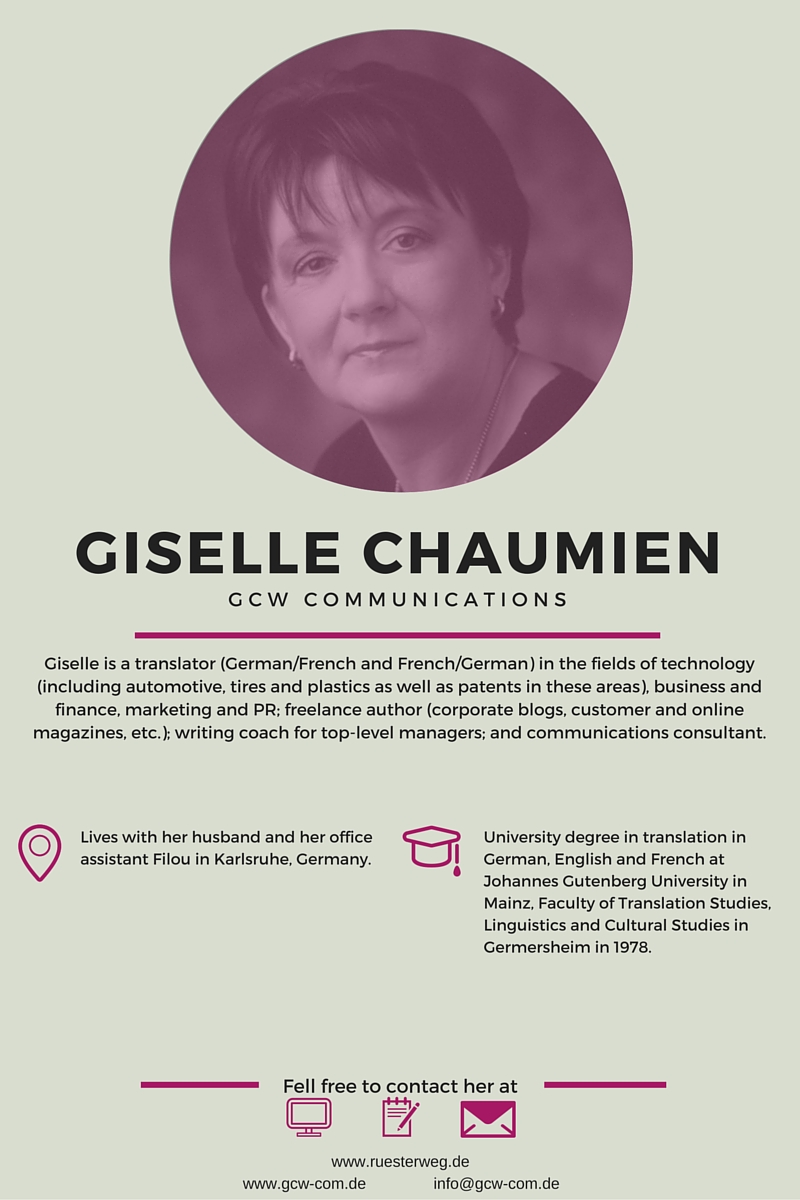
Greatest Women in Translation: Giselle Chaumien

^3BD2FAACEAC897D21BE68030808476304DC722B6E37A1C22D8^pimgpsh_fullsize_distr

Welcome back to our interview series Greatest Women in Translation! This month the interview is a bit later than usual because yesterday was a local holiday here, so I took the day off. 😉

Please welcome this month’s Greatest Woman in Translation, Giselle Chaumien, nominated by Nicole Adams.

Welcome, Giselle!
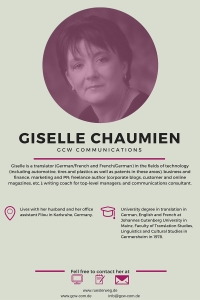

GISELLE CHAUMIEN

1. Your mother is German and your father is French. Was your upbringing bilingual at home? If so, how was the experience?

Yes, we spoke both languages at home – with our dogs as well, who understood the commands in both languages. I believe that bilingual upbringing works well only when both parents speak both languages well and use them with the family. Time and again we hear or read that it’s difficult for children, but I can’t confirm that for me and my siblings. My mother told me that we spoke a mishmash of both languages in our first few years, but then at the age of 3-4 everything straightened out. We lived in Germany, and I attended a private boarding school in France. Today, when I count or do arithmetic, it’s always in French, but I dream in both languages. Oh, and with my office assistant Filou I speak only German. Do you think that’s a mistake? 😉

In my opinion, there’s something that’s much more important than a bilingual upbringing: our parents taught us that random acts of kindness enrich your life. That’s something that’s much more widespread in the United States and the United Kingdom than in Germany. This principle has come to play an increasingly important role in my life – perhaps it has to do with my age. The life that we share with everyone else is like a big pot of soup, with chunks of meat, slivers of vegetables and noodles floating in it. You pick something out of the soup that you like or need, and that makes you happy. And you should put something else back into it, so that others find something good as well. Thus, in my own small way, I try to give back some of what helped me in earlier years and from which I still benefit today. This approach to life is the real legacy of my parents.

2. You studied in Germersheim, at Johannes Gutenberg-Universität Mainz, Faculty of Translation Studies, Linguistics and Cultural Studies (one of the best universities for translators and interpreters in Germany), where you later became a lecturer. What was it like to switch roles and become a lecturer where you were once a student?

I had already held a teaching position while I was studying there, as one of the instructors who headed the tutorial for German/French legal translation became seriously ill and it was not possible to find a regular substitute so quickly,  so that was not a problem for me. In the early 1980s I then had a half-time position on a two-year contract; my employment contract with Michelin was reduced to 60% during this period – otherwise I would never have managed such a full schedule. I was teaching German/French legal translation and French commercial correspondence to 3rd and 4th semester students on the one hand, and on the other I was in charge of the tutorials in German/French technical translation for those students taking their comprehensive examinations. I also supervised a number of diploma theses. I greatly enjoyed working with the students. Unfortunately there are hardly any permanent positions at German universities. Teaching people, awakening their enthusiasm for a subject, accompanying them through a part of their professional development – that’s very fulfilling.

3. You have been working for Michelin for nearly 30 years! You began as a French and German teacher for managers, but then had the chance of implementing a translation department there. How cool is that? You programmed CBTs (computer-based training courses) for factory workers, organized professional development courses for managers, installed an intranet for Michelin Germany, Switzerland and Austria, and implemented an Internal Communications department in those three countries as well. I clearly see why Nicole nominated you! How does this impressive professional experience help you nowadays as a freelance translator?

I had the privilege of pursuing an unusual path at Michelin. I gained incredibly valuable experience from the implementation of the projects you mentioned as examples, and I still reap the benefits from that on a daily basis. When you manage a project and you’re responsible for a budget of six figures or more, and you have to procure external services and manage and monitor the implementation in multiple plants, you learn what doing business with an entrepreneurial approach really means. Nobody can ever take that away from you. I should add that Michelin is a very special company, in which people are given numerous opportunities regardless of where they come from, their gender, their disabilities, etc. I had the great good luck and the honor to accompany the executive directors at that time on numerous business trips in Germany and to interpret for them: François Michelin and his son Edouard, two unique and impressive human beings. And yet I took the risk of going into business for myself, because I wanted to put myself to the test once more.

4. Giselle, you have your “Rüsterweg” blog, the knowledge database “Wissenswinkel” and the “Tips for Translators” on your website; recently you also began your newsletter “Café Umlaut”. Honestly, that’s an amazing amount of work. What motivates you?

As I just explained, I had the good fortune to learn a lot and gather valuable experience over the course of my career. I’d like to share all this experience with those who are interested, or, to return to the example of the pot of soup, I simply want to put a few good pieces of meat into the broth so that others benefit from it as well.

It all started with the section “Die Welt des Übersetzens” (“The World of Translation”) on my “Rüsterweg” blog. At some point I wrote about a subject specifically for translators – that was the article “Langatmig, aber zielführend” (“Tedious, but Productive”), about customer acquisition, and suddenly I had loads of subscribers. My post entitled “Honorarfreie Übersetzung” (“Pro Bono Translation”) – an article that was translated into English, Italian, Spanish and Russian and which I translated into French – is surely the most popular of my blog posts with 1,660 “likes”. In spring 2015, I launched the “Wissenswinkel” website – a knowledge database for young language professionals – together with my colleague Sabine Lammersdorf. And then in July 2015 I began writing my “Newsletter”. None of this is aimed at customers – it is neither sales-oriented nor is it financed by advertising or similar means.

Since you asked about the time involved – yes, of course it is a lot of work, but it’s worth it, because in the meantime so many interesting contacts to younger and older colleagues in the translation industry have developed that I really enjoy it.

5. You don’t use CAT tools and never have – why not? Don’t you think it could help you be more productive?

Well, many of my texts are simply not suitable for them, and in many cases my translations are adaptations. Quite honestly, I can’t say much about CAT tools. I hear about “segments” and imagine that in the end, the work of the translator consists of inserting the missing pieces of the puzzle – that’s not my style at all. My translation memory is my brain, and yes, a few glossaries I put together myself. I’m an avid user of the voice recognition program “Dragon Naturally Speaking” and with that I am extremely productive. In my specialist fields such as tire technology, financial reporting, plastics technology, etc., I rarely have to do any research any more – I can simply start dictating and wander around my office while doing so – yet it’s not at all boring. Besides, translation is only one of my sources of income. I also work as a freelance author for several companies, e.g. for corporate blogs, customer and online magazines, and so on, and for many years I’ve done intensive writing coaching for top-level managers. I’m currently expanding the two latter activities and reducing my translation work slightly. And I’ll let you and your readers in on a secret: I’m also working on two of my own books. I can’t tell you anything more about that at present.

6. You are an advocate of high(er) rates, premium markets and the like. Could you tell us a bit more about those topics?

Well, I’m firmly convinced that there’s a place for everyone in the global translation market: the big full-service agencies for the so-called bulk market, the smaller SME service providers that operate in defined market segments and/or have their regular customers in niche markets, and of course for the individual translators who provide their services in their (premium) market, in their own particular playground, so to speak. The market has all those elements, no question about it – just like there are premium tires and low-budget tires. And here we’re not debating what’s “better” or “not as good” or “worse”. As a customer, I have to decide what I want, no matter what the product is: a 13-cent roll from a discounter or bread from a baker who still grinds his whole-grain flour himself; a low-priced tire, because I only drive my small car to town, or a premium tire for a powerful car and long drives on the autobahn; an 11-euro haircut by a hairdresser who doesn’t give appointments, where I have to blow-dry my hair myself; and last but not least the translation of an internal working document or of the financial report that’s sent to shareholders, the customer magazine that’s really an adaptation rather than a translation, and so on.

What makes the difference (and I am speaking here exclusively for “non-literary” translators, as I have no experience with literature translations), is, in addition to the talent required for this profession, outstanding qualifications in the relevant field and above all specialization, which however becomes increasingly differentiated and narrowly focused. I don’t work for agencies, but once in a while agencies contact me because they can’t find anyone for certain niche specialties in my language combination (French/German or German/French – I don’t work in any other languages). Then they are willing to pay nearly my direct-customer price.

Of course, the so-called soft skills are just as important. I conducted a small, non-representative survey on this subject in summer, and described the results over the past few weeks in a three-part blog post on “Rüsterweg” (in German). The major German professional associations and even the FIT shared the article in the social media. This series has now been reprinted by the magazine of the German professional association ADÜ Nord.

In general, the following can be said of the market: there are more and more translators willing to work for very low prices. I’m not talking about countries or continents where the prices are low due to the low cost of living. The agencies are under pressure and competing with platforms via which even students are offering their translation services for little money. On the one hand, I believe our colleagues have an obligation to persuade customers to accept reasonable prices using appropriate arguments. That is possible – I am speaking from experience. But there are many agencies as well that need to educate their customers about the complex process of translation. If all of the discounters in Germany priced their rolls at € 0.26, i.e. double the present price, they would still be cheaper than the rolls of “real” bakers, but the producer and his employees, suppliers, etc. would be happy. The key word here is fair working conditions. I always ask myself how it affects us when we see a T-shirt for € 2.99 in a shop. Doesn’t anyone think about that?

7. On this same topic, it seems that your opinions, even though they are similar to Kevin Hendzel’s and Chris Durban’s, for example, are sometimes criticized quite harshly by some people. Do you think people are more influenced by what “famous” translators say as compared to what we, for example, say? If so, why do you think that happens?

It’s not my ambition to become “famous”. And by the way, I don’t count myself among the “greatest women in translation”. Over the course of my career, I’ve been an employee, as a department manager in an executive position as well; I’ve also been an employer and I am an entrepreneur – in my heart I always have been, even when I was working at Michelin. Against the background of this comprehensive experience, I’d like to highlight a few subjects and problem areas, make people aware of options for optimization and provide a bit of support to young colleagues. Some of our colleagues forget that before you can optimize anything, you have to determine where progress can be made and how shortcomings can be rectified. Why do people attack me, even though I don’t do anything differently than Kevin and Chris? Several highly esteemed colleagues have asked me that recently. It’s certainly easier to throw punches at someone who’s within arm’s reach. 😉 I’m “close” to my colleagues, I’m accessible, and therefore attackable. Those who take a public stance have to expect that. I can live with it – my motto is “Strength lies within serenity”. In the end, my professional success shows that my strategy and my way of doing things can’t be wrong – which of course doesn’t mean that it’s the only way. Lots of different roads will take you where you want to go.

Criticism is important when it’s constructive. Discussions that bring together very different opinions and experiences are extremely interesting when they are conducted in a factual, objective manner. But there’s the rub: critical reactions are not always factual or objective – apparently some people (only a few – I’d like to emphasize that) think that in the virtual world of social media they can just chuck all of the basic principles of respectful interaction with one another out the window. That’s not my style.

But to be honest, I receive so much nice feedback, colleagues call me up and ask for advice or tell me about their success in implementing one of my suggestions, ask interesting questions… it’s wonderful! Whenever my work gives colleagues food for thought and helps them professionally, I’m happy. And that’s all that counts.

8. During the time you worked at Michelin, you also worked as a freelance translator and consultant in your spare time (in the evening, on holidays, weekends, etc.). What advice would you give someone who has a full-time job, but wants to become a freelancer? How can they make the most of their spare time to start their freelance work?

When I started working at Michelin as a German and French teacher for managers at the end of the 1980s, I didn’t earn very much, so I went looking for a second job. I taught at language schools and translated. And yes, I worked very long hours, but I must admit I’m a workaholic. To me, the word “work” does not mean an oppressive burden or stress, but rather passion and joy. I’ve no idea where this mindset came from.

During all the years at Michelin, I held other jobs on the side, and thus built up a solid customer base, pursued my specialty fields in-depth, talked to experts, developed a network, long before the term “networking” in its current form became a buzzword. You mustn’t forget that when I started out, there were no computers, no Internet, no e-mail, no mobile phones. Of course I had leisure time, weekends and vacations, but probably not to the extent of most of my colleagues. I don’t regret that at all – on the contrary. Thanks to all that hard work (and solely that hard work) I am now in a position in which I can lean back, to help my colleagues with tips and suggestions, to reduce my customer base (which consists only of direct customers), and to focus on personal projects like a planned foundation and my books, and I don’t have to worry about what comes after my active professional career.

You asked what I would recommend to our colleagues. I’d like to start by saying that there are simply too many people who become freelancers immediately after completing their studies or give up a salaried position without having any financial reserves. They then accept practically “every” job, even at low prices, work under great pressure and end up in a vicious circle because they don’t have the time to acquire better-paying customers. That’s not a good situation for anyone. I think it’s better when you prepare your entry into the world of self-employment from a secure position, i.e. from a salaried position. That doesn’t have to be in translation.

9. Now it’s your turn. Who, in your opinion, is one of the Greatest Women in Translation?

I could name several colleagues who do great work and successfully reconcile their family and professional lives. They have my full respect. I’d like to nominate our dear colleague Sabine Lammersdorf as one of the Greatest Women in Translation. She raised a son, developed her customer base, specialized in her fields and is pursuing a university degree “on the side” as well. Chapeau! Sabine and I share not only the love of our wonderful profession and our mindset in that regard, but a friendship as well and a pet project – the knowledge database “Wissenswinkel”. I could not possibly imagine a better partner for this project!

Now I feel a bit like I’m at the Oscars, but I’d like to thank you, dear Caroline, very warmly, for giving us Women in Translation a forum here, and Nicole Y. Adams for nominating me. I hold her work in high esteem. Thanks also go to my colleague Monique Simmer for putting my Franco-German thoughts into English. Without a doubt, she is also one of the “Greatest Women in Translation”, a genuine professional.


Thank you, Giselle, for kindly accepting Nicole’s nomination and my invitation to answer my questions for our interview! It was a pleasure connecting and getting to know you better.

Newbies, clients will not knock on your door nor fall on your laps

photo-1444653614773-995cb1ef9efa

I recently read an article on Forbes (in Spanish) about the mistakes recently graduated students make when looking for a job. It got me into thinking that the same old mistakes repeat themselves over and over again, and it is not something exclusive of the translation area. Is it a generation z issue?

Even though there are endless articles on the internet mentioning the Dos and Don’ts, newbies keep asking the same questions and making the same mistakes – what is even worse. Even this post is repetitive! I have already written here a few posts with advice to those who are starting out. To name but a few, only here in my blog (both in English and in Portuguese, as you can see):

Don’t wait for things to fall from the sky. Go and get it!
Conselhos aos tradutores iniciantes
How to establish rates
O começo
Some personal heartfelt tips for newbies
Dear beginner
Lidando com o início da carreira

I guess there is no need to question my availability and willingness to help newbies, right? And here I am again trying to put some sense into your heads.

However, people, for Jerome’s sake, research! There is absolutely no excuse nowadays for claiming you do not know something. We have Google! Not having experience is NOT an excuse for anything, especially in our profession. Every established professionals were newbies someday and they had to figure it out by themselves. I had to figure absolutely everything out by myself. I did not have a mentor, nor did I know anyone who was already an established translator. No client fell on my lap as by a divine miracle. I had to chase them like crazy! I learned things practically banging my head against a wall.

It is not easy. As it isn’t in any profession. Life is not easy. Deal with it. Whinning and blaming is not going to get you anywhere. Hard work will. And persistence. And willpower.

Please note that this is not me ranting against newbies who ask and want to learn, this is me ranting against newbies who ask before even researching and trying to find out by themselves. Research, first. Did not find it out? Research more. And again. And again. Then ask. People may already be busy with their own questions, so do not waste their time with questions you could really find the answers for by yourself.

As a dear colleague and friend just posted on Facebook, “The good translator is not the one who knows everything (there is no such a thing). The good translator is rather the one who knows where/how to research and who to ask.”

To sum it up and end this post with tips from established translators, I recently asked on my social media channels: “If you could give only one piece of advice to a recently graduated translation student about how to get into the freelance translation market, what would it be?” Here are the answers:

  • Provide your clients with high-quality translations.
  • Acquire experience through an in-house internship or a partnership with a more seasoned colleague.
  • Believe in yourself.
  • Learn how to use CAT tools.
  • Don’t settle for lower rates, ask to be paid what you deserve.
  • Find yourself a mentor.
  • Never stop learning.
  • Don’t listen to people on social media.
  • Be professional: deliver what was promised and, if possible, go beyond.
  • Chat with established professionals.
  • Read books on the area.
  • Always review your work: one bad job can ruin your reputation.
  • Study, study, study!
  • Pay attention to the world around you: What does it need? What do you need? How will you do it?
  • Study your target language.
  • Take some business classes: professional knowledge will lead to further learning; lack of business savvy will lead to failure.
  • Get on Twitter and start networking with other linguists from all over the world.

Dicas de português no Periscope

Interrompemos a programação editorial normal para fazer um anúncio importante:

Dicas de Português no Periscope!

O questionário sobre dicas de português no Periscope foi encerrado e eis os resultados:

  • 19 pessoas responderam ao questionário
  • Houve um empate no dia da semana: segunda e sexta-feira (6 pessoas cada); terça e quinta-feira também ficaram empatadas (3 pessoas cada); apenas 1 pessoa prefere a quarta-feira
  • A esmagadora maioria prefere a parte da tarde (12), contra 7 pessoas que preferem o período da manhã (opções: 8h – 12h ou 14h – 17h)
  • A esmagadora maioria também prefere que a transmissão seja feita semanalmente, contra 4 pessoas que preferem quinzenalmente e apenas 1 que prefere mensalmente
  • 10 pessoas não tem Periscope ainda, contra 7 que já têm o aplicativo
  • Das pessoas que ainda não têm Periscope, 15 afirmaram estar dispostos a baixar o aplicativo para acompanhar as transmissões, contra 2 pessoas que disseram não querer baixá-lo

Embora tenha havido um empate entre segunda e sexta-feira, decidi definir na segunda-feira, pois foi o dia de preferência durante grande parte do questionário e acredito que seja um bom dia para fazermos algo diferente e quebrarmos a rotina chata do primeiro dia da semana. Também decidi por definir logo às 14h para espantarmos o sono pós-almoço.

Perguntei o que os respondentes esperam dessas transmissões e o que sugerem como tópicos. Eis os comentários:

  • Norma culta e contexto
  • Uso de crase, concordância verbal e nominal
  • Nova ortografia, em especial hifenização e acentuação
  • Uso de verbos
  • Tudo
  • Como fazer uma escrita natural em traduções
  • Erros comuns
  • Dicas para tradutores
  • Explicações de erros e exercícios de correção de erros
  • Dicas de livros e materiais para estudo
  • Expressões
  • Vocabulário
  • Pronúncia
  • Maneiras diferentes de escrever de acordo com o ambiente/meio

Houve também dois comentários não relacionados ao tema do questionário, mas que estou considerando para futuras transmissões.

Como funcionarão as transmissões

As transmissões não terão duração maior que 30 minutos. Caso seja necessário, continuaremos de onde paramos na semana seguinte. Dessa forma, não atrapalha a rotina normal de trabalho de ninguém, por mais atarefada que a pessoa esteja.

Escolherei um tópico para cada transmissão, sobre o qual começarei falando no horário marcado. No entanto, vocês poderão fazer perguntas, e eu seguirei o fluxo dos comentários quando eles começarem a surgir. Também podemos discutir casos que vocês tenham encontrado nas próprias traduções, tirando dúvidas e encontrando soluções. Se possível, enviem-me esses casos por email (caroline@alberoni.com.br) antes da transmissão para facilitar.

A data de início das transmissões será na próxima segunda-feira, dia 19 de outubro. Caso ainda não tenha o aplicativo, baixe-o com antecedência. Caso ainda não me siga no Periscope, faça-o também com antecedência (@Alberoni). Meia hora antes do início das transmissões, escreverei um lembrete no Twitter (@AlberoniTrans). O Periscope automaticamente tuíta sobre a transmissão e envia uma notificação no seu celular assim que a gravação é iniciada.

Caso queira fazer parte do mailing list dessas transmissões e receber lembretes e eventuais informações e recursos adicionais por email, indique seu nome completo e email nos comentários abaixo ou envie-me um email manifestando seu interesse (endereço acima).

Sobre o Periscope

Para quem não sabe, o Periscope é um aplicativo de transmissão de vídeos ao vivo com interação dos espectadores em tempo real. Os espectadores podem escrever comentários que serão exibidos na tela para todos. Se você estiver gostando da transmissão, poderá indicá-lo tocando na tela. Essa ação exibe corações coloridos, função parecida com o “Curtir” do Facebook e do Twitter. A diferença é que você pode tocar e exibir coraçõezinhos quantas vezes quiser.

Até segunda-feira, às 14h!

Guest post: Networking

Welcome back to our guest post series! This is the first one after my holidays, but they already seem so far, far away… I could use some break again, but, hey, the good news is I have a long weekend ahead of me! And this time I’m not working. Yay!

While I enjoy my three days off, I hope you enjoy our next guest post, by Alison Hughes.

Welcome, Alison!

photo-1440335680360-79703e7032f9

Softly, softly…

Networking: love it or hate it, it is part and parcel of any freelance business.

Does it fill you with dread or do you look forward to getting out and meeting real people in the business world? Have you family responsibilities and/or a limited budget that stop you getting to that all-important client event? Or do you just beaver away on your own and hope you’ll never have to do it?

Changing times

I began freelancing in 1997. At the time it was common practice to work for agencies who all paid roughly the same rate. Life for me was straightforward and I could earn a decent living. But in recent years, with the advent of machine translation and other price pressures, I found I was constantly battling to keep my rate and I knew I had to do something.

Although I had always been an active member of ITI and its local networks, I decided to specialise and up my marketing and networking endeavours. But where to begin? It was obvious I was going to have to go further afield to meet potential clients.

I decided to invest in one main conference a year plus a visit to my source language country, France, but beyond that I had a very limited marketing and CPD budget.

So I started looking for local events in my specialist areas and was astounded at how many there were. And most were either free or inexpensive.

But what is the value of a local event if you don’t live in your source language country? The chances of finding potential clients at these events can be fairly slim. So is there really any point?

If you specialise, I believe there is.

Why?

1) These events are wonderful learning opportunities. Listening to experts talking enriches not only your knowledge but also your vocabulary. The more you attend, and the more you learn, the more you gain the confidence to use the correct terms in your own translations. And clients are going to love a translator who speaks their language.

2) I won’t use the stereotype of the introvert translator but – let’s face it – we do spend a lot of our time alone in front of our computers so even the best communicators don’t get much face-to-face interaction. And often the pressure to make a good impression leads to panic and, ultimately, disappointment, when we attend a networking event.

However, if you know you are unlikely to come face-to-face with the ideal potential client, the pressure is off. You can be yourself, talk about your business naturally and listen to what other people say about theirs, without the worry of saying something that will ruin your chances.

3) While you are there you can use the opportunity to promote the translation industry as a whole. At smaller events you will be asked to introduce yourself and I always say:

‘I am a French to English translator working mainly for the creative industries. So this event is an excellent opportunity for me to learn about your industry and to reassure you that excellent, specialist translators are here to stay. Contrary to what you might think, we won’t be replaced by machines any day soon.’

4) And if you do this often enough, when you do splash out on an important industry event, networking will have become second nature. You will have some first-hand knowledge of the industry, you will speak their language, and you will have the confidence to approach important potential clients.

An example:

The Glasgow University College of Arts organises an annual industry day. This year I went to a breakaway session by the dress and textile department. As fashion is one of my specialist areas, this was of particular interest to me and I learnt a lot about Paisley pattern shawls and Singer sewing machines, both local to me in Glasgow. Also, one of the speakers happened to mention she had a background in fabric design and I happened to have a question I could ask her. We have now made contact so I have someone to approach with future queries.

Next month I have invested in the Costume Society Conference in London. I now feel confident I will be able to converse knowledgeably about at least one area of dress and textile design that will perhaps even be new to other attendees. It doesn’t make me an industry expert but does show that I’m taking a close interest.

So now with my well rehearsed introduction, my little bit of knowledge, and my practice networking at much smaller events, if I do come face-to-face with the ideal client, I would hope to be able to handle the situation professionally and see a return on my investment.

Soft networking

Yes, there’s even a term for it. Indeed, any sort of business ‘socialising’ without a strategy or strict targets probably qualifies as soft networking. Engagement on social media is another example.

Have you tried the ‘softly, softly’ approach?

Thank you so much for accepting my invitation to write a guest post for our blog, Alison! It was a real pleasure hosting you.

Alison has also kindly written a poem about the topic. Here it is:

Networking

Of course I’ll go, it’s something new
And definitely time my business grew

The event is free so that’s a plus
Networking? Don’t understand the fuss

I’m no shrinking violet, or so I’m told
So what’s the problem for one so bold?

New cards, nice suit and business head
I’m ready for action… what’s that you said?

No, it’s my first, of many I hope
It won’t be easy but I’m sure I’ll cope

Damn and blast it where’s the map?
Not yet a panic, just a bit of a flap

OK I’m not early, but not that late
Just remember it’s not a date

No-one is waiting just for you
But, oh my God, what do I do?

With a beating heart of increasing pace
I scan the room for a familiar face

I’m on my own, there’s no other way
I’ll just have to think of something to say

I approach a group deep in conversation
But stop in my tracks as the topic’s inflation

Deciding I need some time to think
I head for the table to have a drink

I grab a water and down it in one
Desperately fighting the urge to run

Group number two looks a better bet
Just need to do it, no time to vet

‘Do you mind if I join you?’ I say to be nice
It does the trick and breaks the ice

‘My name is Jan’ one says with a smile
Is this your first event in a while?

‘Yes’ I say, ‘well to tell the truth.
First event ever, shaky hand’s the proof.’

‘Only my second so I feel your pain.
But little to lose and lots to gain’

Her words of encouragement are all I need
I join the group and am soon up to speed

Explaining the work of a freelance translator
I discover a client who may need me later

Cards are exchanged and it’s time to move on
Somehow I no longer feel so forlorn

It certainly wasn’t as easy as expected
But a couple more and I could have this perfected.

So, did you like it? Nice, huh? 🙂

About the author

After 17 years in the wines and spirits industry, Alison Hughes embarked on a freelance career and is now a French to English translator and copywriter for the creative industries. Her specialisms are food and drink, fashion and cosmetics, tourism and the arts. She has been coordinator for the ITI Media, Arts & Tourism network since 2010.

This guest blog post expands on one of the points of the talk Alison gave at the 2015 ITI Conference in April: It’s not what you spend but the way that you spend it.

You can contact Alison on her website, Facebook, Twitter (@AHcreattrans) or LinkedIn.

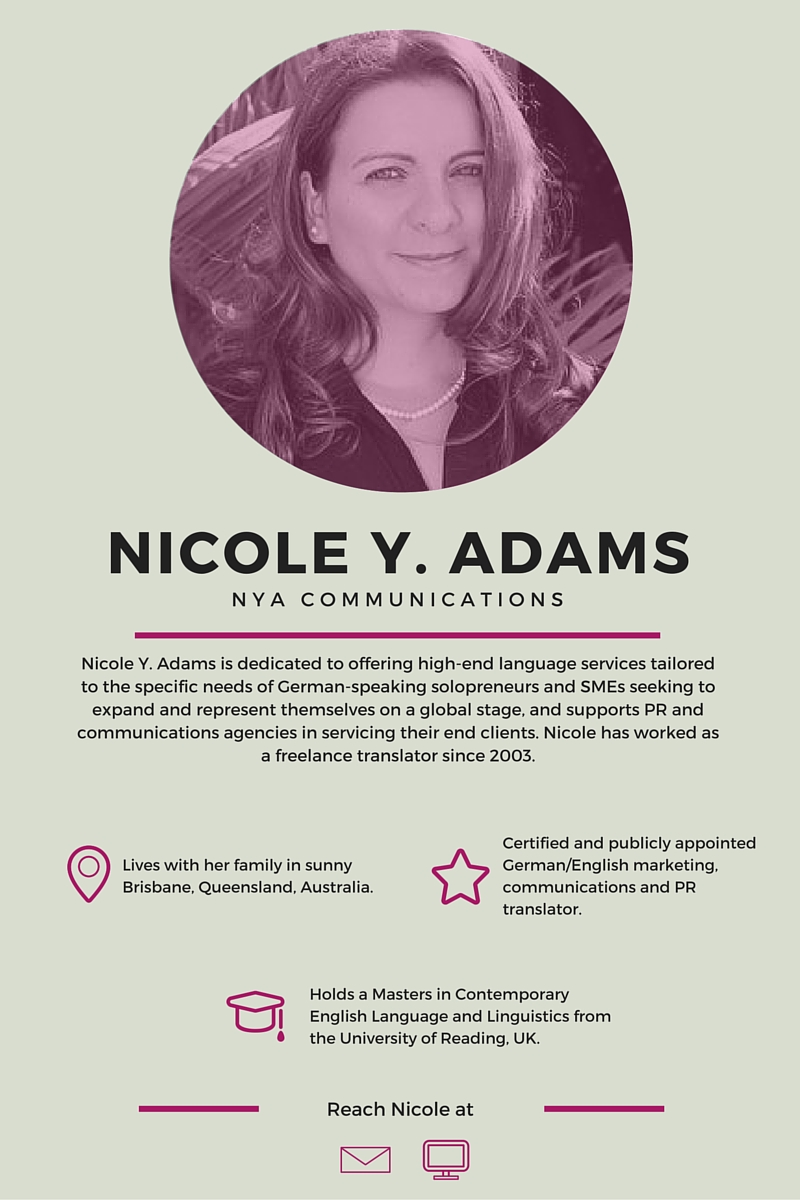
Greatest Women in Translation: Nicole Y. Adams

^3BD2FAACEAC897D21BE68030808476304DC722B6E37A1C22D8^pimgpsh_fullsize_distr

Welcome back to our Greatest Women in Translation interview series!

This month’s interviewee is the great Nicole Y. Adams, who was nominated by Sarah.

Welcome, Nicole!


Email: info@nyacommunications.com Website: www.nyacommunications.com

1. Your website describes you as an “award-winning German to English language professional”. Do you think that being granted an award or being a certified professional makes a great difference to the client when choosing a translator?

Being certified – absolutely. Having won an award is merely the icing on the cake. If I’m looking for a service provider, or even just a new restaurant to try out, I tend to feel reassured and be more confident that I’ll have a good experience with a business if it has won awards in the past. Although it’s certainly not the only criteria, I’ll be more likely to choose them. After all, they must be doing something right to have been awarded them!

Most of my business awards were based on votes and/or detailed feedback from my clients. It was very satisfying to learn that they were so delighted with my services, and winning the awards certainly motivated me to keep going and do even better. I’m also very proud of my nomination for the 2013 AUSIT Excellence Award for ‘Outstanding Contribution to the Translation & Interpreting Industry’, although I didn’t win. To be recognised by peers was a truly humbling experience.

Back to certification: Although there are, of course, examples of highly successful colleagues who deliver excellent work without being certified, I believe that a professional should ideally have some accreditation or certification in the service they’re offering. In my case, I’d already translated part-time for a couple of years when I decided to become a certified translator to make it ‘official’ (which meant flying to Germany to take the state exam as an external candidate – I wanted to obtain a German qualification first, as all my clients are based in Germany and Switzerland). I wouldn’t have felt comfortable offering professional translation services without having a piece of paper showing I’m qualified to do so. In an unregulated profession such as ours, I feel that’s the least we can do to reassure clients and demonstrate professionalism.

2. You have quite a wide list of remarkable marketing and business qualifications! How important do you think it is for a translator to take courses in order to specialize in a certain area?

To be honest, I just love learning. The courses and qualifications I’ve listed on my website are only a small fraction of what I’ve completed and obtained. I also have a number of qualifications in subjects unrelated to my areas of specialisation, taken purely out of personal interest and ranging from airport operations to nutrition. ☺ In terms of my areas of specialisation, I like to know what my clients are talking about and stay on top of the latest jargon, which is why I regularly participate in relevant courses. With the range of free and low-cost online courses out there these days (just think MOOC!), there’s no excuse for anyone not to take courses to keep abreast of current developments in their specialist fields, or simply to brush up their general knowledge. A couple of years ago, I completed ‘An Introduction to Marketing’ by the Wharton School of Business via Coursera, and although it was classed as an introduction, I found it very interesting and certainly learned a new thing or two. It’s probably not ideal to complete a degree in a certain subject area and then work as a specialist translator in that area for the next 30 years without ever engaging in any further professional development in that field.

3. You are a member of incredibly 12 associations! Well, I’m guessing you are an advocate of professional associations. Why do you think it is important to be a member of professional associations? And in which grounds should a translator choose the associations they can be a member of?

Is it really that many? I must admit, I’ve never counted them! ☺ Call me crazy, but I’m actually just about to join another one that I’ve been considering for a while.

For me, there are a number of criteria for deciding to join a professional association. First of all,

it’s a given to join the translators’ association in your country of residence to meet and network with local colleagues and stay informed about the state of the industry on your home turf.

In my case, this is purely out of interest, as I don’t work in the Australian market at all.

Next, I like to be a member of translator associations in the countries of both my source and target languages. It is amazing how different these associations are, and what different advantages they offer translators (or not, as it may be). Being a member of the BDÜ, CIOL and ATA, for example, gives me insights into the different approaches to the profession in each country, which is extremely interesting. I also subscribe to the paper versions of all associations’ magazines, and I love reading them to relax at the end of a working day – although, being in Australia, I usually only get them about a month after they’re published! 😉

Thirdly, it’s a must for me to be a member of at least one association in my areas of specialisation, where I can network with (potential) clients and stay informed about what’s going on in my clients’ industries. These associations also usually offer courses or webinars with discounts for members. I particularly enjoy the courses offered by the Chartered Institute of Public Relations, where the prices for members and non-members differ hugely.

Finally, there’s being listed in professional member directories. I see being listed in such directories as a pleasant side effect, but by no means the main criteria for joining an association. Yes, I am sometimes contacted by potential clients who found me in an association directory, but the frequency of these enquiries is not the main reason I’d join or leave an association.

4. You have a great deal of positive testimonials on your website, but one quality in particular called my attention: reliability. It is probably the most mentioned one. Why do you think is this such a key skill to have as a translator today?

This is a great question, and I’m glad you are asking it! I’ve always considered it a given that reliability is non-negotiable. Informing the client you’ll deliver late at the last minute or not responding to enquiries promptly are just not an option. To most professional translators, these things are a matter of course – at least that’s what I had always thought until more and more clients told me how pleased they were that I’m ‘so reliable’ as that wasn’t the experience they had had with other translators.

I still couldn’t quite believe it, until a small (two-person) agency I used to work with regularly many years ago asked me to become their preferred translator for a certain end client. I knew that their regular translator always delivered outstanding quality work, so I was more than a little surprised why he wasn’t working for the client any longer. When I enquired, they told me that although he delivered superb quality, they could never be 100% sure whether he’d deliver on time, and often they couldn’t reach him when they needed to follow up on something. So a lack of reliability was his downfall. That was a real wake-up call for me and clearly demonstrated how highly clients value reliability.

We’re not ‘just translating’. We need to offer a full package, and that includes customer service and, of course, reliability.

Clients need to know they will get a text when we say they’ll get it. They have enough on their plate and need to be able to relax without having to worry about the reliability of their translation partner. Reliability is also a sign of respect in a successful business partnership. (By the same token, I expect to be able to rely on timely payments!)

5. One of the questions you ask on your A to Z of Freelance Translation course is “Do you have what it takes right now to be self-employed?” What does it take to be self-employed? Can’t simply anyone work as a freelancer?

Well, certainly anyone can work as a freelancer, but not everyone will be successful. ☺

As most of us know, working as a self-employed freelance translator requires a certain mindset. It’s essential to be versatile, flexible, adaptable and to never stop learning. Freelance life is not predictable and we need a huge amount of self-discipline and, most of all, resourcefulness to deal with unexpected issues (from power cuts to hard disk failures to clients going bankrupt).

I’d also say it’s important to never be afraid to ask questions of peers and more experienced colleagues. Many people shy away from this, which can hold them back.

So, being able to produce great-sounding translations is wonderful (and should be a given), but by no means all that is needed to be successfully self-employed. At the start of The A to Z of Freelance Translation course, which you mention, participants take a test to ascertain whether or not they’re in the right place to commence self-employment, or whether they should consider another path.

If you don’t have the right resources and mindset, no amount of training will help you succeed – it has to come from within you.

My own freelance journey has certainly been a crazy ride, and I’m pretty sure this career path is not for everyone. When I first started out (or rather, when I happened to stumble upon translation as a professional career by chance ;-)), I was a complete novice and had to learn everything from scratch without any help, from pricing to what a CAT tool was. I needed to be very resourceful and did a lot of research, and I even joined a large London-based language services provider as a project manager for a few months to learn how things work from the other side of the table. Fast forward a few years, things were going well and I had the glorious idea of starting my own agency, with a new company name and website. But I quickly realised that outsourcing and being on the administrative side really wasn’t my thing, so the idea was swiftly shot down again. Today I only ever outsource work to a trusted couple of colleagues when my working hours are limited due to school holidays or my children being sick.

Speaking of children, when my boys were born, my husband turned stay-at-home-dad for almost four years, making me the only breadwinner. In hindsight, this created quite a lot of pressure, which many freelancers may not expect or may not enjoy. You should be prepared for this kind of financial pressure, in case your partner, for example, can’t work for a while, or your children get sick and you have to cut down your own working hours.

Next in my freelance lifecycle came what I call my experimental phase. I’d started mentoring new colleagues a few years before and thought I’d venture into coaching – and even completed a certificate in business coaching and mentoring! However, I only ever coached one client for exactly one session before realising that it’s not my cup of tea and that I wasn’t comfortable charging people for sharing my experiences in one-on-one relationships. I generally prefer to work alone and from the comfort of my home office – one reason why freelance translation suits me down to a T. So I’d say as a freelancer

it’s also key not to get sidetracked but to remain focused on what you enjoy doing.

Today, I still work solely as a freelance translator, and I couldn’t be happier. Putting together Diversification in the Language Industry – a snapshot of how colleagues have chosen to diversify and offer additional services beyond translation proper – in 2013 made me realise that I enjoy translating more than anything else, and that I personally have no desire to diversify into other areas. I’m glad I got all those distractions out of my system and can focus 100% on my clients. My final advice to fellow freelancers is:

do what feels right to you and don’t ever go down a path you’re not comfortable with because others think it’s a good idea or simply because the opportunity arises – just say no! 😉

6. You are one of the few translators who state the prices you charge on your website. Why do you prefer to do so? Do you think that makes a difference to the client?

Interesting question, Caroline. First of all, I should say that I’m quite lucky that most of my clients are either personal contacts I’ve made in-house or through networking, or direct referrals by existing customers, so most of my business comes from word-of-mouth and I don’t primarily rely on my website to attract new clients.

In general, I usually charge a flat rate per project and don’t give clients a per-word price in either quote or invoice. I also state this on my website, but give them a rough guide as to the price range they can expect (which is based on per-word ranges for information only). This is mainly because I hate wasting time, both as a consumer and as a service provider. Clients with price expectations that are wildly different from mine are kept at bay (except for the ones who fail to check the prices before getting in touch!), saving everyone a lot of time wasted on fruitless negotiations and multiple email exchanges. Serious clients obviously still ask for a custom offer, but at least they already have an idea of what to expect.

Putting my consumer hat on for a minute, I can safely say that if I want to hire a professional service provider, say, a web designer or typesetter, I always look for a pricing page on their website. Often, I’ll choose to contact a provider who displays prices (or at least a rough price guideline) over one who doesn’t, simply because it saves me the hassle of having to contact them especially to enquire about prices. Keeping it simple and providing as much information as possible works best for me! On my website, I also refer to the Australian Society of Authors’ (of which I’m a member) price guidelines, which reassures more sceptical clients that I’m not just pulling numbers out of thin air, but that there’s some justification behind them. It also reminds them that they’re hiring a certified professional who is backed by a professional association (which brings us back to your earlier question).

7. Now it’s your turn to nominate our next interviewee!

First of all, thanks to Sarah for nominating me, and to you Caroline, for hosting this interesting series! ☺ (And I second Sarah’s invitation to come and visit us in sunny Queensland!)

I’d like to nominate our lovely colleague Giselle Chaumien on the other side of the world in Germany. Giselle is always more than happy to share her wealth of experience with peers, both on social media and through her blog (in German), and is a great role model for new and experienced translators alike. And her office companion, Filou, is just too cute ! 😉


Wow! I loved your answers, Nicole! Even though I handed the questions last minute and you were not working as usual the last few weeks, as it seems, you managed to answer my questions in a very thorough and thoughtful manner. I really really appreciate that! 😀

I especially loved some parts so much that I took the liberty to highlight them on the text.

You can reach Nicole via email (info@nyacommunications.com) or her website.

I’ve already reached Giselle, and she has kindly and promptly accepted Nicole’s nomination. Stay tuned, because Giselle’s interview will also be amazing! 😉 I already have interesting and thought-provoking questions coming up my mind.

Guest post: A translator in the making

Hello, dear readers! I hope you are all doing fine. First of all, I’d like to apologize for not publishing my monthly post on August 20. I was really busy finishing up projects and planning my vacation.

Side note: this post was scheduled, because I’m actually on vacation as you read this. 😀 Therefore, bear with me in case you write comments. It may take a while to receive a reply. 😉

Let’s welcome todays guest, the Polish translator Roman Kozłowski.

Welcome, Roman!

photo-1438302292089-1bfacb810383

A translator in the making: How I got to where I’m at

To start off, I’d like to take a moment to thank Carol for accepting my submission for a guest post – much appreciated. Now, let’s get down to business. I’ve spent some time reading and enjoying previous guest articles in search of a topic that hasn’t been previously covered here. Since many of the essential aspects of the translation industry have been already discussed, I decided that the best way for me to contribute would be to give you a sneak peek into my life as a translator, or rather how I became one, as I think it’s pretty interesting.

What I really strived for developing this post, was to make it as sincere and as natural as possible. Considering the fact that translation is such a big part of my life, I couldn’t afford to force a topic just to be published here. Thus, I thought it would be best if I gave my colleagues by profession, and hopefully young aspiring translators as well, a genuine perspective on the journey that took me here, and lead me to working as a professional translator, among other things. I intend this post to be a lighter read, packed with my personal experience rather than dry facts. I don’t want you to think that this is going to be solely a bunch of egocentric ramblings, though. I will make a number of points toward the end so stay with me.

The origins of passion

Again, just to reiterate what I said in the intro – with this post, I’d like to tell you a story and make you become a part of it. Whether you work as a translator, or wanting to become one, you may find certain points to be similar to your journey, others will undoubtedly be alien to you.

So, how did it all start for me? Well, I guess I have to take you back to middle to late nineties. Back then, in Poland, where I come from, cable TV was a hallmark of luxury, obviously no one had even dreamt about broadband Internet yet. What we did have, though, were NBA basketball games broadcasted on one of the public TV channels and ‘telegazeta’ (lit. TV newspaper), which was exactly what the name suggests it was.

Just to be on the safe side, let me explain that I’m talking about a sort of Internet 0.5., a system of pages you could access on color TV sets by typing page numbers from your remote control. I would get up every morning to check NBA scores and stats before hitting school, so I could discuss the latest developments in the league with my classmates.

Basketball was big back then, despite severe technological limitations in comparison to what we have now. Anyway, I don’t want to stray off topic too much. I always had a bunch of bilingual dictionaries at home, so I started with translating the team’s names.

It was fascinating to learn how various animals are called in English – there were Bucks, Hawks, Timberwolves. I had a quick course in engineering with Pistons and Rockets. There were also names that required you to dig deeper in order to understand them, like Knicks or Trail Blazers. Mind you, I was about 11-13 years old then.

Basically, I spent my forming years on the court and I’m still a huge basketball fan after all these years. Back in the 90’s, we underwent significant socio-political changes and were bombarded with American culture – movies, music, video games – they all left a lasting mark on me and my peers to this day. So, the English language was somewhat a part of the 90’s kids’ daily menu.

Looking back, I might have been somewhat set up for work in a culture-language related field. Coming from a two-national family and being exposed to different worldviews, I think I’ve been molded to be more open-minded and appreciative of other cultures.

Add in the fact that I’ve felt for a long time that language has been a fundamental evolutionary development for our civilization, without which we wouldn’t be able to function the way we are, and you have yourself a material for a translator in the making.

College – laying groundwork

Ok, let’s fast-forward to post-high school times. The funny thing is that although English classes were never a trouble to me, I don’t think I seriously considered becoming a translator back in high school.

My original choice of college was different. I wanted to become an urban planner. Cities have always fascinated me. The vibe, the architecture, the wide range of people you can come across – it was always, and still is, very appealing to me.

Well, I didn’t make it and had to resort to my plan B, which was English studies. At the time, I started reading excessive numbers of novels in English. We had a British Council run library here in Poznań with decent selection of mostly modern literature. This has helped me immensely in enriching my vocabulary and getting familiar with grammatical structures of the English language.

Later on, while writing my thesis on the issue on untranslatability in advertising, I came across a lot of theoretically-geeky translation stuff that I liked and this might have been the moment when I first started seriously considering becoming a professional translator.

Getting started for real 

So, how did I transfer from doing pretty well in translation classes to actually getting paid for knowing a foreign language good enough? As you can probably imagine, the road to success is rather bumpy.

After I graduated, I was doing some minor freelance gigs and working with some English language-related jobs. It was only about after a couple of years, that I got a job at a translation agency.

I’ve been working with them since June 2013 and it’s been great thus far. Cool people, a variety of texts I can learn from for free, working flexible schedule. I guess what I’m trying to say is that I’m pretty happy with my profession.

It all came out natural, I’ve been lucky enough to not have to force anything and be able to do something I actually enjoy. There’s no supervisor hovering over me, no dress code, the working hours depend largely on me.

Conclusions

As promised, I didn’t want to make this post just about me. The hidden message is for the younger readers, who may be looking to find their profession.

My message is this: if you’re interested in a certain country’s culture – music, literature, specific sports, cuisine – and you love communication, foreign language is one of your easiests subjects at school and you never stress it, then maybe becoming a translator is a way to go!

You’ll definitely keep learning new things along the way, as a freelancer you’ll be free from many of the regular office restraints and having a number of people scrutinizing your every step. Possibly you’ll also learn some useful business basics. Let’s be realistic, though. Instability in terms of projects and having to deal with difficult clients may be an occasional downside.

Final word

All in all, I want this post to resonate positively with whoever is reading this. My journey has been nothing but fun thus far. I’d like to thank again Carol for having me and I want to hear how did you guys reach the point you’re currently at in the industry. Let me know in the comments.

Thank you, Roman, for your contribution to our blog!

Comments?

About the author
Roman-Kozlowski_guest-post-aviRoman Kozłowski
is a translator of the Polish-English language pair, also working at Chatwee. Creating web and social media content helps his translation work and vice versa. Passionate about the Internet, NBA and SETI research. Let him now via LinkedIn if you ever stop by Poznań or think he would match your project requirements.

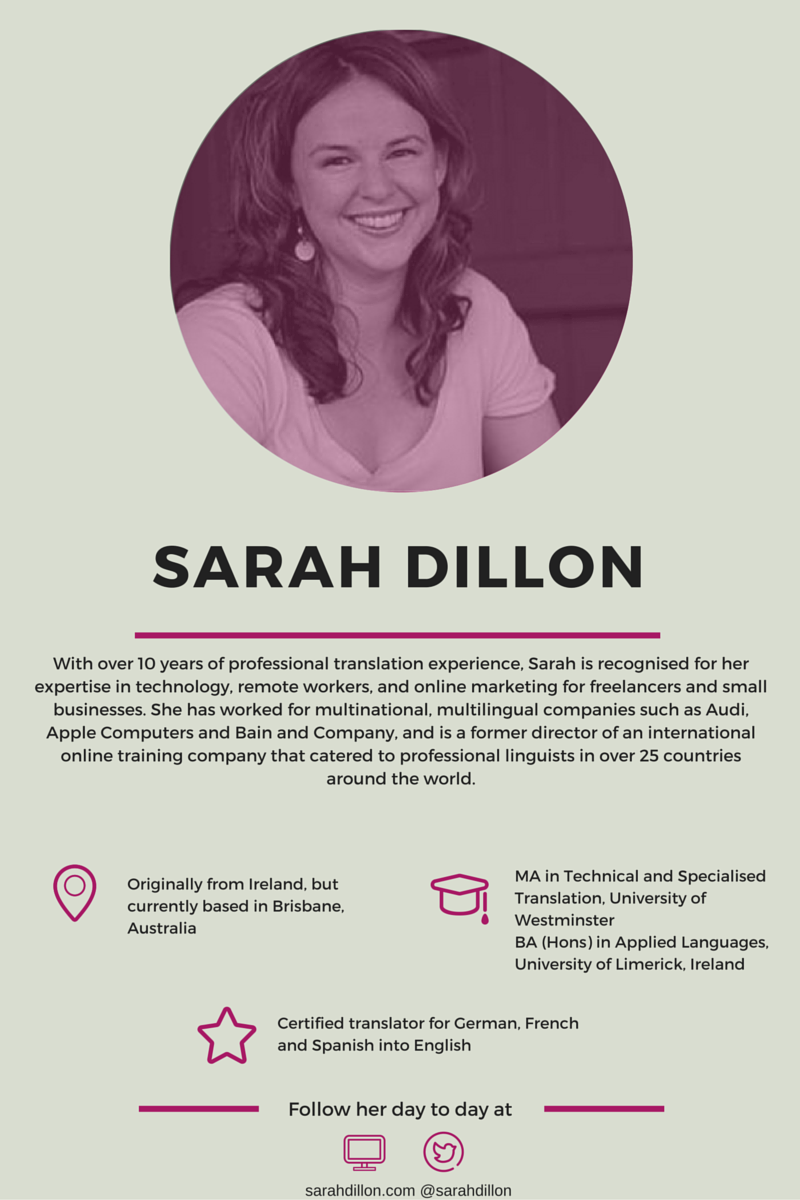
Greatest Women in Translation: Sarah Dillon

^3BD2FAACEAC897D21BE68030808476304DC722B6E37A1C22D8^pimgpsh_fullsize_distr

Welcome back to our Greatest Women in Translation interview series!

It’s with a great pleasure that I introduce you to our next interviewee, Sarah Dillon, who was nominated by Lucy.

Let’s hear it from her!

Welcome, Sarah!


Lauryn born 1986 is an accomplished

1. You are a wife and mom of a cute 3-year-old daughter. Some women entrepreneurs may struggle with the ability to balance working at home with their family responsibilities, especially if the children are around. How you keep your family close while also staying productive?

I do what every other working parent does: I get clear on my priorities, I narrow my focus and I do my best to work smart as well as hard, by making full use of whatever support systems I can create around me. Sometimes it works better than others.

2. What encouragement do you have for a woman with children at home who is thinking of starting a business and is feeling guilty, terrified, or completely inadequate?

Starting a business is an emotional rollercoaster, even for those who are relatively certain it’s the path they wish to take. It also involves varying degrees of risk. It’s not the right decision for everyone, nor is it always suited to every stage of life. So I think it pays to be at least reasonably secure in your decision before embarking on that journey.

What strikes me in this scenario is the degree of emotional turmoil this person is feeling around starting a business. Maybe this person is justified in feeling those things – who am I to say otherwise?

One way I test my decisions is by asking plenty of hard questions of myself. For starters, what makes me think doing this scary thing right now is going to bring me closer to achieving my goals? What, exactly, am I feeling bad about? Are there steps I can take to reduce the degree of risk to myself and my family?

Everyone who starts a business feels fear and inadequacy at times, and there’s certainly no perfect set of circumstances to take on such a challenge. But being the boss (like being a parent) means taking responsibility for managing yourself as well as your business. If that’s something that’s not happening very easily at the moment, that’s fine – but maybe that’s what needs addressing, before racing down the rabbit hole of business ownership.

I’m not sure I’m being encouraging in the traditional sense here, but I’d hope my perspective would be more useful than meaningless cheerleading! (That’s what Pinterest is for ;)).

3. On one of your videos on YouTube, you mentioned your career wouldn’t be where it is if it weren’t for blogging. Why do you think so? How do you think blogging can help translators?

I started blogging in 2005 and it was my introduction to the world of content marketing (although I’m pretty sure no-one was calling it that then!). I realise now that content marketing was the cornerstone of how I developed my business as a translator.

I also had an opportunity to build my content marketing muscles at eCPD Webinars in the early days as their marketing director, a role I loved. I’m pretty certain it will also be a mainstay of anything I do in the future 😉

As part of a wider marketing strategy, relevant, useful content published to a blog or indeed any other platform that gets noticed by your target audience makes huge sense for translators. But to give ourselves the best possible chance of success, it’s important to understand where we sit in the wider business ecosystem. We’re service providers, often speaking to other businesses (as opposed to direct consumers), and that means we can’t expect to behave in the same way that someone selling a product to a consumer might, for example. Luckily there’s lots of great examples online of those who have gone before us.

4. On your Instagram, you posted a picture of the book “Fluent in 3 Months: Tips and techniques to help you learn any language”, by Benny Lewis. Did you read it? Would you recommend it? If so, why? Could you also list any other books every small business women should have in their library?

Benny is a friend and a great guy. I’ve followed his journey over many years, and been completely inspired by the way he’s grown his business around his blog which is the most-read language learning blog in the world (Fluent in 3 Months).

I did read his book and picked up lots of great ideas for maintaining my source languages beyond the usual old “watch foreign movies” and “travel to the country” drivel you see everywhere else. Benny has some great methods for busting through excuses to just get things done, and he also addresses lots of language-learning myths that I often hear even translators and interpreters say. If you’re looking for a well-researched but accessible, practical read to give your dusty old translator brain a bit of a shake-up, then this is definitely it!

Other business books I’ve learned a lot from include Book Yourself Solid by Michael Port, Working Identity by Herminia Ibarra and Ready, Fire, Aim by Michael Masterson.

5. Still speaking of books, I understood you prefer paperback copies (me too!). Is there any particular reason why? Do you also read e-Books or do you really stick to the traditional print ones?

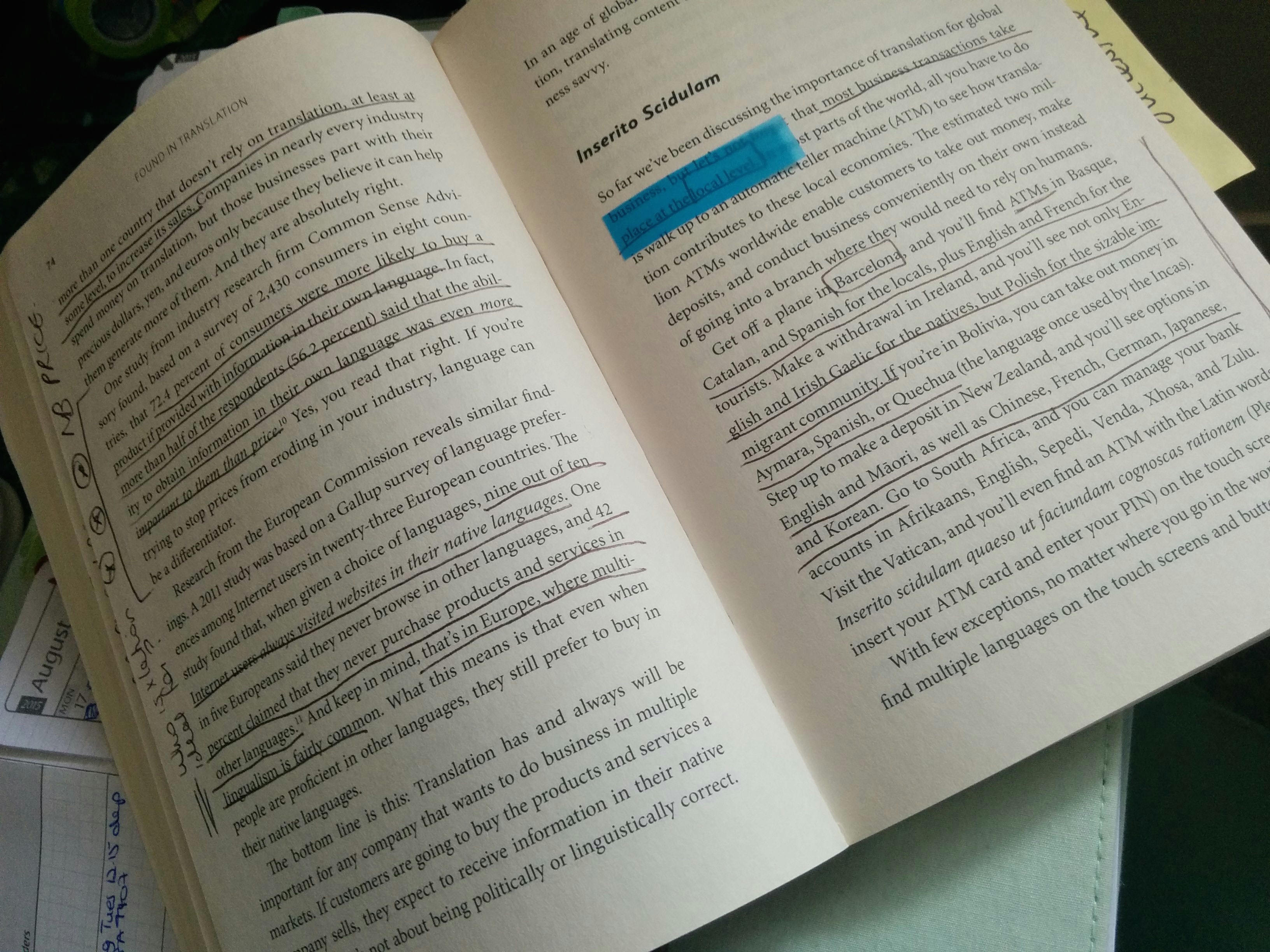
I like paper, certainly, but don’t necessarily prefer paperbacks. I don’t read a lot of ebooks currently but I do listen to a lot of audiobooks. That way, if it’s non-fiction, I can get through a lot of content very quickly, but if there’s a lot of juiciness in there and if I’m really enjoying it, I’ll order the paperback so I can do things like this:

IMG_20150824_111126


I don’t read as much fiction as I’d like these days, but when I do, I still prefer audiobooks. They allow me to really relax, give my eyeballs a break and exercise a different part of my brain.

6. You are Irish and have lived in six different countries (Ireland, of course, France, Germany, Spain, UK and now Australia), but ended up living in Brisbane. Any particular reason related to your career made you choose Australia as your home? In your opinion, is Australia somehow a good place for freelancers and/or translators?

Coming to Brisbane 8 years ago was a decision made entirely for love! To be honest, career-wise, it was probably the worst possible decision for me at the time – the third-largest city in an English-speaking country, on the other side of the world from all my target markets, not known for the quality of its internet access, support of knowledge workers, or even language learning… But I like to keep life interesting, so they were all challenges I was willing to embrace 😉 And I haven’t left yet, so I guess that’s a good sign!

In short, no – Australia is not a great place for translators, and certainly not native English speaking ones. The market is small and tightly controlled, so unless you’re willing to work very, very hard to get and keep clients overseas, it’s an uphill battle to make a living on translation alone. What it means to be a translator here looks very different to what it means to be a translator in Europe, for example. Saying that, no translator anywhere has the perfect set of circumstances, so it’s about getting on with minimising the challenges that face you, and making the most of the opportunities you have going for you.

What I think Australia has lent to my career is a spirit of give-it-a-go entrepreneurship that may have been harder to tap into in a place where translation was a more well-worn option. It has also helped me hone my “outside-in” perspective on the industry, which I’ve found incredibly useful and I think will ultimately be the key to my career longevity.

Obviously, translators’ circumstances in Australia can differ depending on their language combinations and so on, so there may be those who disagree with me (they should feel free to comment, if so!), but that’s my opinion after 8 years of working and talking to lots of translators here.

7. You offer free Weekly Action Emails for those who subscribe on your website. Could you mention a couple of the most important instructions on how to grow our business beyond our own borders?

First of all, a clear overview of your business goals is essential, as is an understanding of your target buyer. This isn’t always easy when you’re deliberately trying to attract an audience in a country other than your own, but there are some simple things you can do to help you along the way.

For example, Google Analytics can provide some very useful information on who is already visiting your website from your target market. You can use that as a basis to determine what you’re doing right, and therefore what you need to do more of. Facebook also has a free feature that allows you to find a “lookalike” audience. This basically allows you to find similar sets of people in different countries, which you can learn a huge amount from and use as a basis for your marketing decisions.

Ultimately, as a service provider especially, growing your business beyond your domestic market is a lot like growing your business into any new segment: you need to set a few goals, try a few things, see what happens, and then adapt based on your results. And keep trying! You just need to be more deliberate in your actions and more conscious of the assumptions you’re making along the way.

8. Last, but not least, which role model do you nominate to be interviewed next as one of the Greatest Women in Translation?

I’m going to stay in Brisbane and nominate Nicole Adams of NYA Communications. The way Nicole manages her business and indeed herself has been a great source of inspiration to me over the past few years. Definitely role model material!

Thanks to Lucy for nominating me, and to you Caroline, for hosting the interview. It’s been fun ☺ Come visit us in Australia some time, we love showing translators how we do things Down Under!


Thank you, Sarah, for accepting Lucy’s nomination and my invitation to be interviewed by our blog. It was a real pleasure to host you here and lovely getting to know more about you.

Nicole Adams has also kindly accepted Sarah’s nomination and my invitation, so she will be our next interviewee in early October.

Now I’m off on vacation. Don’t worry, I’ve already scheduled our guest post for the 10th and I’ll be back in time for our monthly post on the 20th.

Have a great beginning of September! 🙂

You can already access Nicole’s interview here.

Guest post: Keeping our well-being as freelancers

Dearest readers, here we are again with yet another lovely guest who has kindly taken the time to write something interesting and really useful to us, freelancers. It is not all about productivity, feedback, quality and stuff, but also about quality of life.

Welcome, Laura!

Meditation-2

Zen and the art of translator’s maintenance

Being a professional is hard in this day and age. Being a sane, well-rounded professional (and human being!) is even harder.

As independent workers we often face high levels of stress, having to deal with deadlines, customers’ demands – and the occasional slump, when work suddendly slows down and we are left worrying and wondering about the “if” and “when” of the next assignment.

As people often working from home (and thus mostly alone) we are indeed free to set our own hours, arrange our work environment as we please, and even decide to go working someplace else (a café, a park, a co-working space), if we feel like it. The possible downsides are a sense of solitude and isolation; the long hours spent sitting; a certain laziness which tends to creep on us and leave us unfit, tired, with a (long) list of aches and pains, from the back to the wrists to the neck.

All these things take a huge toll. Especially when you happen to be a professional translator in your late thirties (very late: I will be 40 in a few months!), who is been doing this job for about 15 years.

I love being a translator, and I don’t think I could do anything else. But a few years ago I came to realize that, if I wanted to keep doing this as long as possible, and conserve my sanity, and the use of my limbs, in the process!, I would have had to do something, and fast.

Obviously I am not an expert. What follows is simply a recount of my experience, which I think could be beneficial to our colleagues – and to anyone who is an independent professional and is forced to work long hours in front of the computer.

What seemed particularly apparent, and thus urgent to counteract, were the effects of the job on my body. First of all, I was getting fat and unfit. There were periods of time when I indeed went to the gym, to do weights, or some classes (which I didn’t particularly like); but those twice or thrice a week outbursts didn’t seem to do any spectacular difference. The simple truth I didn’t actually grasp at the time was that they simply couldn’t: I was too un-active, much more so than the average person, who at the very least has to leave home everyday, take a walk to get to the office, to get some lunch, to reach a bus stop. Things I didn’t do, for obvious reasons.

So, going to the gym a couple or even three times a week had costed me (in terms of time, effort, willpower, and also money), without making any perceivable difference. Understandably, I would get discouraged, and stop. And then, after a while, I’d feel lazy, heavy, guilty, aching, and start again. In a sense, the very definition of madness 😉

How did I break the circle? Three years ago, I started running, almost by chance, following a very well-known interval plan for absolute beginners, called C25K.

I loved it from the start: it was easy, it gave me structure (which I very much need), and I saw progress right away.

Initially the intensity wasn’t high enough to give me results in terms of weight loss, or real physical fitness: but it didn’t matter, because for the first time I loved what I was doing. I would go running three days a week, sometimes even more often, just for the sake of it: not because I had to, or to obtain some kind of result (which was way too soon to get anyway), but because I wanted to. And this made the real difference.

Fast forward to a couple of months later: I easily ran 5k without any walking break, I started to tackle longer distances. It was pure bliss. Running regularly I finally got to counteract those long hours in front of the computer. I wasn’t un-active anymore: I was a runner!

After a while, I started to see the difference in terms of my body changing. But I also realized running had become my go-to method to sort problems out, work-related or otherwise: I went out the door all stressed out, my brain swirling with things to do, decisions to make, upset with a customer, or with the feeling I couldn’t manage a particular issue. And I came home perfectly calm, my mind finally at rest, and more often than not with a clear solution for that “insolvable” issue.

After a while, I decided to combine running with Pilates: something low-intensity (or so I believed…), which gave me the opportunity to train the whole body, and get more flexible. For a couple of years, I trained five or six days a week, happily alternating the two disciplines.

About a year ago, my love story with running, sadly, came to a halt, due to a pretty serious injury. For a while I tried to ignore it, but obviously that was not the way to go. I was devastated (and I don’t use the term lightly): I was addicted to running, I missed it badly – and I had to rethink my whole training plan.

The upside: I realized I couldn’t stop doing physical activity regularly. Not only because I didn’t particularly fancy the idea of becoming fat and lazy again (!), but also because it was now part of my life. In a way, running was my gateway drug!

I tried a few things, made some experiments, mixed and matched different activities. Now Pilates is a big part of my routine, including a one-hour-a-week-one-to-one workout with my instructor and the aide of a few torture instruments – like the reformer (!); together with a few shorter, high-intensity cardio workouts. Oh, and I also go out for a run once in a while: luckily, endorphines don’t know the difference between 20 kilometres and 2 😉

Bottom line: I am happier, more productive, less stressed out, more able to deal with all the daily challenges of our profession, physically and mentally. Added bonus: I now have a standing desk, so… no more sitting for me!

… And the translator lived happily (and fit) ever after?

Not exactly.

As I was saying, all this activity had a pretty good influence on my mood and my state of mind, but in a way that was quite ephemeral. Maybe as a consequence of getting old(er), I felt the need to take care of my mind in a more deliberate way, and I found it in meditation: more specifically, in an app (if you’re curious, it’ s called Headspace).

Yep, as you can very well imagine there’s an app for that. This could sound counterintuitive, and I know it’s perfectly possible to take on meditation without anything of the sort (without anything, really!): but as I said I am the kind of person that needs structure, a plan, and some guidance, to form a habit – and Headspace gave me just that.

Again, I am really new at this. I have been meditating steadily for just a month now, starting with 10 minutes a day and progressing to 15 and now 20. I was skeptical, to be honest. I am really NOT the kind of person you think about when you picture someone who practices meditation; quite the opposite! And maybe that’s exactly why I should not have waited so long to try it…

The first 10 to 14 days, I got a few odd reactions. Strange, localized aches and pains which came and went in half a day or so. One morning I woke up with a swollen eyelid, without any soreness or pain; the swelling was gone the same evening.

I was a bit baffled to say the least. I can’t be sure, of course, that was indeed my body releasing tensions and stress; but it was definitely strange (and it’s completely gone now).

I also won’t say that I am a different person – that I am calm, enlightened, mindfull all the time. Far from it.

But I do feel a difference. I feel that this practice is indeed beneficial for me, that I am making progress (even if it’s not quite the right term to use in association with meditating!). I catch myself being lost in thoughts during the day, and trying to be more mindful; when working, when talking to a client, replying to a particularly upsetting e-mail, reacting to a problematic situation with an assignment – and the same applies to personal relationships.

I have the distinct feeling that I am indeed “training my mind”. Nevertheless, I wouldn’t be able to pinpoint exactly which are these benefits, how specifically meditation is beneficial for me, when in particularly I have seen my new, “trained” mind put to the test.

I am very much glad to have started it though, and I am looking forward to continue practicing in the future. Also, it’s not a training I will have to stop anytime soon due to an injury, or so I hope! 🙂

Looking back, I am starting to see I have been following a kind of path. It certainly would have been better if I had started taking care of myself sooner, but all in all I am pretty happy. And I hope I’ll be able to keep on translating (and standing up!) for many many years to come.

What’s your way to take care of yourself, body and mind? Do let us know in the comments!

“Time and health are two precious assets that we don’t recognize and appreciate until they have been depleted” – Denis Waitley

Thank you, Laura, for accepting my invitation and kindly taking the time to write about what worked out for you to our readers! Working as a freelancer can be really dangerous, because we can simply get used to staying at home, sitting in front of the computer all day (and night) long, eating like a pig… However, sitting for that long can be really damaging to our health, and we have to do something before it’s too late. I’m also addicted to running and going to the gym, and I have learned to take good care of what I eat as well. 🙂

We would love to read what your healthy daily routing is: what sport do you enjoy practicing? What healthy activities/practices have you adopted to mitigate potential health issues? Do you follow a healthy diet?

About the author
elle_NYLaura Dossena has been working as a professional translator into Italian since 2000; she is madly in love with translation, and also has a passion for technology, writing, and minimalism (and running, and Pilates). She’s always on the lookout for new ways and new tools to increase the quality of her work and the level of satisfaction of her customers. You can find her on Twitter and on Facebook. Her web site (and blog) can be found here: http://www.elleditraduzioni.it.