Guest post: Tradução do português para o espanhol

Sejam bem-vindos de volta a mais uma publicação de convidado!

Hoje, recebo a Sonia Rodríguez Mella, do blog Traducir Portugués e tradutora de espanhol e português.

10 erros comuns de tradução do português para o espanhol

Antes de mais nada, muito obrigada por ter me convidado para participar do seu blog. Para mim, é realmente uma honra.

Como você sabe, sou uma apaixonada pela língua “brasileira”.

Na Argentina, trabalho muito como tradutora e revisora dos pares espanhol <> português e gostaria de compartilhar com você e seus seguidores minha experiência, o que eu aprendi como revisora de espanhol.

Ninguém deseja enganar na hora de fazer uma tradução, mas o tradutor é um ser humano, portanto, não é perfeito. Sempre pode haver algum errinho em seu trabalho e, por isso, as traduções devem ser revisadas, sempre.

Os erros que eu vejo com frequência quando reviso traduções do português para o espanhol são de diferentes tipos. Realizei aqui, em decorrência disso, uma pequena seleção:

1) USO DA PREPOSIÇÃO A

O uso de preposições é difícil tanto em espanhol quanto em português. Sempre é bom ter por perto uma boa gramática e ler muitos textos de bons autores para consolidar de forma consistente o conhecimento.

O mundo das preposições, por si só, levaria à escrita de, pelo menos, um artigo, ou inclusive um livro dedicado ao tema. É por isso que aqui vou dar apenas alguns exemplos:

Encontrei Alicia na porta do cinema.
Incorreto: Encontré Alicia en la puerta del shopping.
Correto: Encontré a Alicia en la puerta del shopping.

Vou estudar português.
Incorreto: Voy estudiar portugués.
Correto: Voy a estudiar portugués.

Ela tem um filho doente.
Incorreto: Ella tiene un hijo enfermo.
Correto: Ella tiene a un hijo enfermo. (Doenças são consideradas passageiras.)

Ela tem um filho cego.
Incorreto: Ella tiene a un hijo ciego.
Correto: Ella tiene un hijo ciego. (A cegueira é permanente.)

2) PRONOME RELATIVO E CONJUNÇÃO QUE

Estes são erros que os nativos também cometem.

No primeiro caso, na verdade, o gerúndio não está bem usado e, portanto, a escrita certa exige o uso do pronome relativo que. No segundo caso, trata-se da conjunção que.

Neste caso, o uso do gerúndio não é correto:

Ele devolveu uma carteira contendo todos os documentos.
Incorreto: Él devolvió una billetera conteniendo todos los documentos.
Correto: Él devolvió una billetera que contenía todos los documentos.

Ela tinha certeza de que não passaria na prova.
Incorreto: Ella estaba segura que no aprobaría el examen.
Correto: Ella estaba segura de que no aprobaría el examen.

3) TRADUZIR “MUITO” POR MUCHO (SEMPRE)

Em espanhol, a palavra “muito(a)” pode ser traduzida como muy ou como mucho(a), dependendo da construção da frase.

Muy: antes de adjetivos e advérbios.
Mucho(a): antes de substantivo singular e depois de verbo.

Atenção! Há exceções…

Mucho é usado:

  • antes dos advérbios: antes, después, más e menos.
  • antes dos adjetivos: mejor, peor, menor e mayor.

Exemplos:

Ella es muy linda.
Él llegó muy tarde.
La traductora sabe mucho.
El traductor llegó mucho antes.
Este diccionario es mucho mejor que el anterior.

4) USO INCORRETO DO HÍFEN

Em português, o hífen é muito usado, mas, no espanhol, as regras de uso do hífen são muito diferentes.

América Latina para os latino-americanos.
Incorreto: América Latina para los latino-americanos.
Correto: América Latina para los latinoamericanos.

Conclusão de uma metanálise publicada em janeiro.
Incorreto: Conclusión de un meta-análisis publicado en enero.
Correto: Conclusión de un metaanálisis/metanálisis publicado en enero.

Nesse último caso, por exemplo, trata-se de uma palavra que o DRAE não registra. Porém, o dicionário de Fernando Navarro inclui apenas “metanálise”, mas a Fundéu aceita as duas formas.

5) ACENTUAÇÃO DE MONOSSÍLABOS

Em português, os monossílabos tônicos são sempre acentuados, mas, no espanhol, de modo   geral, os tônicos e os átonos não são acentuados, exceto nos casos de acento diferencial:

Termo Classificação Termo Classificação
De Preposição (de) Verbo (dê)
El Artigo (o) Él Pronome (ele)
Mas Conjunção (mas) Más Advérbio, adjetivo ou pronome; conjunção (mais)
Mi Adjetivo possessivo (meu) Pronome pessoal (mim)
Se Pronome (se) Verbo (sei)
Si Conjunção (se) Advérbio (sim)
Te Pronome (te, lhe) Substantivo (chá)
Tu Possessivo (teu, seu) Pronome pessoal (tu)

Também são acentuados os monossílabos posicionados entre sinais de interrogação e admiração.

Exemplos:

¿Qué hora es?
¿Cuál quiere?
¿Cuán grande era?
¿Quién era?

6) USO DO SINAL DE PORCENTAGEM

Em português, o sinal de porcentagem vem depois do número, sem espaço. Em espanhol, entre o número e o sinal de porcentagem deve ter um espaço: 20 %. Só não tem espaço se for o caso do espanhol dos EUA.

7) ABUSO DA VOZ PASSIVA

Em português, usa-se muito a voz passiva, mas, em espanhol, ela deve ser evitada.

Nessa loja, são vendidos os bolos mais gostosos de SP.
Incorreto: En esa tienda son vendidas las tortas más ricas de São Paulo.
Correto: En esa tienda se venden las tortas más ricas de São Paulo.

8) FORMATO DAS HORAS

Em espanhol, as horas são escritas de diferente forma, dependendo do local.

Espanhol da América Latina (LA), da Espanha, internacional (XL) e da Argentina:

10:00 h – 22:00 h

Espanhol do México (MX) e dos EUA:

10 a. m. – 10 p. m. (com espaço)

9) FORMATO DOS NÚMEROS

Em espanhol, os números são escritos de diferente forma, dependendo do local.

Espanhol da América Latina (LA), da Espanha, internacional (XL) e da Argentina:

  • Quatro dígitos: sem vírgula, por exemplo, 1000
  • Mais de quatro dígitos: com espaço, por exemplo, 10 000
  • Uso de decimais: com vírgula, por exemplo, 0,75

Espanhol do México (MX) e dos EUA:

  • Quatro dígitos: sem vírgula, por exemplo, 1,000
  • Mais de quatro dígitos: com espaço, por exemplo, 10,000
  • Uso de decimais: com vírgula, por exemplo, 0.75

10) ARTIGO ANTES DE NOMES DE EMPRESAS

Em português, é habitual o uso do artigo antes do nome de uma empresa. Isso não ocorre em espanhol.

A Odebrecht foi responsável pela construção do edifício.
Incorreto: La Odebrecht fue responsable de la construcción del edificio.
Correto: Odebrecht fue responsable de la construcción del edificio.

Tudo tem um limite; por isso, registrei apenas dez tipos de erros, mas a lista é muito maior.

Espero que você tenha gostado e que seja útil para os tradutores que seguem você nas redes.

Mais uma vez, muito obrigada por ter me dado esta oportunidade.

Sobre a autora

foto soniaSonia Rodríguez Mella é contadora, tradutora de português e autora do Diccionario ACME Español-Portugués/Portugués-Español, publicado pela Editorial Acme Agency, da Argentina, e supervisionado pela Editora Nova Fronteira, do Brasil. Trabalha de forma autônoma desde 1993. Antes dividia seu tempo entre as duas profissões, mas, em 2005, decidiu dedicar todos os seus esforços à área de tradução. Em 2010, criou o blog www.traducirportugues.com.ar e mantém uma página no Facebook, Traducciones de Portugués, que está atingindo os 9.000 seguidores. No blog e nas redes, ela transmite regularmente suas experiências relacionadas com os idiomas espanhol e português. Em 2017 e 2018, participou do Congresso Internacional da Abrates, associação da qual é membro.

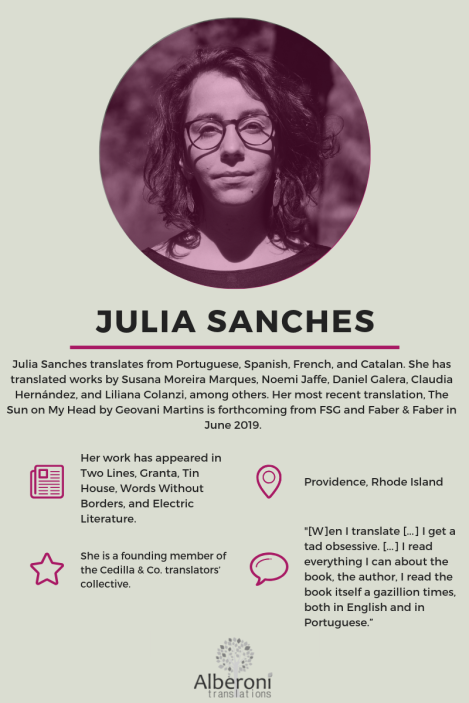
Greatest Women in Translation: Julia Sanches

^3BD2FAACEAC897D21BE68030808476304DC722B6E37A1C22D8^pimgpsh_fullsize_distr

Image created by Érick Tonin

Welcome back to our Greatest Women in Translation interview series, dearest followers! After a long hiatus of setbacks, we’re finally back!

Please welcome this month’s interviewee, Julia Sanches, Brazilian-born literary translator from Portuguese, Spanish, French, and Catalan into English.

Julia Sanches

Image created with Canva

1. You’re Brazilian-born (São Paulo), but work into English (from Portuguese, Spanish, Catalan and French). How is that so, considering we usually translate into our mother tongue?

I’ve been thinking about this quite a lot, lately; not about how it is I translate into English – it’s obvious to me – but about the idea of mother tongues. This rethinking was in part prompted by Esther Kim and Frances McNeill’s essays in the latest issue of In Other Words. In “We May Have All Come on Different Ships, But We’re in the Same Boat Now: Why We Should Not Label Translators as ‘L2’ or ‘Non-Native,’” McNeill interrogates the validity of the L1/L2 designations (L1 being “the language you think in, you feel in, you know best, whereas L2 is the language you aspire to speak fluently”), while in “Inheritance from Mother,” Kim points to the troubling lack of heritage speakers in the professional world of literary translation, and offers ways to address this.

In her essay, McNeill offers three examples that belie the L1/L2 dichotomy and interrogates whether or not one should consider the person in question an L2 speaker. Here’s my example: A person born in Brazil to Brazilian parents moves to the United States with her parents when she is three-months old. She is dropped into English-only education and quickly comes to speak English fluently. She speaks Portuguese at home and with her extended family in Brazil; they call her gringa. Eight years later, she moves with her parents to Mexico City and enters a bilingual school, where classes are imparted both in Spanish and English. She becomes fluent in Spanish – they call her güera – retains her English and continues to speak Portuguese at home. Five years later, she moves back to the United States with her family, where she attends a monolingual (English) public school. One year later, she moves with her family to Switzerland, where she attends an international school (read: where students’ common language is English). She later completes her higher education in Scotland (English) and Spain (Spanish). What is this person’s (you got it, it’s me) L1/L2?

The Oxford English Dictionary defines ‘mother tongue’ as ‘one’s native language; a first language.’ So, in that respect, Portuguese is my mother tongue – it is the first language I picked up at home, from my mother, who always insisted that I should never lose it – although the notion of languages being native (i.e. inherent to, innate, naturally becoming, again according to the OED) to anyone baffles me a little; our capacity for language may be innate, but its execution has, in my experience, been very much learned.

What’s more: I’m a citizen of Brazil and of no other country. Although I lived in Europe for fifteen years, it was never anywhere that made citizenship an easy path for me. After about thirteen years in the United States, I can finally apply for citizenship, though I’m not sure I’ll ever feel American. I could uncomplicate my identity as a translator by obviating the fact that I’m Brazilian, but what’s the fun in that?

2. On your website, you say you are soon-to-be chair of the Translators Group of the Authors Guild. Could you tell us more about it?

We’re in the process of creating a Translators Group within the Authors Guild, following the model of the Society of Authors’ Translators Association in the UK. Generally speaking, there’s an industry standard for author contracts and terms here in the U.S. This standard wasn’t arrived at out of the kindness of publishers’ hearts, but was fought for. The idea behind creating a Translators Group is to support work to establish similar industry standards for translators. Alex Zucker and Jessica Cohen have been working with the Authors Guild on a model contract that would spell out certain contractual terms that might seem impenetrable to some translators, among other things.

Another thing we’re exploring is establishing translator communities within the Authors Guild’s regional chapters around the country, to help better share information about contracts and other working conditions. The Authors Guild is the only organization in the U.S. with in-house lawyers providing legal services to authors and translators, and they’re already huge advocates for translation and translators. The idea is to focus this effort.

3. Last year, the Brazilian publishing house Companhia das Letras invited five Brazilian literary translators to talk about their professional trajectory in their blog in celebration of the International Translation Day, and you were among them. You wrote about your experience translating The Sun on My Head, Geovani Martins’ first book. On Twitter, you said you wrote the blog post in English and then translated it into Portuguese, but didn’t like the self-translation process. Do you remember why?

I sound completely unlike myself in Portuguese. It was like giving voice to a stilted and awkward-sounding stranger who happened to also be called Julia Sanches.

4. You retweeted a quote by Javier Cercas at the Edinburgh Book Festival, “Translators are like psychoanalysts. They know you really, really, really well. I’m really scared of them.” On your post for Companhia das Letras (above), you said the relationship between translators and “their” authors is disturbing, unbalanced, partial and voyeuristic (curiosity: were these the words you originally used in your English version?). Could you elaborate more on the relationship between the author and their translator?

First off: in English, it was “lopsided, unreciprocated, and often hair-raisingly voyeuristic.” Interesting…

What can I say but that: when I translate – especially when the book in question is such an engrossing challenge as Martins’ collection, something so distant from my lived experience – I get a tad obsessive. If you were to decontextualize my behavior, it might seem stalkerish, even. I read everything I can about the book, the author, I read the book itself a gazillion times, both in English and in Portuguese (and I’d probably read them in other languages, if it were available to me). I follow the author on Twitter if I can, and Instagram (yikes). I draw connections between what they post about music (etc) and the musical (and other) references in the book. Often, I go to bed with a translation problem at the back of my mind – sometimes even at the forefront – and wake up fretting about it, too. On good days, I’ll have a solution by the time I’m at my computer.

It’s a bit like crawling into and living in another person’s skin for a long stretch of time. Or spying on a neighbor from across the street. You know near everything about them and often they don’t know the first thing about you. It’s a little bit creepy – in a totally harmless way.

5. You are one of the organizers of the And Other Stories’ Portuguese Reading Group. The 2018 group had, for the first ever, an all-Brazilian reading list (including one translated by yourself). Could you tell us a bit more about how it works? Are there any plans for another edition in the near future?

And Other Stories’ Reading Groups are a rather innovative and ingenious way for the publisher (AOS) to find overlooked gems from other languages to publish in English. The idea is to put in the hands of readers some of the sleuthing, reading, and evaluating that goes into figuring out what to publish. On my side: I email a bunch of Portuguese readers and ask if they’d like to participate; then reach out to agents and ask for materials (hard copies usually, no one really likes reading on screens); we meet, in person, if possible, but usually over Skype, to discuss our impressions, which I then memorialize and share with the publishers. Rinse and repeat. It’s quite fun. Victor Meadowcroft, who will be heading the UK group, and I are currently choosing which titles to read and discuss in the fall. You should join us!

6. You write really well! I’m truly impressed and in love with your writings. Haven’t you ever thought of venturing into being an author yourself?

Oh, gosh. Thank you! Writing fills me with a very particular and acute anxiety, so I tend to avoid it. Translating ticks that box for me, whatever that means. It’s thrilling, plus, I get to hang out in and between various languages, which is where I feel most at home.

7. I will take advantage of your inside view into Brazilian literature and ask for recommendations. What books do you personally recommend, translated or not?

I’ve recently finished reading Emilio Fraia’s Sebastopol, which I deeply enjoyed. The prose is just my style, limpid and charged. He’s also quite masterful at creating suspense, at leaving things unsaid, at giving voice and weight to silences.

8. I could keep asking you a ton of questions, but I’ll leave you for now. So now it’s your turn to nominate our next Great Woman in Translation.

I’d like to nominate Charlotte Whittle, an acrobatic translator from Spanish whose recent projects include Norah Lange’s People in the Room and Jorge Comensal’s The Mutations. She is also one of the editors of Cardboard House Press and periodically holds cartonera workshops. Aside from all this, Charlotte is an amazing storyteller; she’s got an eye for the most off-kilter and delightful details and remembers them, too. We keep each other sane and safe from bouts of imposter syndrome. I think of her as a co-conspirator.