Tradução como ferramenta de ensino

Sejam bem-vindos de volta, queridos leitores!

Hoje temos mais uma tradução parte da parceria do blog com a UTFPR. Esta é a segunda tradução da aluna deste mês, a Débora França de Oliveira. E a tradução de hoje é da publicação da convidada Tammy Bjelland, Translation as a teaching tool.

photo-1444427169197-de497742b62d

Fonte da imagem: Unsplash

A tradução é um assunto que pode ser controverso quando se trata do ensino de línguas, mas como professora de idiomas, alguns dos melhores e inesquecíveis momentos pedagógicos vieram com o uso da tradução no ensino.

O uso da tradução em sala de aula com turmas de nível básico a intermediário é contraprodutivo, pois faz com que os alunos acreditem que toda língua tem uma palavra ou ideia equivalente em sua língua de destino, o que todo tradutor (e professor de idiomas!) sabe que está longe de ser verdade. Porém, pode ser difícil evitar completamente a tradução com alunos de níveis iniciais, especialmente quando se trata de adultos, visto que já são capazes de se expressar empregando um vocabulário mais sofisticado. Demonstrar os problemas que uma tradução mais “literal” pode causar pode ser uma boa ferramenta de ensino em níveis básicos e intermediários, para indicar não apenas a complexidade das L1 e L2, mas também a importância de entender o contexto e a cultura, juntamente à gramática e ao léxico das duas línguas.

Os benefícios pedagógicos da tradução são ainda mais significativos em níveis avançados, como ferramenta para explorar as complexibilidades da língua e da cultura de textos que variam em tipo, perspectiva e propósito. Muitas das minhas memórias como professora universitária vêm do ensino da tradução em turmas nos EUA e na Espanha. Após alcançar certo nível de proficiência dos alunos, aulas dedicadas à tradução podem mostrar não só o processo de tradução em si, mas também orienta os alunos a se aprofundar mais no significado das palavras e ideias, além da diversidade de interpretação em vários níveis e estágios de compreensão e tradução.

Um tipo de texto que funcionou muito bem para demonstrar a diversidade de interpretação foram pequenos textos literários. Poemas e contos foram ideais, principalmente quando tínhamos acesso a uma série de traduções diferentes para o mesmo texto. Ao estudar várias traduções profissionais de um mesmo texto, os alunos podem apontar quais ideias foram interpretadas de maneiras diferentes e trabalhar de trás para frente para encontrar uma melhor forma de entendimento do contexto e do significado do texto em si. Esse exercício em si já confirma que a simples pergunta “O que esta palavra significa na língua _____?” pode ser bastante problemática e não deve ser o foco de nenhuma aula de língua. Pensar na comparação direta entre duas línguas nos leva a uma simplificação excessiva e a pular lacunas de significado, dois erros comuns que podem ser suavizados utilizando cuidadosamente a tradução como abordagem pedagógica.

Além do valioso aprendizado sobre a diversidade de interpretações e complexidade das línguas, a tradução como ferramenta pedagógica confere aos alunos as habilidades necessárias para traduzir efetivamente. Quando atividades como a que citei são utilizadas em sala de aula, normalmente, é a primeira vez que os alunos veem e analisam, lado a lado, textos traduzidos profissionalmente comparados com o texto fonte. Essa é uma oportunidade única para o professor apresentar o profissional por trás da tradução e discutir os requisitos e desafios que fazem parte da área da tradução.

Portanto, enquanto alguns professores de língua ainda temem o uso da tradução em suas aulas, na minha experiência, há vários benefícios ao incorporar a tradução em turmas de adultos de nível avançado. Uma atividade bem planejada utilizando a tradução pode aprofundar a compreensão das línguas, promovendo a valorização de opiniões e interpretações diferentes, além de educar os alunos sobre a profissão de tradutor.

Sobre a tradutora

Foto_DeboraDébora França de Oliveira
é estudante de Letras – Português e Inglês na Universidade Tecnológica Federal do Paraná. Apaixonada pela língua inglesa. Tem grande interesse na área da tradução.

Traduzir jogos? Muito Fácil!

Sejam bem-vindos de volta, queridos leitores!

Hoje temos mais uma tradução parte da parceria do blog com a UTFPR. Esta é a primeira tradução da aluna deste mês, a Débora França de Oliveira. E a tradução de hoje é da publicação da convidada Paula Ianelli, Translating Games? That must be piece of cake!

Online-Games

Ei, ei! Calma aí!

A localização de jogos parece bastante atraente se você gosta de jogar, mas tem tantos desafios quanto traduzir um texto para qualquer outra área – afinal, é tradução! Isso fica claro nas equipes que localizam jogos para diferentes línguas: a esmagadora maioria é de linguistas altamente qualificados, profissionais experientes que trabalham em tempo integral com tradução e/ou têm formação acadêmica na área.

“Mas o que pode ser tão desafiador nisso?” Pra começo de conversa, todo processo de localização de jogos abrange várias etapas que podem ou não envolver diretamente a equipe de localizadores, mas que, com certeza, impactam nosso desempenho. Ao contrário do que se pensa, um jogo é localizado enquanto é produzido e não após seu término, ou seja, tudo é interligado. Além disso, não é um trabalho que envolve somente o localizador e o cliente final. É algo que envolve centenas de pessoas, desde o criador do jogo até roteiristas, produtores, designers, engenheiros, produtores de trilha sonora, equipes de marketing, atores, gerentes de projeto, tradutores, revisores, testadores e o último integrante da equipe de impressão que produz a capa do jogo uma semana antes de ele ser lançado. Isso tudo pode parecer um tanto exagerado, mas essa rede complexa exerce um impacto direto em como nós trabalhamos e no que o público-alvo verá ao final desse trabalho.

As etapas da localização de um jogo rendem um tópico à parte. Aqui vamos falar dos desafios mais comuns enfrentados por localizadores de jogos. O primeiro deles é o favorito do tradutor:

 Contexto (ou deveríamos dizer a falta dele?)

O contexto pode ser algo bem complicado na localização de um jogo. Ao contrário do que se pensa, os tradutores não traduzem o jogo enquanto jogam. Geralmente, não há contextualização visual durante o processo de tradução. Isso significa que trabalhamos com textos, assim como a maioria dos tradutores, mas a dificuldade vem agora: às vezes, nossos textos não são nada lineares.

Isso pode acontecer por uma série de fatores. Por questões confidenciais, alguns clientes misturam frases de diferentes lotes ou textos para evitar o vazamento de alguma cena. Pode haver, também, atualizações com palavras aleatórias que o tradutor deve adivinhar – ou se perguntar – qual é o contexto. Outra prática frequente é a de lotes não lineares: pode ser que façamos a tradução do último estágio do jogo logo no início do projeto, quando ainda não sabemos exatamente do que se trata.

Em The Last of Us, por exemplo, Joel e Ellie estão conversando com Tess. Ela sai da cena e o diálogo que segue é:

Ellie: “When is she coming back?”
Joel: “Later.”

Bem direto, certo? A tradução, no entanto, é um tanto enigmática:

Ellie: “Quando ela vai voltar?”
Joel: “Até mais.”

Sabemos que isso é simplesmente uma questão de contexto. “Later” pode ser uma expressão de despedida, sendo assim traduzido como ”Até mais”. Assim, podemos supor educadamente que o tradutor recebeu essa linha sem contexto, não é? Isso nos leva a outra questão recorrente:

Os jogadores dependem da sua tradução

Partindo do princípio de que jogos não são baseados apenas em histórias, mas também em ações e instruções, a maneira como o jogo é traduzido afeta diretamente a performance do jogador. Digamos que um personagem precisa encontrar um item que garantirá a ele seguir na direção certa, e as instruções são:

“Find a compass and return to the island.”

Vocês sabem aonde isso vai chegar, certo? Se a tradução falar para encontrar um compasso, os jogadores irão em uma busca interminável a um objeto diferente. E eles ficariam muito bravos! Essa é uma das razões pela qual um localizador de jogos deve ser bem cuidadoso: além de criar um texto que corresponda ao original, tenha um bom ritmo, seja curto o suficiente para caber na tela, tenha gramática e ortografia perfeitas, seja atraente etc., nós ainda temos que fazer com que as instruções sejam claras e que a história seja corente ao longo do jogo.

E são muitos jogadores

Como plataformas móveis e mídias sociais crescem em países desenvolvidos e em desenvolvimento, o número de jogadores aumenta a cada dia – e o Brasil é um grande mercado.

Por um lado, a demanda por localizadores de jogos está em sua maior alta. Por outro, muitos jogadores cresceram acostumados a jogar sem legenda – e provavelmente já entendem inglês – e vigiam nossos passos de perto.

Não me interpretem mal, eles são boas pessoas. Mas nem sempre gostam de mudanças, sabe? E cresceram acostumados a escolher a opção multiplayer, não a versão multijogador.

Podemos discutir se devemos ou não traduzir esse tipo de termo em outro momento. A questão é que localizadores de jogos estão sempre convivendo com o desafio de encontrar traduções convincentes para cada terminologia específica mantida em inglês há mais de 20 anos. Requer tempo e esforço encontrar boas soluções e fazer com que as pessoas se acostumem a elas.

Certo. Isso é tudo?

Não necessariamente. Discutimos aqui apenas três dos principais desafios encontrados pelos tradutores de localização de jogos, mas existem outros desafios menores que merecem atenção:

  • Ao traduzir um jogo, normalmente trabalhamos em equipes de tradutores e revisores, o que dificulta a padronização de termos e estilos.
  • Precisamos ser bastante experientes com computadores para trabalhar com diferentes ferramentas CAT, tanto on-line quanto off-line. E, geralmente, ainda temos aquelas tags amadas, portanto, cuidado nunca é demais.
  • Os prazos normalmente são bem apertados, porque depois da tradução ainda há a revisão, garantia de qualidade, testes, lengendagem etc., e todos querem ter certeza de que o jogo já tenha legendas na data de lançamento.

Espera-se ainda que sejamos versáteis: eu posso traduzir um jogo repleto de gírias e palavrões na segunda-feira, na terça-feira, um enigma para crianças de 5-9 anos e uma história medieval épica na quarta-feira – fica evidente que esse é um dos maiores prazeres de se trabalhar nessa área!

Pra terminar, a localização de jogos é uma área maravilhosa se você é tradutor profissional e adora jogos e desafios. Mas, pense duas vezes antes de traduzir seus jogos favoritos: spoilers, spoilers em todo lugar!

Sobre a tradutora
Foto_DeboraDébora França de Oliveira é estudante de Letras – Português e Inglês na Universidade Tecnológica Federal do Paraná. Apaixonada pela língua inglesa. Tem grande interesse na área da tradução.

ConVTI (Virtual Interpreting and Translation Conference)


logo_extensa4_medium

Márcia Nabrzecki and I, Gio Lester, have a lot in common. Besides being Brazilian and translators, we are also advocates, instructors, and mentors. Last year, a common friend brought us together and the result is a 2-day event that we believe will delight those who attend it.

I better tell you a bit about ourselves. My career in Translation and Interpreting started in 1980. Yes, I am a legacy professional and have witnessed and adapted to many changes over the years. I have also been an advocate for our professions: President of two Florida Chapters for the American Translators Association-ATA (2001-2003; 2011-2012; 2015), Director and also Interim Vice Chair for the National Board of Certification for Medical Interpreters (2010-2013), mentor for members of ATA and also of its Brazilian counterpart, ABRATES, and currently I am also the Editor of The NAJIT Observer, a weekly online publication by the National Association of Judiciary Translators and Interpreters. Márcia started her career in 1995. Love for her profession led Marcia to engage in activities beyond translation projects. She is busy mentoring other professionals for Coletivo Identidade, a program that evolved from T&I events in Curitiba and spread to other cities in Brazil; she leads workshops and organizes events such as the monthly barcamps that also started in lovely Curitiba. Márcia manages to find time to lead Pro-Page, Traduções e Projetos, her own company. You can read more about us here.

So, after a few conversations and planning, we decided to throw a party at your place. Well, actually, a conference. Why, you may ask. Well, how many conferences have you missed this year? How many more are on your wish list? The truth is, regardless of origin, language and customs, we all share the desire to learn, grow and save. ConVTI ([//kon-vee-tee-eye//], in Portuguese, Congresso Virtual de Tradução e Interpretaçãomakes all three available to all of us.

Márcia and I feel the same way: earning continuing education credits, networking with colleagues, improving the quality of our services, etc. should not be a hardship. And we have a solution that makes use of modern technology to solve that issue – after all, this is the 21st Century!

Our professions have experienced exponential changes at different levels. Technology’s effects have been both negative and positive: clients expect a lot more from us in a shorter period of time but we have tools that help us work smarter; new market segments are open to us but the learning curve can be discouraging; there are incredible new tools out there but either cost, availability, compatibility, or something else are obstacles.

However, technology has reached a point that allows for presenters from all over the world to congregate on your laptop. And we have arranged just that for you: a great professional event with international talent, respected colleagues, best representatives in their specializations. ConVTI will fill in the gap between events, allow professionals to meet their certification requirements and learn from leaders in various segments. And the latest: HeadVox will be providing simultaneous interpreting for the live sessions.

We have put together a collection of top-notch T&I professionals to delight you. No divas. We wanted an even constellation of professionals who understand the changes in the market and what they mean to us.

Wherever you are, we promise you two event-filled days. On August 26, we will have four 1-hour presentations followed by a 90-minute panel on MT and interpreting technology. The day’s closing event is a live roundtable with all presenters. On August 27, we will have six 1-hour presentations and the closing is another live roundtable with all presenters. ConVTI will cover subjects ranging from the practical side of translation to the technical aspects of it, interpreting technology and changes in judicial interpreting, the business side of our profession, and we are working on bringing sign language interpreting into the offerings. Since Márcia and I do believe in equal opportunity learning, we have plans to have the presentations subtitled in English, Portuguese and Spanish.

And your wallet will be happy too: No airfare cost. No hotel cost. No meals cost – well, that will depend on you. Just take your mobile device to wherever you feel more comfortable and join us. A flat fee of $75 gives you access to the 2-day event. The presentations will be available for sale after the event.

Are your ready for a visit? Have your computers, laptops, cell phones or tablets at the ready. We are coming your way: August 26 and 27.

Visit our website for more detailed information. Also, like our Facebook page, follow the event on Twitter, and subscribe to our YouTube channel to stay updated. Should you have any doubts, send us an email to info@convti.com.

If you missed the webinar The Business of Being in Business – Part I: The Professional Side (free webinar to give you a taste of ConVTI), just click here to watch the video. And get ready for the second installment: The Business of Being in Business – Part II: The Commercial Side coming to you on June 24, at 8 am EST – check your local time on Time Buddy. Registration is now open, just click here.

Márcia has talked about the event (in Portuguese) for the TradTalk podcast. You can watch or listen to it here.

About the author
GioBrazilian-born Giovanna “Gio” Lester‘s career in translation and interpreting started in 1980. Gio is very active in her profession and in the associations she is affiliated with. She has held many volunteer administrative positions within various organizations related to our profession, and often speaks and writes on issues that affect us. As an international conference interpreter, Gio has been the voice of government heads and officials, scientists, researchers, doctors, hairdressers, teachers, engineers, investors and more. Gio has been a contributor to The NAJIT Observer since its inception in 2011, and its Editor since 2016. She can be reached at gio@giolester.com.

Guest post: Translator digital nomad

Last April, during the IAPTI Conference in Buenos Aires, Argentina, I had the pleasure of meeting Rea Gutzwiller, already a connection on Twitter, in person, and spending some fun time together. And now I have the pleasure of welcoming her on the blog.

Welcome, Rea!

Snowbuddha in Harbin, China

Image provided by the author.

Taking off from your desk

We’re freelancers, right? So have you ever considered leaving you everyday view behind and take off to a new place every so often? You think this is crazy? Unfeasible even?

I’m with you. Before you’ll be able to fully enjoy your nomadic lifestyle, you’ll need to get a few basics in place. In this article I’ll be sharing the most important secrets I wish I had known before I started, so you can start fully prepared.

I admit, I’ve always been a bit of a free spirit, but at first – even after becoming a freelancer – it did not occur to me, that one could freelance and travel. Just about when I had fallen into a routine and started to get itchy feet, I stumbled across a few digital nomad blogs and thought: Wow, great, I want to go to those places too! And after I took off for China, to improve my Chinese, I didn’t stop.

What is probably most important of all is that you make up your mind. I can understand that on a cloudy, foggy winter’s day you’d rather be at a beach in Southeast Asia, but that doesn’t account for the real thing. Mind you: You will leave your house, your neighbourhood, your friends, your family, your pets, your hairdresser, the shopkeeper at the corner store and other people you have some sort of relationship with. They and mostly you will change. You will meet new people; you will live exciting experiences and scary or downright horrible things too. To give an example, I experienced one of the strongest typhoons hitting Xiamen in 50 years. There was no more water, electricity or any other supply where I lived for two weeks. These things don’t happen where I come from and if you don’t speak the language too well, horrible things can become even scarier pretty quicky. But if you’re prepared, things are mastered more easily. Ask yourself: Do I really want to become a nomad? Or do I want to live amazing things, but 80 or 90% of the time, I am quite happy where I am? You see, if you become a nomad, this isn’t just your regular holiday enhanced. This is a new lifestyle, where tomorrow is often unknown. Do you love routines? Are you okay with last minute changes?

If you think it’s scary, you can gradually start it. Try it out! A couple of months somewhere across the globe will help you decide whether you want to continue or you’re happy to go back home, wherever that is. But once you’ve tried it, you’ll realise that being on the road is not more costly and often even less expensive than renting your permanent place and going on holidays.

Secondly, remember, you can’t bring along too many things. Usually a suitcase and a daypack is the maximum. So you’ll need a base where you can leave your stuff for a while and where your snail mail will get picked up by somebody you trust and scanned for you to deal with. Also, you’ll want to go as digital as possible. I get often asked “but what about your books?” – well, frankly, I don’t have all that many books. I use digital books on a Kindle, PDFs, and dictionaries as software…

Going digital involves a performing laptop, phone and external hard drive. Once you’re fully location-independent, you’ll want to be able to do a lot on your phone. I’ve put together a list of the basics that you’ll find helpful for a fully digital office as a small giveaway from me.

The other thing I can’t stress enough is communication with your clients. Let them know about your plans, use newsletters as a means of keeping in touch with them and always let them know ahead of time when you’ll not be available. There’s Wi-Fi at most airports, Lufthansa even offers it high above the Atlantic and German ICE trains do too. But it might not be available. Think ahead, work ahead, plan ahead.

I think one of the things I actually enjoy the most when working in a different time zone is the quiet hours when the majority of my Europe-based clients have either left for the day or are not yet in the office. That way you get a few peaceful hours of work all while they will have that last minute evening job sit in their inbox the next morning. Tell them about this advantage, they might not have realised before! Set an automatic response when you’re asleep. It will spare you from waking up to 10 missed calls and 20 e-mails from the same person as to why you’re not replying. If you’re worried they’ll turn to other providers, remember, clients are humans. They want top service. They will not run away if you’re still delivering. Be confident!

At the beginning, I’d recommend you keep your actual travelling limited. Stay at a place for a bit longer, so you get to adapt to the new lifestyle and enjoy the experience. Plan enough time. If you’re on a workation, you’ll need to put in a few desk hours every day, which limits your visiting time. Hence, you need more time to enjoy the location. For all of us stable internet is important. Mind you, often these are not the most expensive, luxury places, but quite the opposite; think backpacker hostels and small pensions. For example, quite a few five star hotels still charge for internet, while I haven’t paid for Wi-Fi in a hostel in years. Many hostels nowadays offer private rooms, so if you don’t fancy sharing with 8 snoring party-goers, that’s totally okay! Never underestimate how important sleep is, which leads me to the next point:

Apart from work and play there are three things you should not leave aside on the road: eating healthily, regular exercise and good sleep.

If you follow these few tips, you’ll be able to enjoy your time on the road and work efficiently all while discovering exotic or historically interesting places!

About the author
ProfileRea Gutzwiller translates marketing and technical texts from French, English, Spanish and Italian into German. She has grown up in Switzerland and after graduating at the ETI in Geneva and a couple of years in-house started to travel the world as a nomad translator. She has visited over 20 countries in the last 6 years, which has grown her horizon in many ways and enhanced her world view greatly. Her first article on a nomad lifestyle in a series of four has recently been featured in the first edition of connections. You can follow her on Twitter and Facebook.

Greatest Women in Translation: Sophie Lewis

^3BD2FAACEAC897D21BE68030808476304DC722B6E37A1C22D8^pimgpsh_fullsize_distr

Created by Érick Tonin

Welcome back to our Greatest Women in Translation interview series!

Please welcome this month’s interviewee, Sophie Lewis (nominated by Alison Entrekin).

Sophie Lewis

Credits at the end of the interview.

1. Besides translating, you used to be senior editor at And Other Stories. What exactly do you do now?

I still edit but as a freelancer. I edit fiction for And Other Stories but also for other publishers, including Peirene Press and Tilted Axis Press. This sits more easily alongside my freelance translating: I try only to take on one major job, whether translation or edit, at a time, and run the smaller jobs of whatever kind alongside. In addition, though, since 2016 I have been running workshops on translation in secondary schools, under the title Shadow Heroes.

2. As editor of And Other Stories, you wrote this article about the Year of Publishing Women 2018. This has everything to do with our series, so why don’t you tell us a bit more about this amazing initiative?

What I didn’t manage to include in the article was an argument for why it’s even more important for a publisher working mainly with translations to publish women: if British publishing is male-dominated, what filters through via translation is so masculine it’s breathtaking. So the opportunity to get the word out around the world that we’re interested in something else, in women’s writing particularly, and then in digging into the systems and nets around women that allow them to write, be published and be translated – or not, was something particularly pertinent to And Other Stories. And with some very exciting books already scheduled for 2018 the provocation is already working its magic.

3. You mainly translate from French into English, and one of your numerous translations was Violette Leduc’s Thérèse and Isabelle, that, in your own words, is “groundbreaking women’s writing”, giving voice to “a schoolgirl in a convent school […] systematically repressed from a young age.” Being aware of the many difficulties women face and of the sex issues the world is facing, how was this experience of translating such an amazing woman writer and such a delicate story?

This was a very tough job. The prose was frequently both precise and purple, anatomical, highly detailed and also emotional and sensual. I had to find words for parts that are never comfortably named in English – the usual problem is the lack of middle ground between offensive slang and medical terminology. So I reluctantly employed some euphemism, while making sure I was as precise as I could be everywhere else. And I tried to keep hearing that teenage girl’s voice. Thérèse is precocious but also sheltered. She herself is finding new ways to express her experience and she does that awkwardly, sometimes, but always with genuine feeling. Following and recreating her experience was nearly as painful and exhilarating as it must have been for Leduc to get it down on paper.

4. Besides Leduc, you have also translated several other French writers, such as Stendhal, Jules Verne, Charles Cros, Marcel Aymé, Emilie de Turckheim, Emmanuelle Pagano. Have you already ventured into translating Brazilian Portuguese literature? If so, what have you translated so far? If not, why not?

I have translated short fiction by João Gilberto Noll and also a fair bit of non-fiction and paratextual stuff – for literary festivals and the like. I need to build up my contacts in publishing, so they know to trust me for this work as well as French books. I also need to read more Brazilian fiction, so that I can better trust my own sense of taste and how the literary landscape lies in Brazil. Lastly, I need to convince the Brazilian authorities to reinstate the translation funding so confidently announced only a few years ago. That would really help publishers make the leap to commission translations of Brazilian works.

5. What, in your opinion, are the main differences between translating from French and Brazilian Portuguese into English?

I find Brazilian Portuguese often more fluid, not being required to be quite as specific as either French or English. But really, the differences between each book and each writer’s style are much greater than the differences between the languages overall.

6. How did your story with Brazil and Brazilian Portuguese begin?

I originally began to study European Portuguese in evening classes. I had some ideas about what my next language should be and so chose Portuguese for somewhat academic purposes. I was the only person in my class to be neither related to lusophones nor in love with a lusophone. It was hard! Then my husband landed a job teaching in Rio, so we switched our Portuguese classes to Brazilian. It only really came together when we reached Rio. We lived there for four and a half years; our son Xul was born there in 2014.

7. Now it is your turn to nominate our next interviewee. Who inspires you the most?

I admire Sarah Ardizzone very much for following an inclination to specialise in working with younger writers and translating a youthful, ‘street’ world that requires immense sensitivity to slang and to street-level politics. As I see it, the work she translates presents at least as challenging difficulties as any other texts could do, but Sarah tackles them both more systematically and more passionately than any other translator I’ve encountered.

* Image created with Canva.
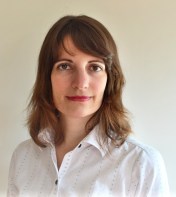
Credit of Sophie Lewis’ picture (provided by the interviewee herself): photographer Anna Michell.
Source of the quote on the image: Sophie Lewis and her authors.