Newbies, clients will not knock on your door nor fall on your laps

photo-1444653614773-995cb1ef9efa

I recently read an article on Forbes (in Spanish) about the mistakes recently graduated students make when looking for a job. It got me into thinking that the same old mistakes repeat themselves over and over again, and it is not something exclusive of the translation area. Is it a generation z issue?

Even though there are endless articles on the internet mentioning the Dos and Don’ts, newbies keep asking the same questions and making the same mistakes – what is even worse. Even this post is repetitive! I have already written here a few posts with advice to those who are starting out. To name but a few, only here in my blog (both in English and in Portuguese, as you can see):

Don’t wait for things to fall from the sky. Go and get it!
Conselhos aos tradutores iniciantes
How to establish rates
O começo
Some personal heartfelt tips for newbies
Dear beginner
Lidando com o início da carreira

I guess there is no need to question my availability and willingness to help newbies, right? And here I am again trying to put some sense into your heads.

However, people, for Jerome’s sake, research! There is absolutely no excuse nowadays for claiming you do not know something. We have Google! Not having experience is NOT an excuse for anything, especially in our profession. Every established professionals were newbies someday and they had to figure it out by themselves. I had to figure absolutely everything out by myself. I did not have a mentor, nor did I know anyone who was already an established translator. No client fell on my lap as by a divine miracle. I had to chase them like crazy! I learned things practically banging my head against a wall.

It is not easy. As it isn’t in any profession. Life is not easy. Deal with it. Whinning and blaming is not going to get you anywhere. Hard work will. And persistence. And willpower.

Please note that this is not me ranting against newbies who ask and want to learn, this is me ranting against newbies who ask before even researching and trying to find out by themselves. Research, first. Did not find it out? Research more. And again. And again. Then ask. People may already be busy with their own questions, so do not waste their time with questions you could really find the answers for by yourself.

As a dear colleague and friend just posted on Facebook, “The good translator is not the one who knows everything (there is no such a thing). The good translator is rather the one who knows where/how to research and who to ask.”

To sum it up and end this post with tips from established translators, I recently asked on my social media channels: “If you could give only one piece of advice to a recently graduated translation student about how to get into the freelance translation market, what would it be?” Here are the answers:

  • Provide your clients with high-quality translations.
  • Acquire experience through an in-house internship or a partnership with a more seasoned colleague.
  • Believe in yourself.
  • Learn how to use CAT tools.
  • Don’t settle for lower rates, ask to be paid what you deserve.
  • Find yourself a mentor.
  • Never stop learning.
  • Don’t listen to people on social media.
  • Be professional: deliver what was promised and, if possible, go beyond.
  • Chat with established professionals.
  • Read books on the area.
  • Always review your work: one bad job can ruin your reputation.
  • Study, study, study!
  • Pay attention to the world around you: What does it need? What do you need? How will you do it?
  • Study your target language.
  • Take some business classes: professional knowledge will lead to further learning; lack of business savvy will lead to failure.
  • Get on Twitter and start networking with other linguists from all over the world.

Dicas de português no Periscope

Interrompemos a programação editorial normal para fazer um anúncio importante:

Dicas de Português no Periscope!

O questionário sobre dicas de português no Periscope foi encerrado e eis os resultados:

  • 19 pessoas responderam ao questionário
  • Houve um empate no dia da semana: segunda e sexta-feira (6 pessoas cada); terça e quinta-feira também ficaram empatadas (3 pessoas cada); apenas 1 pessoa prefere a quarta-feira
  • A esmagadora maioria prefere a parte da tarde (12), contra 7 pessoas que preferem o período da manhã (opções: 8h – 12h ou 14h – 17h)
  • A esmagadora maioria também prefere que a transmissão seja feita semanalmente, contra 4 pessoas que preferem quinzenalmente e apenas 1 que prefere mensalmente
  • 10 pessoas não tem Periscope ainda, contra 7 que já têm o aplicativo
  • Das pessoas que ainda não têm Periscope, 15 afirmaram estar dispostos a baixar o aplicativo para acompanhar as transmissões, contra 2 pessoas que disseram não querer baixá-lo

Embora tenha havido um empate entre segunda e sexta-feira, decidi definir na segunda-feira, pois foi o dia de preferência durante grande parte do questionário e acredito que seja um bom dia para fazermos algo diferente e quebrarmos a rotina chata do primeiro dia da semana. Também decidi por definir logo às 14h para espantarmos o sono pós-almoço.

Perguntei o que os respondentes esperam dessas transmissões e o que sugerem como tópicos. Eis os comentários:

  • Norma culta e contexto
  • Uso de crase, concordância verbal e nominal
  • Nova ortografia, em especial hifenização e acentuação
  • Uso de verbos
  • Tudo
  • Como fazer uma escrita natural em traduções
  • Erros comuns
  • Dicas para tradutores
  • Explicações de erros e exercícios de correção de erros
  • Dicas de livros e materiais para estudo
  • Expressões
  • Vocabulário
  • Pronúncia
  • Maneiras diferentes de escrever de acordo com o ambiente/meio

Houve também dois comentários não relacionados ao tema do questionário, mas que estou considerando para futuras transmissões.

Como funcionarão as transmissões

As transmissões não terão duração maior que 30 minutos. Caso seja necessário, continuaremos de onde paramos na semana seguinte. Dessa forma, não atrapalha a rotina normal de trabalho de ninguém, por mais atarefada que a pessoa esteja.

Escolherei um tópico para cada transmissão, sobre o qual começarei falando no horário marcado. No entanto, vocês poderão fazer perguntas, e eu seguirei o fluxo dos comentários quando eles começarem a surgir. Também podemos discutir casos que vocês tenham encontrado nas próprias traduções, tirando dúvidas e encontrando soluções. Se possível, enviem-me esses casos por email (caroline@alberoni.com.br) antes da transmissão para facilitar.

A data de início das transmissões será na próxima segunda-feira, dia 19 de outubro. Caso ainda não tenha o aplicativo, baixe-o com antecedência. Caso ainda não me siga no Periscope, faça-o também com antecedência (@Alberoni). Meia hora antes do início das transmissões, escreverei um lembrete no Twitter (@AlberoniTrans). O Periscope automaticamente tuíta sobre a transmissão e envia uma notificação no seu celular assim que a gravação é iniciada.

Caso queira fazer parte do mailing list dessas transmissões e receber lembretes e eventuais informações e recursos adicionais por email, indique seu nome completo e email nos comentários abaixo ou envie-me um email manifestando seu interesse (endereço acima).

Sobre o Periscope

Para quem não sabe, o Periscope é um aplicativo de transmissão de vídeos ao vivo com interação dos espectadores em tempo real. Os espectadores podem escrever comentários que serão exibidos na tela para todos. Se você estiver gostando da transmissão, poderá indicá-lo tocando na tela. Essa ação exibe corações coloridos, função parecida com o “Curtir” do Facebook e do Twitter. A diferença é que você pode tocar e exibir coraçõezinhos quantas vezes quiser.

Até segunda-feira, às 14h!

Guest post: Networking

Welcome back to our guest post series! This is the first one after my holidays, but they already seem so far, far away… I could use some break again, but, hey, the good news is I have a long weekend ahead of me! And this time I’m not working. Yay!

While I enjoy my three days off, I hope you enjoy our next guest post, by Alison Hughes.

Welcome, Alison!

photo-1440335680360-79703e7032f9

Softly, softly…

Networking: love it or hate it, it is part and parcel of any freelance business.

Does it fill you with dread or do you look forward to getting out and meeting real people in the business world? Have you family responsibilities and/or a limited budget that stop you getting to that all-important client event? Or do you just beaver away on your own and hope you’ll never have to do it?

Changing times

I began freelancing in 1997. At the time it was common practice to work for agencies who all paid roughly the same rate. Life for me was straightforward and I could earn a decent living. But in recent years, with the advent of machine translation and other price pressures, I found I was constantly battling to keep my rate and I knew I had to do something.

Although I had always been an active member of ITI and its local networks, I decided to specialise and up my marketing and networking endeavours. But where to begin? It was obvious I was going to have to go further afield to meet potential clients.

I decided to invest in one main conference a year plus a visit to my source language country, France, but beyond that I had a very limited marketing and CPD budget.

So I started looking for local events in my specialist areas and was astounded at how many there were. And most were either free or inexpensive.

But what is the value of a local event if you don’t live in your source language country? The chances of finding potential clients at these events can be fairly slim. So is there really any point?

If you specialise, I believe there is.

Why?

1) These events are wonderful learning opportunities. Listening to experts talking enriches not only your knowledge but also your vocabulary. The more you attend, and the more you learn, the more you gain the confidence to use the correct terms in your own translations. And clients are going to love a translator who speaks their language.

2) I won’t use the stereotype of the introvert translator but – let’s face it – we do spend a lot of our time alone in front of our computers so even the best communicators don’t get much face-to-face interaction. And often the pressure to make a good impression leads to panic and, ultimately, disappointment, when we attend a networking event.

However, if you know you are unlikely to come face-to-face with the ideal potential client, the pressure is off. You can be yourself, talk about your business naturally and listen to what other people say about theirs, without the worry of saying something that will ruin your chances.

3) While you are there you can use the opportunity to promote the translation industry as a whole. At smaller events you will be asked to introduce yourself and I always say:

‘I am a French to English translator working mainly for the creative industries. So this event is an excellent opportunity for me to learn about your industry and to reassure you that excellent, specialist translators are here to stay. Contrary to what you might think, we won’t be replaced by machines any day soon.’

4) And if you do this often enough, when you do splash out on an important industry event, networking will have become second nature. You will have some first-hand knowledge of the industry, you will speak their language, and you will have the confidence to approach important potential clients.

An example:

The Glasgow University College of Arts organises an annual industry day. This year I went to a breakaway session by the dress and textile department. As fashion is one of my specialist areas, this was of particular interest to me and I learnt a lot about Paisley pattern shawls and Singer sewing machines, both local to me in Glasgow. Also, one of the speakers happened to mention she had a background in fabric design and I happened to have a question I could ask her. We have now made contact so I have someone to approach with future queries.

Next month I have invested in the Costume Society Conference in London. I now feel confident I will be able to converse knowledgeably about at least one area of dress and textile design that will perhaps even be new to other attendees. It doesn’t make me an industry expert but does show that I’m taking a close interest.

So now with my well rehearsed introduction, my little bit of knowledge, and my practice networking at much smaller events, if I do come face-to-face with the ideal client, I would hope to be able to handle the situation professionally and see a return on my investment.

Soft networking

Yes, there’s even a term for it. Indeed, any sort of business ‘socialising’ without a strategy or strict targets probably qualifies as soft networking. Engagement on social media is another example.

Have you tried the ‘softly, softly’ approach?

Thank you so much for accepting my invitation to write a guest post for our blog, Alison! It was a real pleasure hosting you.

Alison has also kindly written a poem about the topic. Here it is:

Networking

Of course I’ll go, it’s something new
And definitely time my business grew

The event is free so that’s a plus
Networking? Don’t understand the fuss

I’m no shrinking violet, or so I’m told
So what’s the problem for one so bold?

New cards, nice suit and business head
I’m ready for action… what’s that you said?

No, it’s my first, of many I hope
It won’t be easy but I’m sure I’ll cope

Damn and blast it where’s the map?
Not yet a panic, just a bit of a flap

OK I’m not early, but not that late
Just remember it’s not a date

No-one is waiting just for you
But, oh my God, what do I do?

With a beating heart of increasing pace
I scan the room for a familiar face

I’m on my own, there’s no other way
I’ll just have to think of something to say

I approach a group deep in conversation
But stop in my tracks as the topic’s inflation

Deciding I need some time to think
I head for the table to have a drink

I grab a water and down it in one
Desperately fighting the urge to run

Group number two looks a better bet
Just need to do it, no time to vet

‘Do you mind if I join you?’ I say to be nice
It does the trick and breaks the ice

‘My name is Jan’ one says with a smile
Is this your first event in a while?

‘Yes’ I say, ‘well to tell the truth.
First event ever, shaky hand’s the proof.’

‘Only my second so I feel your pain.
But little to lose and lots to gain’

Her words of encouragement are all I need
I join the group and am soon up to speed

Explaining the work of a freelance translator
I discover a client who may need me later

Cards are exchanged and it’s time to move on
Somehow I no longer feel so forlorn

It certainly wasn’t as easy as expected
But a couple more and I could have this perfected.

So, did you like it? Nice, huh? 🙂

About the author

After 17 years in the wines and spirits industry, Alison Hughes embarked on a freelance career and is now a French to English translator and copywriter for the creative industries. Her specialisms are food and drink, fashion and cosmetics, tourism and the arts. She has been coordinator for the ITI Media, Arts & Tourism network since 2010.

This guest blog post expands on one of the points of the talk Alison gave at the 2015 ITI Conference in April: It’s not what you spend but the way that you spend it.

You can contact Alison on her website, Facebook, Twitter (@AHcreattrans) or LinkedIn.

Greatest Women in Translation: Nicole Y. Adams

^3BD2FAACEAC897D21BE68030808476304DC722B6E37A1C22D8^pimgpsh_fullsize_distr

Welcome back to our Greatest Women in Translation interview series!

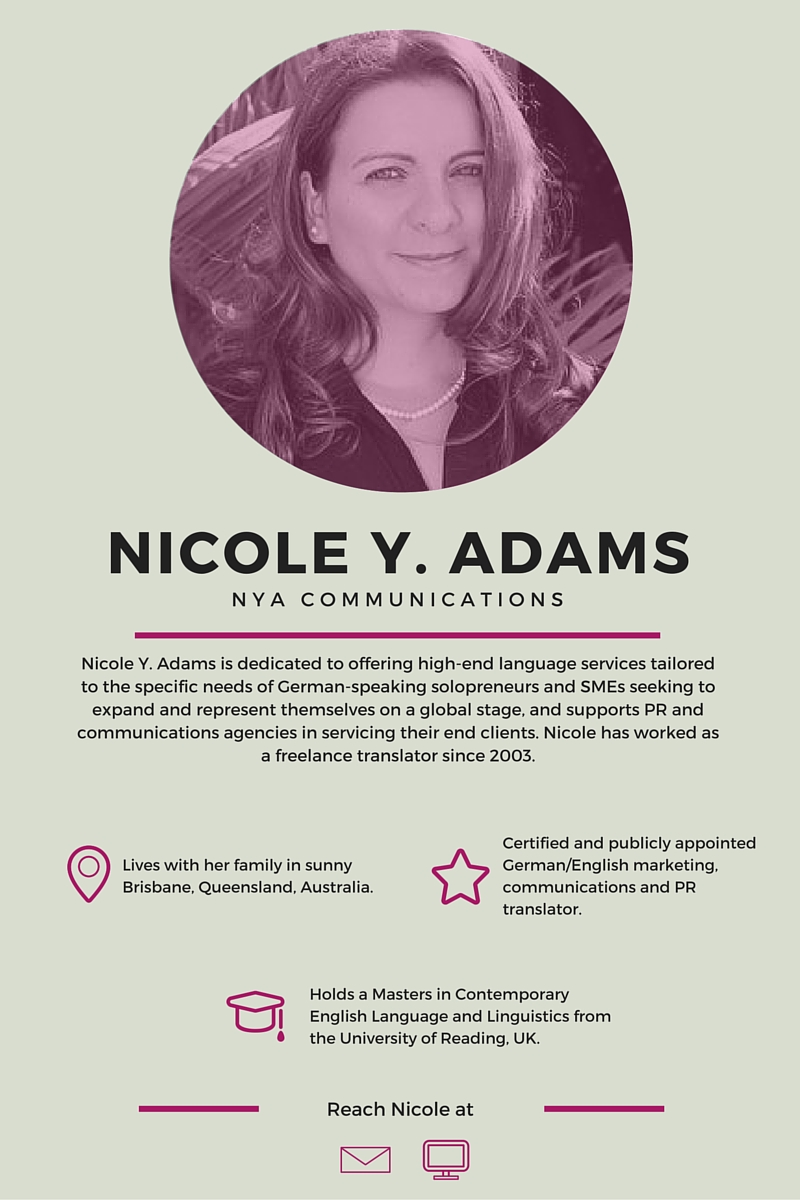
This month’s interviewee is the great Nicole Y. Adams, who was nominated by Sarah.

Welcome, Nicole!

Email: info@nyacommunications.com Website: www.nyacommunications.com

1. Your website describes you as an “award-winning German to English language professional”. Do you think that being granted an award or being a certified professional makes a great difference to the client when choosing a translator?

Being certified – absolutely. Having won an award is merely the icing on the cake. If I’m looking for a service provider, or even just a new restaurant to try out, I tend to feel reassured and be more confident that I’ll have a good experience with a business if it has won awards in the past. Although it’s certainly not the only criteria, I’ll be more likely to choose them. After all, they must be doing something right to have been awarded them!

Most of my business awards were based on votes and/or detailed feedback from my clients. It was very satisfying to learn that they were so delighted with my services, and winning the awards certainly motivated me to keep going and do even better. I’m also very proud of my nomination for the 2013 AUSIT Excellence Award for ‘Outstanding Contribution to the Translation & Interpreting Industry’, although I didn’t win. To be recognised by peers was a truly humbling experience.

Back to certification: Although there are, of course, examples of highly successful colleagues who deliver excellent work without being certified, I believe that a professional should ideally have some accreditation or certification in the service they’re offering. In my case, I’d already translated part-time for a couple of years when I decided to become a certified translator to make it ‘official’ (which meant flying to Germany to take the state exam as an external candidate – I wanted to obtain a German qualification first, as all my clients are based in Germany and Switzerland). I wouldn’t have felt comfortable offering professional translation services without having a piece of paper showing I’m qualified to do so. In an unregulated profession such as ours, I feel that’s the least we can do to reassure clients and demonstrate professionalism.

2. You have quite a wide list of remarkable marketing and business qualifications! How important do you think it is for a translator to take courses in order to specialize in a certain area?

To be honest, I just love learning. The courses and qualifications I’ve listed on my website are only a small fraction of what I’ve completed and obtained. I also have a number of qualifications in subjects unrelated to my areas of specialisation, taken purely out of personal interest and ranging from airport operations to nutrition. ☺ In terms of my areas of specialisation, I like to know what my clients are talking about and stay on top of the latest jargon, which is why I regularly participate in relevant courses. With the range of free and low-cost online courses out there these days (just think MOOC!), there’s no excuse for anyone not to take courses to keep abreast of current developments in their specialist fields, or simply to brush up their general knowledge. A couple of years ago, I completed ‘An Introduction to Marketing’ by the Wharton School of Business via Coursera, and although it was classed as an introduction, I found it very interesting and certainly learned a new thing or two. It’s probably not ideal to complete a degree in a certain subject area and then work as a specialist translator in that area for the next 30 years without ever engaging in any further professional development in that field.

3. You are a member of incredibly 12 associations! Well, I’m guessing you are an advocate of professional associations. Why do you think it is important to be a member of professional associations? And in which grounds should a translator choose the associations they can be a member of?

Is it really that many? I must admit, I’ve never counted them! ☺ Call me crazy, but I’m actually just about to join another one that I’ve been considering for a while.

For me, there are a number of criteria for deciding to join a professional association. First of all,

it’s a given to join the translators’ association in your country of residence to meet and network with local colleagues and stay informed about the state of the industry on your home turf.

In my case, this is purely out of interest, as I don’t work in the Australian market at all.

Next, I like to be a member of translator associations in the countries of both my source and target languages. It is amazing how different these associations are, and what different advantages they offer translators (or not, as it may be). Being a member of the BDÜ, CIOL and ATA, for example, gives me insights into the different approaches to the profession in each country, which is extremely interesting. I also subscribe to the paper versions of all associations’ magazines, and I love reading them to relax at the end of a working day – although, being in Australia, I usually only get them about a month after they’re published! 😉

Thirdly, it’s a must for me to be a member of at least one association in my areas of specialisation, where I can network with (potential) clients and stay informed about what’s going on in my clients’ industries. These associations also usually offer courses or webinars with discounts for members. I particularly enjoy the courses offered by the Chartered Institute of Public Relations, where the prices for members and non-members differ hugely.

Finally, there’s being listed in professional member directories. I see being listed in such directories as a pleasant side effect, but by no means the main criteria for joining an association. Yes, I am sometimes contacted by potential clients who found me in an association directory, but the frequency of these enquiries is not the main reason I’d join or leave an association.

4. You have a great deal of positive testimonials on your website, but one quality in particular called my attention: reliability. It is probably the most mentioned one. Why do you think is this such a key skill to have as a translator today?

This is a great question, and I’m glad you are asking it! I’ve always considered it a given that reliability is non-negotiable. Informing the client you’ll deliver late at the last minute or not responding to enquiries promptly are just not an option. To most professional translators, these things are a matter of course – at least that’s what I had always thought until more and more clients told me how pleased they were that I’m ‘so reliable’ as that wasn’t the experience they had had with other translators.

I still couldn’t quite believe it, until a small (two-person) agency I used to work with regularly many years ago asked me to become their preferred translator for a certain end client. I knew that their regular translator always delivered outstanding quality work, so I was more than a little surprised why he wasn’t working for the client any longer. When I enquired, they told me that although he delivered superb quality, they could never be 100% sure whether he’d deliver on time, and often they couldn’t reach him when they needed to follow up on something. So a lack of reliability was his downfall. That was a real wake-up call for me and clearly demonstrated how highly clients value reliability.

We’re not ‘just translating’. We need to offer a full package, and that includes customer service and, of course, reliability.

Clients need to know they will get a text when we say they’ll get it. They have enough on their plate and need to be able to relax without having to worry about the reliability of their translation partner. Reliability is also a sign of respect in a successful business partnership. (By the same token, I expect to be able to rely on timely payments!)

5. One of the questions you ask on your A to Z of Freelance Translation course is “Do you have what it takes right now to be self-employed?” What does it take to be self-employed? Can’t simply anyone work as a freelancer?

Well, certainly anyone can work as a freelancer, but not everyone will be successful. ☺

As most of us know, working as a self-employed freelance translator requires a certain mindset. It’s essential to be versatile, flexible, adaptable and to never stop learning. Freelance life is not predictable and we need a huge amount of self-discipline and, most of all, resourcefulness to deal with unexpected issues (from power cuts to hard disk failures to clients going bankrupt).

I’d also say it’s important to never be afraid to ask questions of peers and more experienced colleagues. Many people shy away from this, which can hold them back.

So, being able to produce great-sounding translations is wonderful (and should be a given), but by no means all that is needed to be successfully self-employed. At the start of The A to Z of Freelance Translation course, which you mention, participants take a test to ascertain whether or not they’re in the right place to commence self-employment, or whether they should consider another path.

If you don’t have the right resources and mindset, no amount of training will help you succeed – it has to come from within you.

My own freelance journey has certainly been a crazy ride, and I’m pretty sure this career path is not for everyone. When I first started out (or rather, when I happened to stumble upon translation as a professional career by chance ;-)), I was a complete novice and had to learn everything from scratch without any help, from pricing to what a CAT tool was. I needed to be very resourceful and did a lot of research, and I even joined a large London-based language services provider as a project manager for a few months to learn how things work from the other side of the table. Fast forward a few years, things were going well and I had the glorious idea of starting my own agency, with a new company name and website. But I quickly realised that outsourcing and being on the administrative side really wasn’t my thing, so the idea was swiftly shot down again. Today I only ever outsource work to a trusted couple of colleagues when my working hours are limited due to school holidays or my children being sick.

Speaking of children, when my boys were born, my husband turned stay-at-home-dad for almost four years, making me the only breadwinner. In hindsight, this created quite a lot of pressure, which many freelancers may not expect or may not enjoy. You should be prepared for this kind of financial pressure, in case your partner, for example, can’t work for a while, or your children get sick and you have to cut down your own working hours.

Next in my freelance lifecycle came what I call my experimental phase. I’d started mentoring new colleagues a few years before and thought I’d venture into coaching – and even completed a certificate in business coaching and mentoring! However, I only ever coached one client for exactly one session before realising that it’s not my cup of tea and that I wasn’t comfortable charging people for sharing my experiences in one-on-one relationships. I generally prefer to work alone and from the comfort of my home office – one reason why freelance translation suits me down to a T. So I’d say as a freelancer

it’s also key not to get sidetracked but to remain focused on what you enjoy doing.

Today, I still work solely as a freelance translator, and I couldn’t be happier. Putting together Diversification in the Language Industry – a snapshot of how colleagues have chosen to diversify and offer additional services beyond translation proper – in 2013 made me realise that I enjoy translating more than anything else, and that I personally have no desire to diversify into other areas. I’m glad I got all those distractions out of my system and can focus 100% on my clients. My final advice to fellow freelancers is:

do what feels right to you and don’t ever go down a path you’re not comfortable with because others think it’s a good idea or simply because the opportunity arises – just say no! 😉

6. You are one of the few translators who state the prices you charge on your website. Why do you prefer to do so? Do you think that makes a difference to the client?

Interesting question, Caroline. First of all, I should say that I’m quite lucky that most of my clients are either personal contacts I’ve made in-house or through networking, or direct referrals by existing customers, so most of my business comes from word-of-mouth and I don’t primarily rely on my website to attract new clients.

In general, I usually charge a flat rate per project and don’t give clients a per-word price in either quote or invoice. I also state this on my website, but give them a rough guide as to the price range they can expect (which is based on per-word ranges for information only). This is mainly because I hate wasting time, both as a consumer and as a service provider. Clients with price expectations that are wildly different from mine are kept at bay (except for the ones who fail to check the prices before getting in touch!), saving everyone a lot of time wasted on fruitless negotiations and multiple email exchanges. Serious clients obviously still ask for a custom offer, but at least they already have an idea of what to expect.

Putting my consumer hat on for a minute, I can safely say that if I want to hire a professional service provider, say, a web designer or typesetter, I always look for a pricing page on their website. Often, I’ll choose to contact a provider who displays prices (or at least a rough price guideline) over one who doesn’t, simply because it saves me the hassle of having to contact them especially to enquire about prices. Keeping it simple and providing as much information as possible works best for me! On my website, I also refer to the Australian Society of Authors’ (of which I’m a member) price guidelines, which reassures more sceptical clients that I’m not just pulling numbers out of thin air, but that there’s some justification behind them. It also reminds them that they’re hiring a certified professional who is backed by a professional association (which brings us back to your earlier question).

7. Now it’s your turn to nominate our next interviewee!

First of all, thanks to Sarah for nominating me, and to you Caroline, for hosting this interesting series! ☺ (And I second Sarah’s invitation to come and visit us in sunny Queensland!)

I’d like to nominate our lovely colleague Giselle Chaumien on the other side of the world in Germany. Giselle is always more than happy to share her wealth of experience with peers, both on social media and through her blog (in German), and is a great role model for new and experienced translators alike. And her office companion, Filou, is just too cute ! 😉


Wow! I loved your answers, Nicole! Even though I handed the questions last minute and you were not working as usual the last few weeks, as it seems, you managed to answer my questions in a very thorough and thoughtful manner. I really really appreciate that! 😀

I especially loved some parts so much that I took the liberty to highlight them on the text.

You can reach Nicole via email (info@nyacommunications.com) or her website.

I’ve already reached Giselle, and she has kindly and promptly accepted Nicole’s nomination. Stay tuned, because Giselle’s interview will also be amazing! 😉 I already have interesting and thought-provoking questions coming up my mind.