Greatest Women in Translation: Lucy Brooks

^3BD2FAACEAC897D21BE68030808476304DC722B6E37A1C22D8^pimgpsh_fullsize_distr

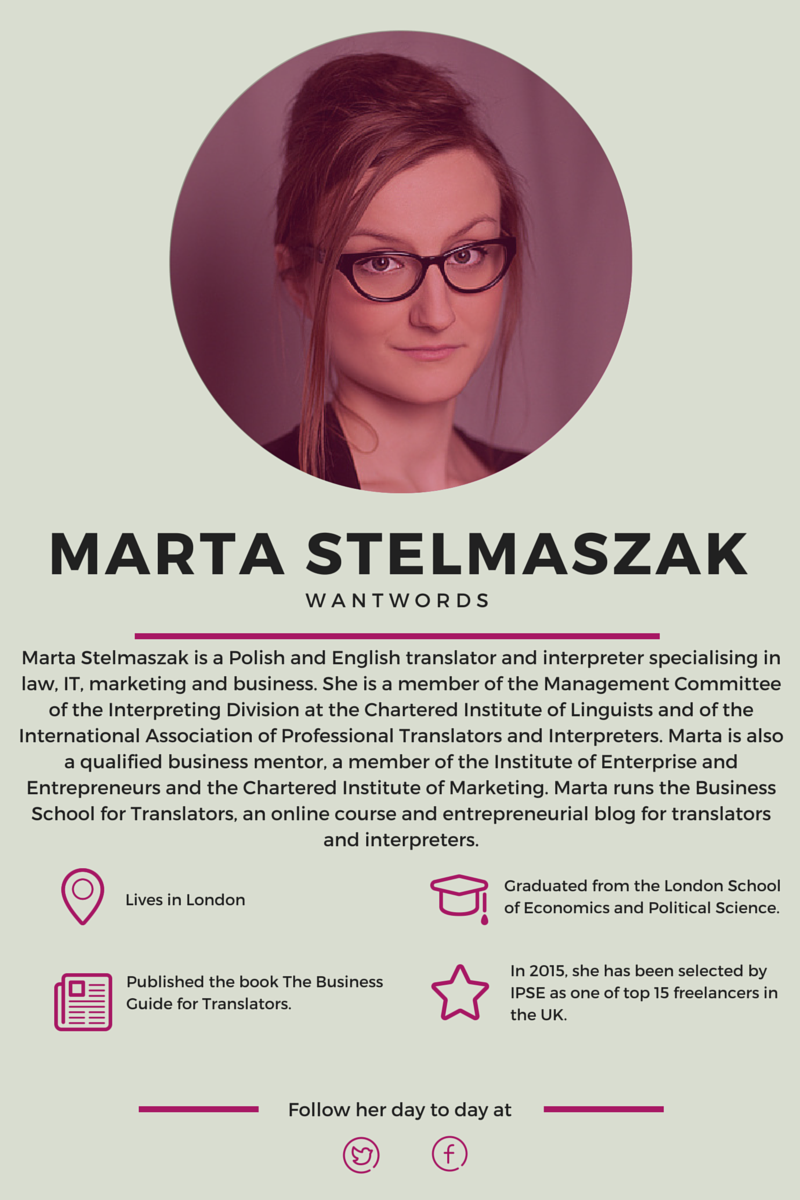
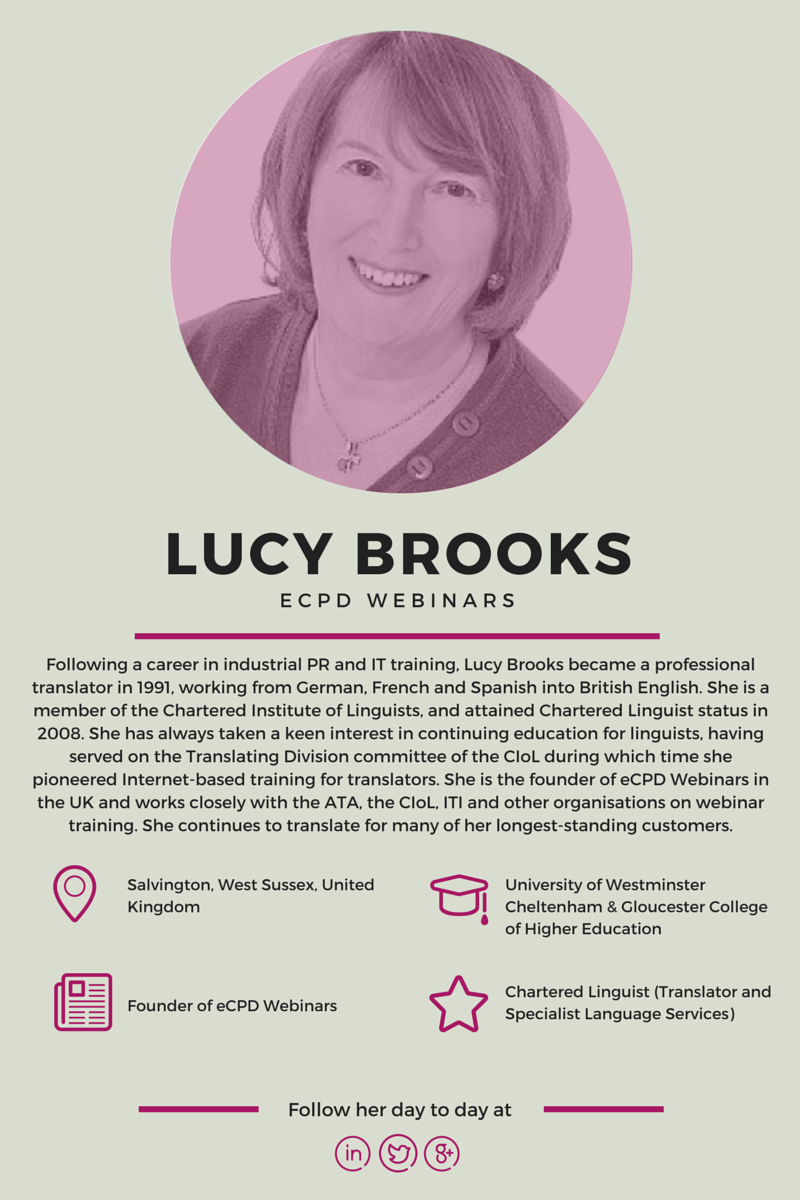
It’s with a great pleasure that I introduce to you our first interviewee nominated by our very first lovely interviewee, Marta Stelmaszak: Lucy Brooks. Who guessed right? Well, I certainly didn’t!

You know what I’m loving about this series? I get to know other determined, inspiring and sophisticated women I didn’t know (or at least not that well). I get to find out other wonderful influencers who are worth following and also learn more about them on the process. It is a pleasure to research about the person in order to find more about their personal and professional backgrounds to ask relevant questions. I’m loving it, and I hope you are too.

Now let’s hear from our second Greatest Woman in Translation.

Welcome, Lucy!

Lauryn born 1986 is an accomplished

1. Why don’t you start telling us more about your background and what caused you to create the eCPD Webinars?

Before I start, I’d like to thank you for inviting me here, and Marta Stelmaszak for nominating me – though I am sure I don’t deserve it. I’m just an ordinary person who has adapted as life has happened – and I made quite a few mistakes along the way.

I started my working life as a bilingual secretary, having trained at a commercial college in London. I studied German and French to a pretty high level – I would say it was degree level but without the literature – and also learned law, commerce, and shorthand and typing (that was a very good skill to have). After college I had many jobs: in law firms, in a London news bureau, in advertising, tourism, a secretarial bureau. All of them gave me valuable experience. In 1991 I decided to become a freelance translator and worked hard at developing this new turn in my career. During that time I was a volunteer for my professional body (CIOL) and was involved in organizing seminars and workshops for fellow translators. They were all based in London and we used to receive complaints from members that we were too London-centric. It was hard for us volunteers to arrange events outside London, so I investigated the idea of holding webinars – a new idea at the time. And that, briefly, is how eCPD Webinars was born.

 2. Speaking of which, I saw you have presented two webinars for eCPD and you also have contact with a wide variety of presenters there. I know all of them are great and the topics useful, but is there one webinar/course/video in particular you highly recommend?

As you say I have personally presented two webinars for eCPD, and hosted several other events. I have also moderated over a hundred of our presentations and courses that are tailored especially to translators or interpreters. I actually recommend them all – well, I would, wouldn’t I? – but the thing I am proudest of at eCPD is our expansion into more in-depth courses. We started in 2013 with Marta Stelmaszak’s Business School for translators, but since then have offered many other courses such as creating corpora, using Excel, writing clear English, IntelliWebSearch, and even a course for Italian translators about translating tourism texts. Trainers on the courses can take the time to delve a little more deeply into a subject and I am proud that we started this trend in professional development. Our current courses are available at this link.

3. You have more than 30 years of experience – practically my entire existence! Back then things were totally different from what they are today. What mistakes (big or small) have you made over these 30 years that you suggest other women small translation business owners avoid? Or, if you prefer, what lessons have you learned?

My entry into the freelance life came about because I was hating having to commute a long distance to work, leaving my small son in the care of someone else. I started a secretarial business from my home, and shortly after I began, was invited to look after the affairs of a local Council, which I could also do at home. This was the time that computers were really coming on the scene and I was already trained in the use of the word processors of the day. A part of my business soon developed into training people on the new-fangled technology. I found myself literally taking newly purchased computers out of the box, plugging them together, and setting up their owners’ office systems on them. I got quite good at it!

As you say, after about seven years of this I launched into translation – something I had always wanted to do but never had the confidence or the contacts to try.

The main thing to remember when you become a freelance translator is that you are an entrepreneur. You are the boss, you set your rates, you decide the direction in which you wish to develop your business. For my first client I did the worst thing you can ever do and ask them (an agency) how much they pay. Of course they will try to trick you into the lowest rate they can get away with.

It’s really hard when you are starting out, but you have to ditch the low payers as fast as you can and gradually move up the scale until you are earning what you are worth.

I believe you should say “no” to a job if you think it’s going to be outside your comfort zone, or is going to be mind-numbingly boring. Boring jobs pay the rent, but if you are trying to develop a niche for yourself, probably best avoided. Mind you, having said that, one person’s boring job may be another’s idea of heaven. I like translating terms and conditions of business and other business contracts! But I am often a pushover and even today, sometimes find myself translating something I am hating.

4. Only after 7 years you decided to start your own small translation business. What was the most intimidating difficulty you encountered?

At the time (1991 or thereabouts) there was no Internet to speak of. There were no networks of fellow translators to help you get started. The two main professional bodies in the UK were finding their feet with helping their members to run their businesses. I was pretty much alone. I used to consult my own library of reference books and often visited the library because Internet research was not an option. I think some of my early translations were less than perfect. But gradually I gained confidence, knowledge and expertise. When CAT tools came along, my working life changed for the better. CAT tools and the Internet. I don’t really know how I managed before they came along.

5. You work from three languages (German, French and Spanish) into British English. Most people I know work with an average of two, so that is a differential. How did you end up learning them? And do you (want to) learn any others?

I learned French and German to A-level (that’s school-leaving standard at 18 years of age) – continuing them both to a much higher level at college. But I also did a course of Spanish at school, taking that to O-level (a slightly lower school-leaving standard). After I left college and had worked for a few years in London, I decided to go to Spain to live and work. It was logical really, because I was given the job on the basis of my German, French and English. Of course I had a good start with my O-level Spanish and quickly became fluent in my new language.

In recent years I have tended to buy a teach-yourself book before visiting a country where I don’t speak the language. So I attempted Russian before a visit to St. Petersburg, but I am afraid I dropped it after our holiday there was over. More recently I decided to learn Greek. But languages really need to be learned when young. My brain no longer absorbs vocabulary like it once did. Still – at least I can now decipher words in Russian and Greek, now that I have almost mastered the alphabets.

6. Freelance translators tend to either fiercely compete or generously collaborate with one another. What is your approach?

I am a bit of a loner and don’t often ask advice. I am happy to give it if I can though.

7. Now it’s your turn to nominate an amazing woman in translation who you think should be interviewed next.

There’s a lady I used to work with at eCPD. Before we worked together I had been following her on social media and already admired her from afar (she’s in Australia). Working with her made me admire her even more. She was an inspiration to me during our time together. Her name is Sarah Dillon.


Thank you, Lucy, for promptly accepting Marta’s nomination and my invitation, and kindly taking the time to answer the interview questions. It was lovely to get to know a bit more about you and your great experience.

Sarah Dillon has also kindly accepted Lucy’s nomination and my invitation, so she will be our third interviewee in early September. Stay tuned.

You can already access Sarah Dillon’s interview here.
Por onde começar?

photo-1433357094834-cdeebc8e9dce

Tardei, mas não falhei! Cá estou com a minha primeira publicação mensal, em português.

Há aproximadamente um mês, recebi uma mensagem pelo site de uma pessoa que assistiu à minha palestra no Congresso da Abrates deste ano e que tem interesse em se tornar tradutora, mas não sabe como. Como acredito que as dúvidas dela possam ser as de muitas outras pessoas que têm interesse em entrar na área, decidi respondê-las aqui no blog, assim elas ficam mais acessíveis.

  1. A criação de um nome para a minha marca como uma sigla soa profissional ou devo usar uma palavra mesmo?
    Sim, claro! Obviamente, contanto que a sigla não soe estranha ou ofensiva em nenhuma cultura. O nome pode ser uma sigla, um dos seus nomes próprios ou o seu nome completo, ou até mesmo um nome criado totalmente do zero. O importante é considerar todos os fatores, como a imagem que ele passa para pessoas de qualquer cultura, a facilidade de pronunciá-lo e escrevê-lo, a não existência prévia dele, etc. Leve sempre em consideração seus possíveis clientes (e as culturas deles), seus valores, suas características e sua preferência, é claro.
  2. Como faço para começar a divulgar meu trabalho? Você acredita que seja uma boa ideia começar a divulgar em algumas faculdades aqui de minha cidade, para fazer traduções de monografias e textos acadêmicos, ou devo procurar outro público?
    Você conhece as particularidades da escrita acadêmica nos idiomas nos quais pretende trabalhar? As regras são diferentes da escrita usual e também são diferentes de acordo com o idioma.
    Você conhece as áreas com as quais pretende trabalhar? As áreas podem variar desde assuntos mais gerais a outros bem específicos, como biologia, engenharia e física. Como textos acadêmicos e monografias/teses e afins são direcionados e detalhados sobre um assunto específico, é necessário ter pelo menos certo conhecimento ou estar preparado e disposto para pesquisar bastante e aprender.
    Você pode começar pesquisando agências de tradução. Elas sempre são um ótimo ponto de início. Você pode encontrá-las em buscas no Google ou em grupos de tradutores, ou mesmo obter indicação de outros tradutores que já trabalharam ou trabalham com agências. O importante é sempre pesquisar sobre a agência antes de enviar seu currículo para saber com quais idiomas e áreas ela trabalha e se é idônea. Envie o currículo para cada uma separadamente, de preferência, citando o nome da pessoa responsável pelo recebimento de currículos, fazendo uma breve apresentação sua já no corpo do email.
  3. Quanto cobrar pelo serviço? Não tenho ideia de onde começar nem de como e quanto cobrar dos clientes. Por exemplo, quanto você acha justo cobrar por um abstract de monografia e pela tradução de textos acadêmicos?
    Não tenho a fórmula mágica, pois não existe uma. Cada tradutor cobra um valor e cada cliente é um caso diferente. No caso de agências, muitas vezes, quem estipula o preço são elas. O importante é você ter uma ideia do seu valor mínimo e não aceitar migalhas.
    Eu, pessoalmente, comecei ganhando R$ 0,03 por palavras do material original. Um mês depois, a agência aumentou para R$ 0,05. Cerca de um ano depois, comecei a receber R$ 0,07. Hoje, meu valor mínimo por palavra para clientes brasileiros é de R$ 0,11. No entanto, varia de acordo com o cliente. Se eu não me engano a tabela do Sintra sugere R$ 0,35, ou seja, como você pode ver, há uma variação muito grande.
    Tente sempre negociar os valores oferecidos pela agência. Na pior das hipóteses, você ouvirá um “não” e decidirá se aceita a proposta deles ou não. Com o tempo, veja qual é sua produtividade de palavras por dia a fim de calcular um valor por palavra com base nas suas necessidades financeiras.
  4. Devo solicitar o recebimento do pagamento antes de fazer o serviço ou depois?
    Depende. Repito, no caso de agências, são elas quem mandam e você tem que aceitar. O prazo normalmente varia de 30 a 60 dias após a emissão da nota fiscal. No caso de clientes diretos, se o cliente é novo, sempre peço parte do valor total (30 ou 50%) mediante a aprovação da cotação e estipulo que só iniciarei a tradução quando confirmar o recebimento desse valor inicial. O restante, nesse caso, solicito que seja pago mediante a entrega do material traduzido. Se eu já conheço o cliente, solicito o pagamento em até 30 dias corridos após a entrega do material traduzido. No entanto, alguns pagam em até uma semana.
  5. Qual é a forma de pagamento que devo oferecer (depósito em conta ou alguma outra forma)?
    Eu particularmente só recebo pagamentos nacionais por depósito ou transferência bancária e internacionais pelo PayPal. Desconheço tradutores que utilizem outra forma de pagamento nacional, como cartão de crédito ou boleto.
  6. Devo estipular um prazo de entrega do serviço de quantos dias ou baseado em quê?
    Isso dependerá totalmente de você. Você precisa saber sua produtividade diária para estipular o prazo de entrega. Se você ainda não tiver absolutamente nenhuma ideia de qual seja sua produtividade diária e precisa estipular um prazo, sugiro que considere cerca de 1.500 a 2.000 palavras por dia. No início, é melhor pecar pelo excesso de cuidado do que pela falta dele e acabar não conseguindo cumprir o prazo, prejudicando sua imagem. Sempre inclua um ou dois dias a mais no prazo, a fim de evitar eventuais problemas. Quando tiver outros projetos em andamento, considere-os também. Aliás, há vários outros fatores a serem considerados, como o par de idiomas (versão ou tradução?), a área do material, o tipo de arquivo, a ferramenta a ser utilizada, se houver, além de outros fatores, como feriados, fins de semana, etc.
  7. A entrega do material traduzido deve ser feita impressa ou digitalizada?
    A tradução só é entrega impressa no caso de traduções juramentadas. Em todos os demais casos, o recebimento e a entrega dos arquivos são feitos por email ou outra forma de envio online.
  8. Você acha que é importante fazer estágio em uma empresa de tradução ou apenas a experiência da prática já é suficiente?
    Eu acredito que qualquer tipo de experiência seja de extrema importância para o aprendizado pessoal. Um não desmerece o outro, mesmo porque o estágio não deixa de ser uma experiência prática. No entanto, é preciso ter cuidado com o termo “estágio”. Contanto que ele seja remunerado, não há problema. Jamais aceite trabalhos não remunerados, exceto se forem voluntários e por uma causa.
    O que normalmente acontece é que muitas pessoas começam trabalhando dentro de agências exatamente por não encontrarem oportunidades como freelancer no início. Algo que também é válido, pois se aprende muito dentro de agências.

Essas eram as perguntas (um pouco reformuladas). Espero ter conseguido responder claramente a elas e que eu tenha ajudado a pessoa em questão, assim como outras.

Outras dúvidas?

ProZ.com Community Choice Awards 2015

NominateNOW!

This extra blog post is to let you know that the nominations for the ProZ.com Community Choice Awards 2015 are now open!

The awards are hosted by ProZ.com every year as a way of its community “publicly recognize language professionals who are active, influential or otherwise outstanding in various media throughout the industry.” The entire process is determined exclusively by the ProZ.com community (from nominations to voting and winners), so if you are not a ProZ.com member, I’m afraid you can’t participate in any way. 😦

There are two main categories, Translation-related and Interpretation-related, subdivided into 16 subcategories.

I’ve already submitted my Translation-related nominations (link above) below and would like to ask your kind help as to nominate me in any of the subcategories you may like, as follows (you can copy and paste the information exactly as they are below in the fields):

1. Blog
Carol’s Adventures in Translation, http://caroltranslation.com
2. Website
Alberoni Translation, http://www.alberoni.com.br
3. Twitter
@AlberoniTrans, https://twitter.com/AlberoniTrans
4. Facebook Page
Alberoni Translations, https://www.facebook.com/alberoni.translations
7. Other social media
Snapchat: @calberoni
14. Blog post
Guest post: Professionalism in the Translation Industry, https://caroltranslation.com/2015/05/19/guest-post-professionalism-in-the-age-of-social-media/
15. ProZ.com profile
Caroline Alberoni, http://www.proz.com/translator/1654933
16. Other
Pinterest: Alberoni Translations, https://www.pinterest.com/alberonitrans/

These are my nominations for the other subcategories, if you want to have a look at them:

5. LinkedIn group
Translation Commons, https://www.linkedin.com/grp/home?gid=6920987&sort=POPULAR&report%2Esuccess=78SkroH7IWfMn0aJK-N_kyozjPc00YdXbZFFCtpAsPcT0-IXiVFFyHXG84mJlxPq4FU5_D
6. Podcast
Marketing Tips for Translators, http://marketingtipsfortranslators.com/archive/podcast/
8. Trainer
Christelle Maignan, from Coaching for Translators, http://coachingfortranslators.com
9. Training course
Business School for Translators, by Marta Stelmaszak, http://wantwords.co.uk/school/business-school/
10. Conference speaker
Marta Stelmaszak
13. Book
The Business Guide for Translators, by Marta Stelmaszak

There are also two other subcategories, 11. Translation mentor and 12. Article.

You can also nominate Interpretation-related (link above) names, if you know any.

Please note you can enter as many nominees for each category/subcategory as you like and you don’t need to nominate people in all of them – they are optional. If you don’t know anyone in any subcategory, simply leave it blank.

Submission of nominations will be accepted until August 18th.

Thanks in advance for your support! 🙂

Guest post: How can I find translation clients?

Here we are with our first guest post after the new editorial calendar was launched. I won’t work tomorrow (today is a holiday here, so I decided to transfer the day off for tomorrow), so I’m anticipating it. As advertised, our guest today is Tess Whitty, from “Marketing Tips for Translators”.

Welcome, Tess!

photo-1436390195361-c3c86efcf48b

Tips on where to find your ideal translation clients

When it comes to connecting with clients, the wonderful news for freelance translators is that potential clients are practically everywhere. It is simply a question of getting in front of them to be able to offer your translation services.

You are probably thinking that I make it sound easier than it actually is, as though you just jump in front of potential clients and they’ll drop everything and pull out their wallets to work with you.  Well, it’s not that easy, of course, but there are some reasonably simple steps you can take to make potential clients aware of your business and expertise.  That is, of course, the first step to attracting new business.

The easiest way to gain new business is to contact translation agencies and register yourself in their databases. In my experience, most translators are able to construct very successful careers by following this strategy.

You can also find translation buyers directly, forgoing agencies altogether. I know many translators that work solely with direct clients these days. Taking this route requires a much more active marketing campaign, but it can be very rewarding, since you get a personal relationship with the client.

In this article I will present some tips and steps for you to go out and find your ideal clients, whether you prefer working with direct clients or agencies.

Finding and contacting translation agencies

Thousands of translation agencies around the world are looking for freelance translators just like you. But, not all agencies are created equal. In fact, experience has taught me that agencies generally come in one of three varieties: smooth-operating professional agencies, price hagglers, and shady dealers. You want to focus on the first kind.

To do this, always research an agency before accepting work from them, and never be afraid to dump an agency if you find out that their working style does not align with your values. Simply bow out as professionally as possible and keep looking for partners who respect you and the work that you can contribute.

You can find lists of agencies in translation association directories, translation portals, databases for payment practices and by conducting a simple online search. After checking credibility, you should also check whether the agency works with your particular language pair and areas of specialization. At this stage, I recommend creating an Excel document with the agency name, location and a brief description about what makes that agency unique. This can help you streamline the process of contacting each one and tracking the results.

If you are asked to contact the agency by email, you can create an email template with the following information:

  • Subject line: Include your language combination and that you are a freelance translator looking for work/clients.
  • Email body: State that you would like to work for them as a freelance translator, highlight your accomplishments, experience, degrees and your field of specialization. Try to keep it brief, only two paragraphs.
  • Conclusion and Signature: Provide a link to your website, if you have one, and encourage the agency to visit to see what you can offer.  Also include your contact information and ask them to contact you for further information.

Most translation agencies these days have an application form on their websites that translators should use. Even if this method might seem impersonal, you must use it if this is their preferred method. Many agencies have these applications go directly to a database and you might just create more work for the agency or even get ignored if you apply by snail mail or email.

Keep track and follow up 

In your master Excel agency list, track the agencies you have contacted and follow up with an email in a week or so if you have not heard back. You can ask if they have received your email and if they have any questions or need further information.

Finding and contacting direct clients

As much as you may not like to hear it, the truth is that most direct clients are found through networking. Therefore, you have to be prepared to devote time and resources to put yourself in front of your prospective clients. If you’re going to start marketing directly to individuals or businesses, your first step will be to narrow down your target audience so you can bring focus to your communication efforts. Then, you can start researching potential clients online in your area of expertise.

Here are some steps to help structure this effort:

  • Decide on a niche and the type of companies in a specific industry that you want to target. Be specific. Include size, location, type of company, etc. What are the major companies? Are there any local companies in your area? I recommend writing this down or creating a database of potential clients so that you can use it for future reference.
  • Identify where these companies “hang out” online and in your community. Understand how you can make contact with them. This can be through LinkedIn, a local chamber of commerce, international industry events, and so on.
  • Check if you already have contacts in the industry that you can use to get in touch with your target clients.
  • Read or subscribe to trade journals in your area of expertise
  • Become a member in a relevant trade association.
  • Look for industry-specific events in your niche that you can attend.

Contacting direct clients can be tricky and perhaps uncomfortable at times, so it is important that you have done your research first. Only contact a direct client when you have the right person to contact. Make sure you have an angle to provide good solid value when you contact the client. The first contact can be done by email, sending out a brochure or meeting this client face-to-face at an event. Be prepared to research and contact many potential clients, and expect about a one percent return rate.

No matter whether you are targeting translation agencies or direct clients, there are some general tips and recommendations that can help you immensely along the way. Here are 10 tips:

  1. Don’t sit and wait for opportunities – create your own
  2. When you meet a good prospect, take action immediately, call and follow up
  3. Send thank you cards to clients
  4. Ask others to refer you and refer others back
  5. Help other translators and they will help you
  6. When you are not translating, make sure to work on your marketing strategy, brush up on your subject or translation technique through continuing education and keep up to date in your specialization and industry
  7. Living in a big city is a plus for networking, but you should also realize that you are not limited by geographic boundaries. Thanks to the Internet you can work with clients from anywhere
  8. That said, try to be available in your client’s time zones
  9. Keep track of your clients and congratulate them on accomplishments
  10. Send out reminders about your services to clients you have not heard from for a while

For more tips and in depth information, take a look at “The Marketing Cookbook – Foolproof Recipes for a Successful Freelance Career and Lifestyle” and for more free marketing tips, subscribe to the monthly newsletter at www.marketingtipsfortranslators.com.

Thanks a lot, Tess, for accepting my invitation and kindly taking the time to write something so useful for our blog! I loved the tips at the end and I completely agree with everything you said.

Comments, questions, doubts?

About the author
2013-09-24 12.29.09-2Tess Whitty has been a successful freelance translator and entrepreneur for over 10 years and owns the company Swedish Translation Services. Her educational and professional background is in marketing and she is passionate about sharing her knowledge with other freelancers in the form of presentations, training, mentoring and consulting. She is also the author of the book “Marketing Cookbook for Translators”, with easy to follow “recipes” for marketing your translation services and achieving a successful freelance lifestyle, and the award winning podcast “Marketing Tips for Translators”. For more information, and to connect, go to www.swedishtranslationservices.com or www.marketingtipsfortranslators.com.

Greatest Women in Translation: Marta Stelmaszak

^3BD2FAACEAC897D21BE68030808476304DC722B6E37A1C22D8^pimgpsh_fullsize_distr

Hey, I hope you are excited as I am with the launch of this series! 😀

For those who missed it yesterday, I wrote a post telling all about the series. If you haven’t read it yet, check it out in order to understand how it works. 😉

Surprise, surprise! The first interviewee is Marta Stelmaszak. Some of you were indeed right on your guesses, so we probably share the same opinion. The reason I chose Marta is because she is one of my role models since my early days as a freelance translator, when I decided to dedicate part of my time to the internet as well, especially Twitter. I don’t remember how exactly I came across her, but she always inspired me, and still does. Her passion, professionalism and dedication to all her projects motivates and stimulates me to always be better and reach higher.

So let’s hear from her!

Welcome back, Marta!


marta stelmaszak

1. You are an incredibly diverse woman, Marta! You are a translator; you give speeches all around the world; you run a blog, a YouTube channel and your other social media channels; you and Valeria Aliperta run The Freelance Box; you are the Business School for Translators course tutor; you have just written a book — just to name a few! Tell us more about what you do and how you first got started.
I think you covered it quite well! Of course, I spend the most of my time translating and, more occasionally now, interpreting. Indeed, in the past few years I’ve been active on a variety of media, from my own YouTube channel (still out of my comfort zone) to publishing a book. It was all part of a plan to give back and pay forward. I’ve received some excellent advice throughout the years and I know I wouldn’t be where I am now without meeting and speaking to some of the most wonderful colleagues, often not in the limelight at all.
However, diversity and multi-passion approach has its price. It took me time to realize that I have to focus and concentrate and this explains why 2015 is the last year where you’ll see plenty of me. Part of being a responsible business owner is to decide what’s best for you and your business at any given time. I’ve already planned my last conference presentation for a while, and decided to scale down on my blog.
How did I get to this point? Since I first started, some 8 or 9 years ago, I’ve always been working at full pace, giving it 100%. I was a very determined student (I left my whole country behind to study translation in London – lots at stake, you see!), then a very determined business person (working against the odds) and I’ve always been striving to be a resourceful colleague.
Don’t get me wrong, though. Giving it 100% is the only way forward, but it’s important to make sure you give 100% of yourself to the right thing.

2. The impression I personally have is that your day has way more than 24 hours – or that you are a superwoman who can do magic with the time you have. How do you do that?
I’m no Hermione, I wish! I think it’s a mix of a couple of personal characteristics I’ve grown over time with careful business planning. I learned that time is the scarcest of all resources and I’m very disciplined by nature. Add some time-management tricks to this, like time boxing or backwards-planning and there you go, you’ll see that you can fit in more things than before.
To be fair, I do have a virtual assistant and I can’t imagine running my business without her. I think I get some 3-4 extra hours a day thanks to her dedication and hard work. I can definitely recommend having a VA to any freelancer. You’ll see how much time you can save by outsourcing non-core tasks.

3. Break down a typical working day for us.
Don’t judge me, but I do get up quite early. On a typical day in July, I’d get up around 4-4.30 and dedicate the first bit of the day to reading or studying. Then I go to the gym to be back before 8 am. I take about an hour to reply to emails and send proposals, do a bit of business development, prospecting, active marketing and reach out. I work from 9 to 4 or 5, depending on workload, with a lunch break in between. I often have meetings or events in the afternoon, so that requires a trip to central London. I use travel time to catch up with social media. If I don’t go anywhere, I spend this time blogging, writing, or doing other hobby-like bits. By the end of the day, I usually read or study. This year it’s Norwegian that’s keeping me busy at night.
All in all, I do go to bed early. It’s been a going joke at conferences: I’m a very bad conversation partner after 10 pm.

4. What is the biggest challenge you face on a day-to-day basis running your own business?
Finding balance. I think it’s extremely easy to go overboard as a freelancer and just work all the time. All work no play makes Marta… you know how the saying goes. Working 12, 14 or 16 hours a day should never be the norm, but it’s just all too tempting if you’re doing it for your own business. Saying no, saying stop, saying enough – this is the biggest challenge.

5. Besides your computer and the internet, what could you never, ever, in a million years run your business without?Purpose. There’ve been so many occasions where I’ve been that close to thinking that it would just be so much easier to find a job and let all worries and insecurities and problems go. But the feeling of purpose is what keeps me going. I know what I’m doing and why I’m doing it and I can’t imagine running my business without having a clear idea of my mission. Purpose is the thing that keeps you going though the hardships and you need it even more than wifi.

6. You usually like to ask “Why do you translate?” to translators in your presentations. Now I’m the one who ask you,“Why do you do what you do?”
I’ve always liked riddles, quizzes and puzzle. I learned English doing crosswords and reading Agatha Christie. My passion for problem solving in business made me do a whole degree in it (“to learn the causes of things”, that is). Enigma has always inspired me (not only because it was “solved” by a team of Polish mathematicians).
Recently, I read a thought somewhere on Twitter that perfectly captured why I do what I do: translation is a problem-solving exercise. Every word, every phrase, every sentence gives me the chill of a puzzle, of a quiz or a problem that needs solving – here, now and only I can do it. Translation makes me feel a bit like a language detective, investigating all possible solutions, looking up traces in books and dictionaries, checking linguistic fingerprints here and there. And when the case is solved, the next one is right there on my desk.

7. As I have already said, you were and still are my role model in translation. You are a great inspiration! Now who has influenced you the most?
Thank you, it really is an honour! Without the slightest doubt I can say that every colleague I’ve ever interacted with has left a mark. Every person has taught me something. But there are three role models in my life that have influenced me the most and really contributed to career-changing moments. I’ll let you guess based on short descriptions.
First, it’s my lecturer from my BA degree who has taught me the basics of professional translation and also – maybe even more importantly – humbleness when working with language.
Second, it’s someone I’ve been working closely with and who actually came up with the idea of creating the Business School for Translators course. It was – and still is – one of the best things I’ve done in my life and I wouldn’t be here without this person’s contribution.
Third – don’t laugh – is a translation scholar. I’ve been really influenced by her books and research and I wish I can meet her in person one day. She’s a German translator and in 2008, she’s been named Profesora Honoraria da Facultade de Filoloxía e Tradución, Universidade de Vigo.
You have all the tips you need to find out who they are!

8. Lastly, nominate an amazing woman in translation who you think should beinterviewed in our series.
Now, this is a puzzle to solve for you, Caroline! I nominate woman number 2 from my previous answer.


I got two of them wrong and one right. Marta gave the fun idea of letting you guess as well. Do you have any idea who her role models are and who she nominates as the next interviewee (I’ve already talked to the person and s/he accepted it)? Let the guesses begin.

Marta has also written a guest post for us a while ago: Freelance translator as a sole breadwinner: opportunities and challenges.

Here’s the link to the second interview.

Who run the world? Girls!

New month, new editorial calendar, new series… Great times are coming indeed!

The time has come to disclose our new editorial calendar with the special feature of our brand new interview series: Greatest Women in Translation.

So here it is:

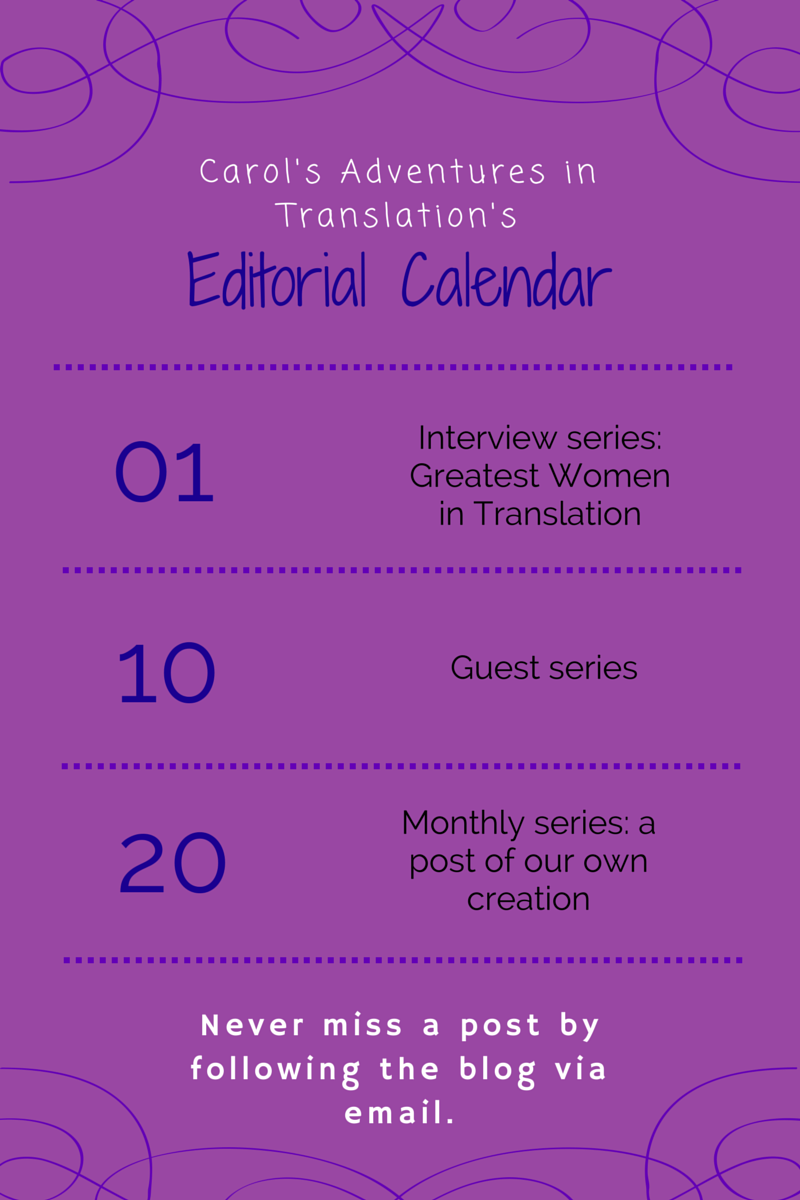
Editorial calendar

On the 1st of every month, we’ll have the brand new interview series, starting tomorrow. On the 10th of every month, we’ll keep having guests writing about diverse and interesting topics on translation (our next guest will be Tess Whitty, from the Marketing Tips for Translators podcast). And on the 20th, we’ll keep having our now monthly posts (previously weekly), written by yours truly, Carol. 😉

If any of those days falls on a holiday or on the weekend, I may anticipate for the previous day or postpone it for the next day.

Since the interview series is new, I’ll explain how it will work.

^3BD2FAACEAC897D21BE68030808476304DC722B6E37A1C22D8^pimgpsh_fullsize_distr

The idea is to feature women translators who are someone’s role model because they inspire and motivate us to reach higher and be better. Since this is a very personal opinion, my role model may not be yours, I’ll let the interviewees themselves choose the subsequent translator to be featured on the series. At the end of the day, we’ll have a group of professionals who are among the greatest women in translation. And I say “among” because the world is pretty large and it would be impossible to feature all the amazing translators who inspire and who are great role models out there.

That being said, tomorrow, the first interviewee will be someone who inspired me, since the beginning of my career, and who keeps being my inspiration. However, I won’t say another word, because it’s still a surprise.

The questions won’t be the same for every interviewee. I’ll try to make them as personal as possible, so we can have a customized interview. If you have any suggestions of questions or if there’s something you’d like to know about a translator, please let me know. I’m open to suggestions.

Last but not least, the hashtag of the series is #gr8testwomenxl8. So feel free to use it whenever you like.

“See” you tomorrow!

P.S.: June is the blog’s 2-year birthday. Stay tuned because there will be something to celebrate soon. 😉

My impressions on the VI Abrates Conference – Part 2

In case you did not read the first part, here it is.

Still on the second day of the conference, after the panel with representatives of some associations, we had a coffee break and, after that, our second keynote speaker, Renato Beninatto, spoke about Brazil’s position in the translation world. Beninatto talked about how Brazilians sometimes complain a lot about the local situation. According to him, translation, as well as its problems, is the same everywhere, not only here. The translation market is globalized. Renato also says it is a shame that ATA has the same number of Brazilian associates as Sintra: we should give more credit to local associations. To conclude his presentation, he shows this video and says a person is able to create a new initiative by themselves and inspire others. The first follower of the initiative is the most important, because he is the one that validates the leader.

In his presentation, he referred to this article: Brazil: The Social Media Capital of the Universe.

The second day was over and, while some attendees headed to a pizza place, I headed to a sushi place, where ACME E-learning hosted a Mixer with a dozen people. It was quite a pleasant evening, and I had the chance to get to know incredible new people from different areas and met a couple I already knew from other events. João, ACME’s director, will soon publish pictures and probably some words about this successful networking event.

11401323_582453758563073_2601120003924514791_n

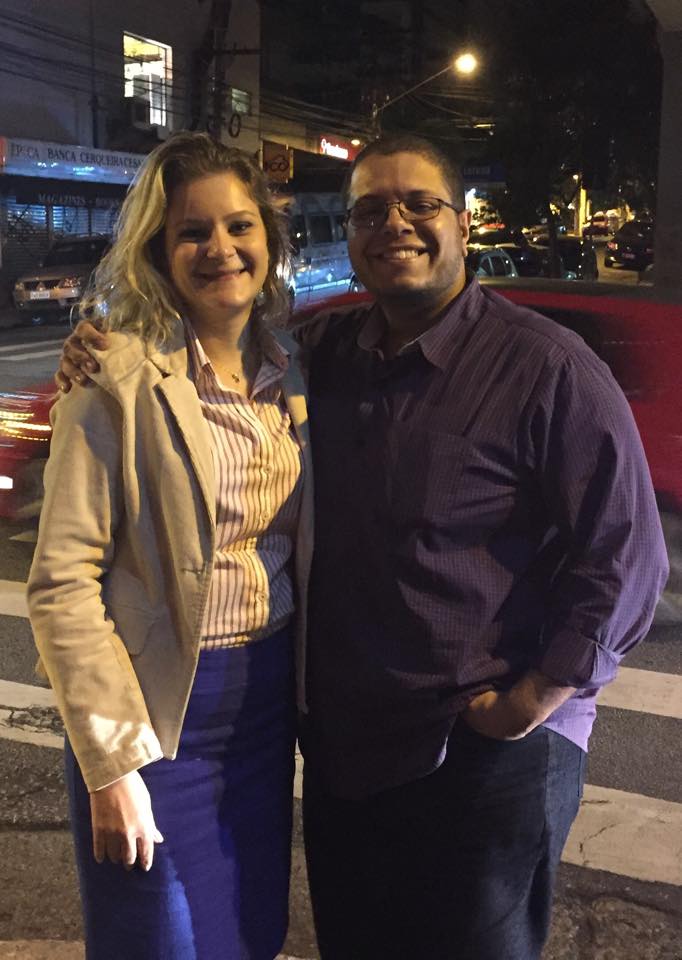
With João Artur Souza, from ACME E-learning.

On Sunday, the third and, sadly, last day of conference started with Renata Cassemiro’s presentation about the importance of the translator’s occupational health. Renata is physiotherapist and Pilates instructor, so she gave us some extremely important tips and orientations. According to her, some diseases take years to start showing its symptoms, therefore, we shouldn’t wait to try to find a solution. Did you know that the incorrect use of the phone is one of the biggest causes of problems? Don’t hold the phone between your ear and your shoulder. Use a headset instead. Fact: the human being is capable and prepared to walk 30 km a day. That’s why a sedentary lifestyle brings so many health problems! Some of her tips: establish pauses throughout your workday; avoid fried food and have lighter meals; therapeutic massage is advised once a week.

The second presentation of the day was by Débora Policarpo, who talked about financial planning. Débora is a business administrator specialized in wealth management and asset allocation. According to her, financial planning is the process of achieving our life’s goals through the adequate management of our finance life. There is nothing that takes more our attention than financial problems, right? We should understand the family’s budget and dynamics, as well as in which stage of life we are in. Débora said we must set our short-, medium- and long-term goals and the income we want/need to have when we retire. There is no magical formula to calculate how much we should save to achieve our goals: we need to know the time we have and the desired income.

11206772_906045236124582_6653212949250827871_o

During Débora Policarpo’s presentation.

We had a coffee break and, after that, my presentation.

After my presentation, I watched part of Carolina Walliter’s presentation on coworking. Unfortunately, I missed a great part of it, but it seemed very interesting indeed. People loved it! According to her, coworking is a network society that generates quality of life and social awareness. Sheila Gomes, who was also watching Carolina’s presentation, recommends that we at least try working in one of the coworking spaces available. I do plan on working some hours or a day in a coworking space we have in my town. As soon as I do, I’ll write a post about my experience. 😉

The last presentation of the conference was with Isabel Vidigal, who mainly talked about ProZ.com and the possibility of getting clients from it. According to her, you have nothing to lose creating a free profile on ProZ.com, but work carefully on it.

After that, we had a lunch break and, finally the last keynote speaker, Ulisses Wehby de Carvalho, from Tecla SAP, who gave a really relaxing and enjoyable speech about the life of an interpreter. We laughed a lot with his funny and incredibly embarrassing/amazing histories! According to him, mistakes happen in the booth because there is no backspace. The interpreter has to learn how to properly deal with them when they happen.

And that was it (or at least part of it, since I attended only 1/6 of the wide array of possibilities). You can find some links to posts people have already published about the conference below:

Talking in the real world, post-conference article by Robert Lange Greene on The Economist
A LBM no Congresso da Abrates, by Ligia Sobral Fragano, from Little Brown Mouse
VI Congresso da Abrates – Parte 1, by Laila Rezende Compan, from the blog Tradutor Iniciante
VI Congresso da Abrates – Parte 2, by Laila Rezende Campan, from the blog Tradutor Iniciante
VI Congresso da Abrates – Parte 3, by Laila Rezende Campan, from the blog Tradutor Iniciante
VI Congresso da Abrates – Parte 4, by Laila Rezende Campan, from the blog Tradutor Iniciante
VI Congresso da Abrates – Parte 5 (final), by Laila Rezende Campan, from the blog Tradutor Iniciante
Impressões sobre o VI Congresso Internacional da Abrates, by Sidney Barros Junior
VI Congresso Internacional da Abrates – Um sucesso muito além do esperado, by Ponte de Letras
Línguas e Tradução: Outro Encontro de Tradutores, by Anita Di Marco, from Anita Plural
VI Congresso da Abrates: uma viagem pelo mundo da localização, by Maíra Monteiro
VI Congresso Internacional da Abrates, by Marina Borges
E o VI Congresso da Abrates?, by Thiago Hilger, from the blog O Jogo da Tradução
CAT Tools na tradução literária: para quê?, by Rafa Lombardino, from eWorldNews, about Reginaldo Francisco’s presentation (in English: CAT tools in literary translation: what are they good for?)
A TradWiki e a visibilidade do tradutor, by Daniel Estill, from TradWiki
Como foi o VI Congresso da Abrates para os iniciantes, by Lorena Leandro, from the blog Ao Principiante
Pesquisa em tradução literária: seleção de fontes e entrevistas, by Rafa Lombardino, from eWorldNews, about Candice Soldatelli’s presentation (in English: Research in literary translation: selecting and interviewing sources of information)
Impresiones sobre el congreso – Abrates 2015, by Víctor Gonzales, from El Heraldo de la Traducción
Vamos fugir do tradutês?, by Rafa Lombardino, from eWorldNews, about Ponte de Letra‘s presentation (in English: Let’s avoid translationese, shall we?)
Pensando a tradução de variantes linguísticas, by Rafa Lombardino, from eWorldNews, about Solange Pinheiro Carvalho’s presentation (in English: On translating linguistic variants)
O tradutor sob os holofotes, by Rafa Lombardino, from eWorldNews, about the round table with Carolina Caires Coelho, Alyne Azuma, Alessandra Ruiz and Candice Soldatelli, moderated by Petê Rissati (in English: Translators under the spotlight)
O papel do tradutor na nova era da publicação digital, by yours truly on the blog eWorldNews, about Rafa Lombardino’s presentation (in English, translated by Rafa herself: The role of translators in the new digital publishing age)

And here are links to some presentations that presenters made available somehow and that I became aware of:

Roney Belhassof’s presentation: Usando a internet sem ter que virar nerd
Val Ivonica’s presentation: A tecnologia vai acabar com o tradutor?
Juliana Samel’s presentation: Falsos cognatos e decalques na tradução médica inglês > português
Layla Penha’s presentation: Interpretação consecutiva e além – como se já não bastassem os desafios da tarefa em si (recorded presentation, part 1 – you can also search for the other parts)
Jorge Rodrigues’ presentation: Rumos e perspectivas da carreira do tradutor profissional
J
orge Davidson’s presentation: O ABC das CATs: o que você nunca se atreveu a perguntar
P
aula Ianelli’s presentation: Quatro traduções e um original
M
itsue Siqueira and Bruno Fontes’ presentation: Gerente de projetos: de onde vem, para onde vai? You can also find a video of part of the presentation on YouTube here.
Carolina Walliter’s presentation: Coworking e os tradutores na vanguarda da nova era do trabalho
F
abiano Cid’s presentation: A situação do tradutor hoje no Brasil: problemas encontrados em três anos de LQA

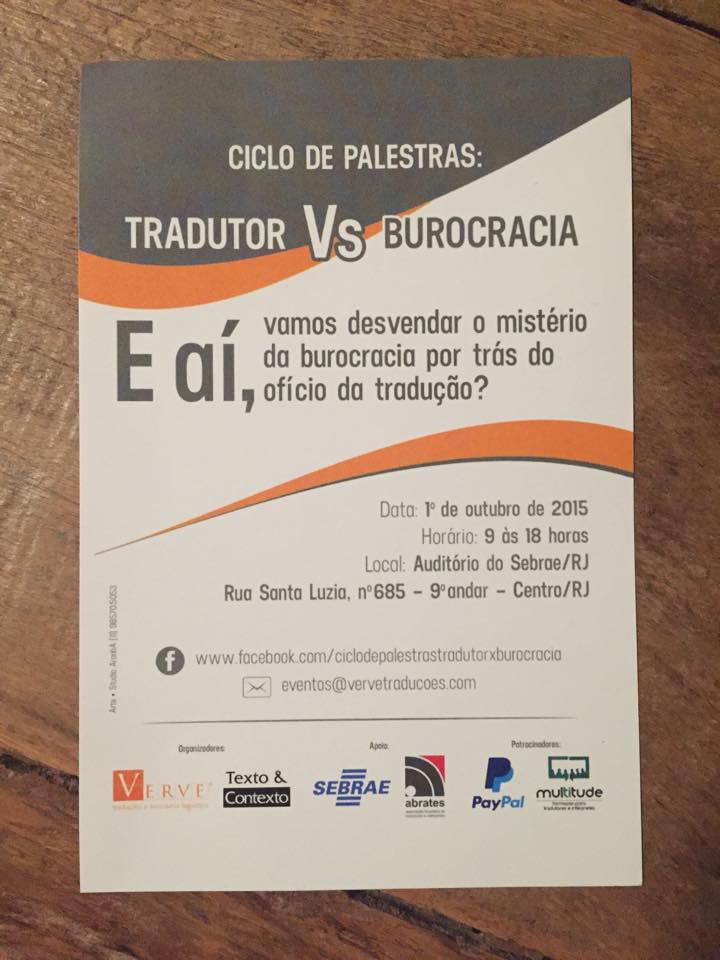
On a last note, it was informed in the conference that there will be a series of talks on bureaucracy and translation, Tradutor vs. Burocracia. The first one will be held in Rio de Janeiro, on October 1st.

1450125_581883981953384_6672309901804117042_n

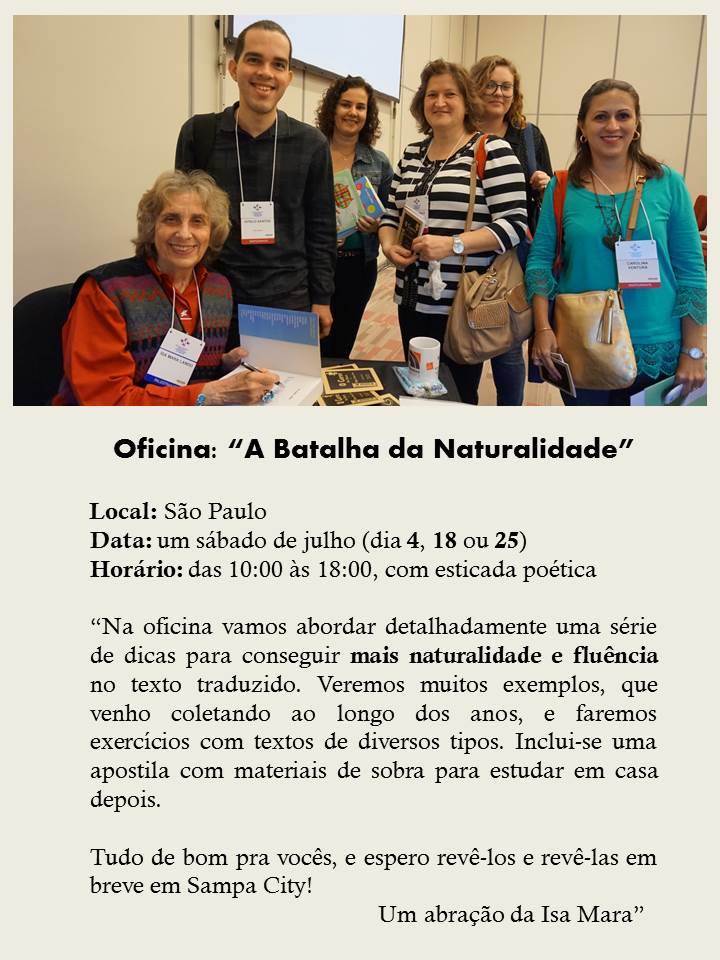
Besides, a workshop is also on the make with the amazing Isa Mara Lando, organized by Luciane Camargo. It will be on a Saturday in July, from 10 a.m. through 6 p.m., in São Paulo. If you are interested at attending in, please send an email to lucianecamargo@hotmail.com informing your date preference (4th, 18th or 25th).

11401553_978419358855948_9047161383587473570_n

And if you are not an Abrates member yet, it’s now or never! They are offering a 50% discount on the annual fee for those who attended the conference. But it’s only until June 30th!

If you want to check what else happened during the conference, follow the hashtag #abrates15 on Facebook and on Twitter.

And if you are interested in attending the next one, it will be held in Rio de Janeiro, date yet to be announced. I’ll certainly let you all know when we have news about it.

Last, but not least, the next post – that will most probably come this week – will be about my presentation.

My impressions on the VI Abrates Conference – Part 1

11425189_581892505285865_1111287860557737037_n

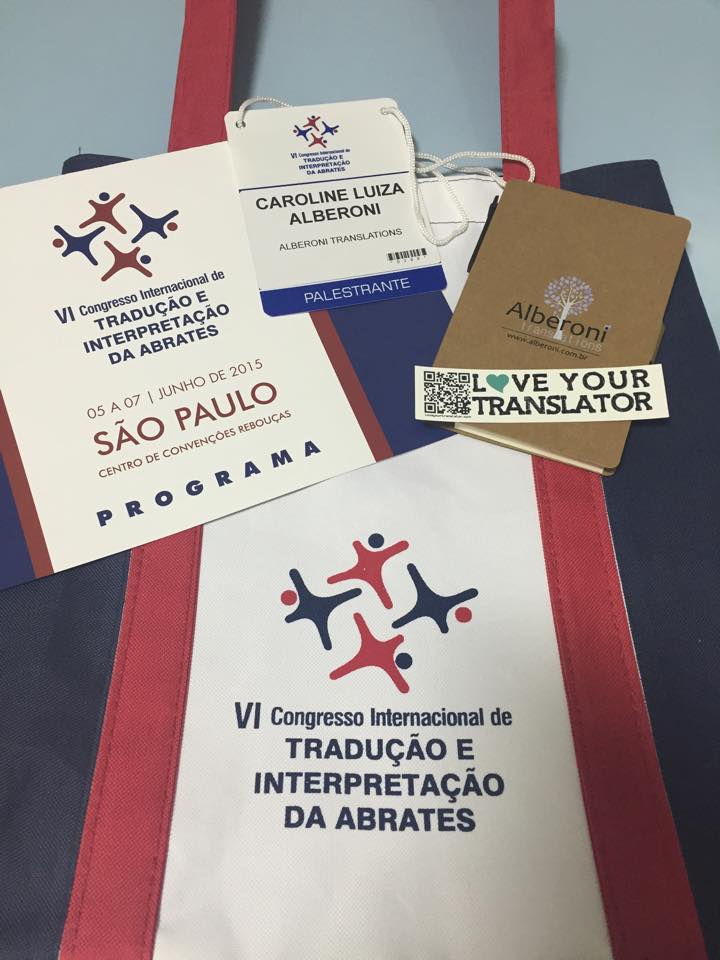
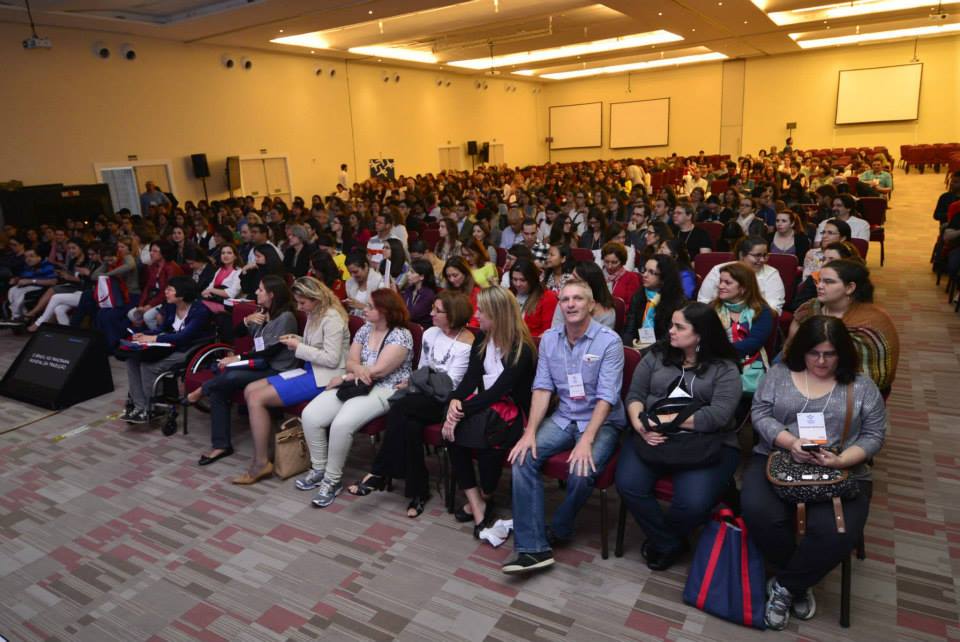
Last weekend, from June 5th through 7th I attended (and presented at) the VI Abrates International Conference in São Paulo (Centro de Convenções Rebouças). Abrates is the Brazilian association of professional translators and interpreters and, since 2013, they hold an annual conference in different Brazilian cities. The event is the largest and most important in the area in Brazil, and possibly now the largest in Latin America. This year, we almost reached 900 participants (last year, in Rio de Janeiro, there were 450 attendees; and in 2013, in Belo Horizonte, 390).

The conference officially started with great news: PayPal partnered with Abrates and will now offer special rates for receiving payments – for Abrates members only. For receiving payments from abroad, the rate will decrease from around 7.4% to 3.49% + R$ 0.60 per transaction. Everybody – including me, of course – was ecstatic with the fantastic news! Stay tuned on how to benefit with it if you are an Abrates member. The association will publish it on their site and share on their Facebook page when they do. Besides, you can also call PayPal’s SAC to know more. Following the official opening, the first keynote speaker, Robert Lane Greene, Berlin-based business correspondent for The Economist who writes the “Johnson” column on language for The Economist online, talked about languages around the world. He starts speaking in an impressive Portuguese and admits he is part of a small group of weird North-Americans who like to learn other languages. After his introduction, he starts his presentation in English and shows us some interesting numbers related to languages on the internet. On Wikipedia, for example, translations are mainly to and from English, indicating a lack of language connections. On Twitter, a great number of users tweet in two languages, and Portuguese/English is one of the most common pairs (behind Malay and Spanish). Greene also differentiates between business suit language and underwear language: the first is the one you simply wear/use for any reason, the second is close to our heart and intimate self.

The infographic on this page was one of the images he showed. Robert also mentioned this article. He also has a book, You Are What You Speak.

11401551_581868801954902_4886438609481579037_n

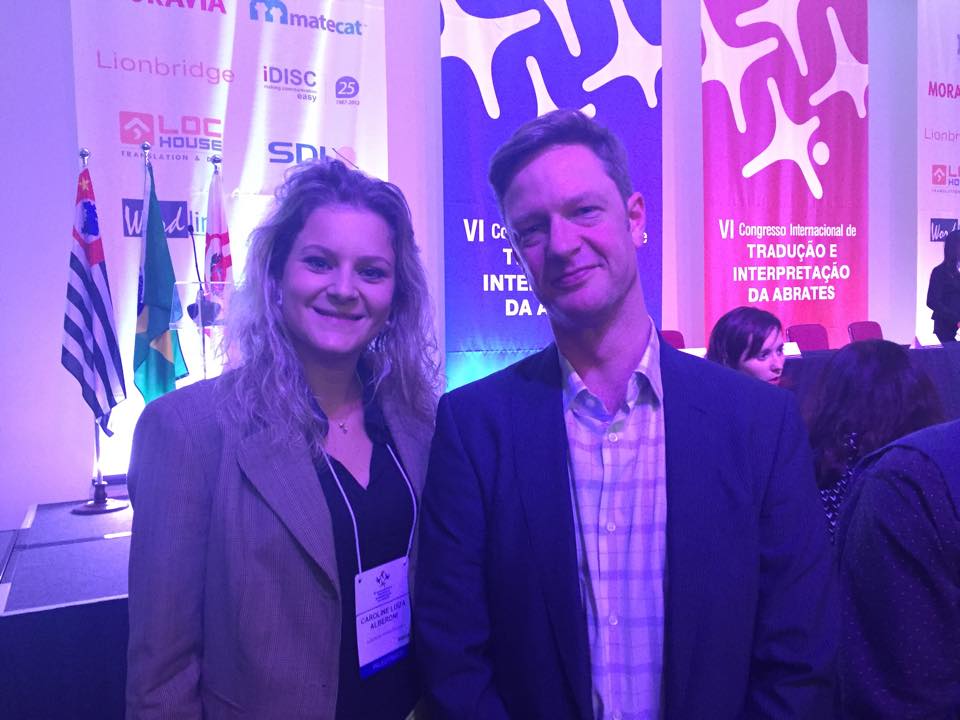
With Robert Lane Greene.

After his interesting presentation, we had a cocktail party where we had to change to say hi to our fellow translators.

The actual presentations started for good the next day. The main characteristic of this conference is that we have plenty of choices to choose from: there were six different rooms with a diversity of topics being presented at the same time throughout the event. My first choice (always a difficult one, Paula Ianelli and Reginaldo Francisco, for example, were also presenting at the same time) was about technology and how we can use them to improve productivity, by Fernanda Rocha. Did you know, for example, that Windows and Mac’s calculators convert units and currencies? They also calculate periods of time. You can also add two other clocks (time zones) to your toolbar.

Time to change rooms! Off to room 5 where Rafa Lombardino talked about digital self-publication. Did you know that, in Brazil, a material becomes public domain after 70 years of the author’s death? She suggests creating a blog/site to document your book translation projects (it can also serve as a portfolio). You can find the newsletter about her presentation and the link to the Prezi presentation here.

Next one was in room 1, with João Vicente de Paulo Jr. and Giovana Boselli, who mentioned some important steps we have to follow when/before accepting a project not to have unexpected problems down the line. For example, read the allocation instructions carefully (delivery date/time, volume, subject), open the files and have a look at them, check if a big project requires partial deliveries, check if there is reference material to be followed (glossaries, style guides), payment method.

After the coffee break, I heard Monica Hruby, president of ATPI-Rio, mentioned some problems sworn translators face in Brazil and the regulation that surrounds it. An important point: translation agencies can’t be sworn translators! So be aware! I chose this presentation because I heard from a colleague last week that many sworn translators on Jucesp’s list are dead and their son/daughter are translating on behalf of the deceased translator! This is totally insane!

Back to room 1 to hear Raquel Lucas de Souza tell us about how she became an agency. Circumstances made her realize she could solve her clients’ problems not by translating, but by finding people who could do it, being a project manager. We need to fully understand ourselves in order to identify our qualities and find out our place in the market. A professional posture is essential for having good final results. At the same time, Capitain Israel Souza Junior, last year’s keynote speaker, was talking in room 4 about idiomatic expressions in war movies’ translation.

After lunch, I watched a panel with representatives of 10 associations: ATPIESP, ATP-MG, APIC, GALA, ATP-Rio, ASTRAJUR-RS, ATPP, Abrates, Sintra and ATA. The panel was very informative and useful, but I’d like to bring the attention here to the current situation of Sintra (Brazilian translators’ union). It once had only 173 paying affiliates and considered closing its doors. Nowadays, there are 233, but it is necessary 327 in order to have a financial balance. With its current budget, they can only run until October. Currently, 106 affiliates are in default, but they can only be removed from the union after 2 years not paying! The annual fee to become an affiliate is R$ 330.00. As pointed out during the panel, some people spend a fortune to attend ATA’s conference, but claim it’s too expensive to pay for the union’s fee. I’m an affiliate and I believe the union is essential for helping us defend our rights. See, for example, what they are doing, with ATP-Rio and Conati, to defend our rights regarding Simples Nacional here.

11392789_583609965114119_5721453994127861075_n

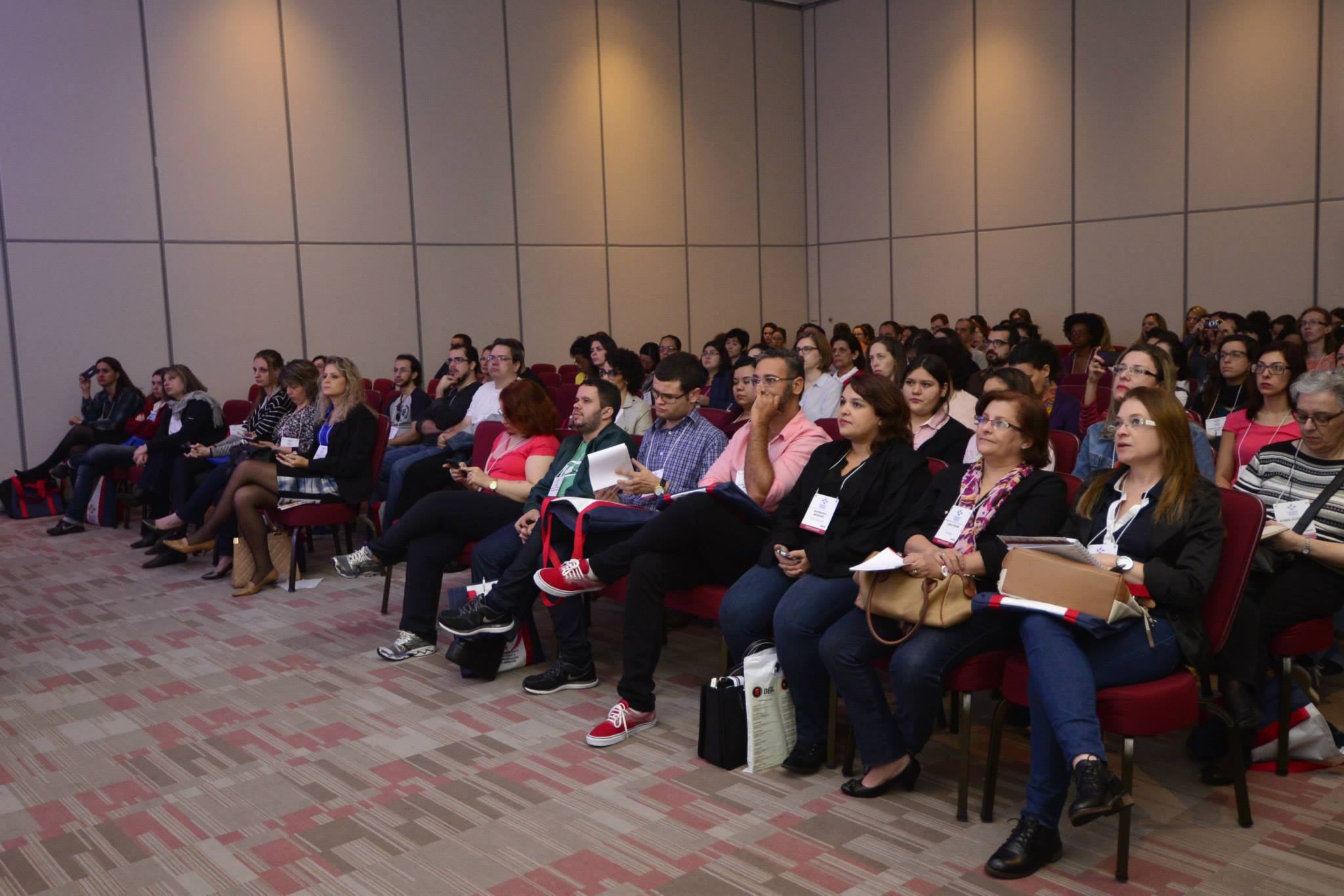
Conference attendees featuring yours truly doing what I did best: tweet. 🙂

Please find the second part of this post here.

Greatest Women in Translation

photo-1431986229655-9ca60378f77d

It does feel good to be back at writing posts for the blog, especially when there are announcements to be made – good ones, of course. Don’t you worry!

But first I’d like to thank you, my dearest readers, for always being so kind and active on the blog! Seriously, you are amazing! And, because of that, while I was giving some thoughts to the changes I’d make to the blog, you were crucial to the decisions I made. After all, let’s be honest, this blog is for you, so why would I not listen to you, right? So, THANK YOU! I hope you like the changes I’ll announce today and that you keep supporting the blog as you already do.

By the way, have you already voted for it as the Top Professional Blogs 2015? If not yet, please do on the button on your right, and fingers crossed!

Now let’s move on to what matters: the news! As you know, I’ve been more absent than ever from writing posts myself. Besides, I also had a couple of issues with the guest posts. This situation made me feel terrible, because I know I have an editorial calendar to follow and I was letting you down on it. Therefore, I decided it was time for a change! I thought of ending the guest posts altogether, but, as I said, you give me such a great feedback on them, that I really felt it would be a shame to end them. That being said, I declare the guest posts stay! As do my own posts, of course. However, their frequency will change. We’ll have both of them once a month, solving my lack of time issues and leaving me more time to plan the guest posts.

Now the great news is we’ll also have, from now on, an interview series, with which I’m really excited about! 😀 It will be called Greatest Women in Translation (#gr8estwomenxl8). As the name clearly says, I’ll be interviewing women only. I have already invited the first interviewee, and she has accepted the invitation! Yay! She’ll answer the questions I made up especially for her and will be responsible for nominating the second interviewee. That’s right! On this series, I’m not the one who gets to invite guests, the interviewees themselves will be the ones to do so. The idea is that each interviewee nominates a woman they look up to and admire in translation. If, for any reason, the nominee is not able to accept the invitation, I’ll invite another one and start the thread again. Are you as excited as me with this? 😀 Everybody has someone who inspires them, right? And isn’t it just lovely to learn more about the person?

Stay tuned, adventurers! I’ll soon disclose the monthly publication dates and when they start.

Meanwhile, how about trying to guess who the first Greatest Woman in Translation is? 😉