Greatest Women in Translation: Doris M. Schraft

^3BD2FAACEAC897D21BE68030808476304DC722B6E37A1C22D8^pimgpsh_fullsize_distr

Happy New Year!

Welcome back to our interview series! It is a great pleasure to start another year here on the blog and to welcome you all. May we all have great adventures together in 2017.

Now please welcome our first interviewee of the year, Doris M. Schraft, nominated by Naomi Sutcliffe de Moraes.

Welcome, Doris!


naomi-sutcliffe-de-moraes

Created with Canva

1. How were you introduced to the world of translation and how did you start working as a translator?

I would have to say that translation actually began for me at the beginning of my language-learning experience, with Spanish in high school. The traditional grammar/translation method of instruction was used, which meant that the greatest emphasis was placed on learning Spanish grammar and writing correct sentences in that language. It built a textbook-oriented, highly visual connection with the language, with little emphasis on conversation skills. I connected very well with this method, because I had spent several years in primary school being taught English grammar and diagramming sentences. As a result, I was already well-versed in the analysis of language mechanics. When I started my university Spanish studies, I came to regard this visual language-learning method as unfortunate, as it was assumed that mid-level language students already knew how to converse in their second language!

When I added French to my language repertoire as an undergraduate student at university, the teaching method was quite the opposite. Although we had textbooks, class time was spent developing oral skills without reliance on visual aids, and grammar received secondary emphasis. But as a Master’s student, I returned to analytics, concentrating on Spanish linguistics. That focus solidified the foundation for my later work as a translator. As a PhD student, I delved into Portuguese as part of a program in Latin American studies. The instruction method there was more of a blend, and the learning came easier. Of course, it didn’t hurt that my three foreign languages were all descended from Latin roots, and just to tie things all together, I studied Latin as well. The bonus was that it opened my eyes to just how many words came to English through that classic language. Even though English is classified as a Germanic language, more than half of our words had their origin in Latin.

Ultimately, I was unable to deny my apparent calling in language analytics. In fact, I seemed to be fated to begin my professional career as a translator. My first job essentially fell into my lap when I moved to Washington, DC, when a friend alerted me to an opening for a Spanish translator in her employer’s industrial firm that made simulators for power plants, submarines and airplanes. I decided to interview with them, despite misgivings that, given my background, I was unqualified to work with such subject matter. They offered great encouragement, however, explaining that I would be able to consult with previously translated materials, consult with the engineers, and tour the simulators as needed. It was a leap of faith, but I took the position, and my two years there were a fascinating and educational experience.

2. In between your early experience as a translator (let’s face it, what is 2 years compared to 40, right?), you worked as an Administrative Manager at a development resources company. Why did you decide to have this change of ground?

When my company’s contract with the Spanish government ended and they failed to win another expected contract, I looked for another translation position in a tight job market. Although my next position — with a consulting firm that undertook socioeconomic development projects in less-developed countries — was not that of a translator per se, I did do some translation for them along with my larger administrative duties. We sent teams of agricultural engineers, agronomists, economists, and environmental consultants to countries around the world that could benefit from their expertise, funded by various international organizations. It was here that I became familiarized with those organizations’ mission of sharing knowledge and resources across borders, and met many professionals who shared that commitment and wanted to use their skills for the greater good of others. My later freelance work greatly benefited from this experience.

3. In your vast experience, you ventured as a staff translator/editor for three years, just before becoming a freelancer. How do you compare both experiences? And considering you are now a freelancer for 30 years, we can say you prefer being a freelancer. Why?

With a continuing desire to work more closely with languages, I decided to pursue that avenue after three years of working mostly as an administrator. Berlitz offered me a broad range of experience over the three years I worked there as a staff translator, able to draw on my three languages as I worked with other, more experienced translators and received their guidance and editing comments. It gave me a broader view of translation in business and legal contexts. At times I was even able to use all three of my languages in multi-language projects as a production team member, checking the page proofs of others’ reviewed English-to-foreign translations of operating manuals to check for uniformity, omissions or other irregularities.

Becoming a freelancer was a natural step beyond that valuable staff experience. Freelancing enabled me to build on it, and gave me independence in the form of the ability to choose my clients and projects, as well as set my own rates. Having a flexible schedule means you can fashion your personal life – appointments, vacations, etc. – as you need and see fit. If you want to work into the evening or on a weekend and the circumstances are amenable, you can do it, with no travel time or transportation expense involved. Over the years I have had the good fortune to be a part of many translation teams with colleagues whom I’ve come to admire and respect. I continue to learn from them on every project. In fact, I regard translation as a wonderful learning experience. And I hope that my own translations, in some small way, are helping others to reach their goals, whether they involve learning, information acquisition, communication, or commerce.

4. You work with Spanish, Portuguese and French. Is it just a coincidence or do you have a soft spot for Latin languages? How and why did they become your working languages?

I think I’ve mostly answered that question above! I certainly do have a soft spot for the Romance languages. Italian would be fun to study, too. I think I focused on Spanish in high school because I heard my older sister studying it, and my father still remembered a bit of it from his own high school days. Those initial sparks piqued my curiosity. I’ve long been a great lover of cinema, and it was through that avenue that my interest in French was awakened – Un homme et une femme, which, by the way, had a Brazilian connection. Later, my PhD program focused on Latin American studies, so of course Brazil and the Portuguese language came onto the menu as a natural extension of that interest.

5. Your areas of expertise are law, business and international development. I always think it is interesting to know how people specialized in their areas, because stories are always different. So how did you end up translating in those fields?

Those areas of concentration grew out of the potpourri of my previous experiences. Most of my work as a staff translator focused on business or legal documents, so those were areas in which I developed some familiarity and confidence. As a freelancer, I took some university law courses and, over the years, have had the pleasure of being a part of many different teams of translators working on major international legal cases, particularly involving environmental issues and patent litigation. In many instances, the teams included translators who specialized in the case-related technical fields, who could therefore provide expertise on subject-matter questions that arose. My experience with the consulting firm offered me an introduction to the major U.S.-based international development organizations, with which I was later able to connect as a freelance translator.

6. You have been a member of ATA for almost 30 years, and an active one, being the chair of its grader group for Portuguese to English certification exams. I think that speaks for itself regarding your opinion about the importance of associations, but it is never too much to emphasize it. Could you share your thoughts regarding the role associations play for the professional translator?

Translation, particularly as a freelancer, can be a rather solitary profession – a fact that anyone reading this interview no doubt already knows. As an analytical person, I’ve always been good at working on my own. But the only way to improve and really come alive as a translator is, in my opinion, to be part of a community of like-minded individuals. I’ve mentioned that I view translation as a learning experience. To be sure, I always find things to learn in the subject matter of my work, whichever field is represented. But there is much learning to be gained from editing or being edited by colleagues, and I have met most of them through ATA. And yes, even grading is a learning experience, in that it makes you focus on the meanings of words and how they are used. I’ve attended most of the ATA conferences over the past 30 years. They offer a wealth of educational sessions, a chance to investigate new topics, stay up-to-date on technological advances, meet new people, explore various cities, enjoy camaraderie, and build friendships. Those are invaluable experiences that enrich one’s life and form the building blocks of good translation.

7. Now it is your turn. I am quite curious to know whom you have in mind as the next honoree.

My nominee is Kim Olson, a long-time colleague with whom I have had the pleasure to work on many translation projects. I admire Kim for her finely-tuned translations, diligence, creativity, and professionalism. Most recently, she has been a model of good project stewardship, skillfully managing a team (of which I am a part) of several high-level translators who produce the English version of a major Brazilian scientific/technical research funding agency’s monthly publication. She presented a session about her experiences with this ongoing project at the most recent ATA conference. I am honored to count Kim as a valued and trusted colleague, and it is a joy to know and work with her.


Thank you, Doris, not only for accepting Naomi’s nomination and my invitation to be part of the interview series, but also for taking the time, during the busy holidays, to answer my questions. It was a pleasure e-meeting you and getting to know you a bit better.


2017 Resolutions for Translators

vg8uf3dx4pw-annie-spratt

Christmas is here. We have 11 days left in 2016 before starting a fresh new year. We will have a clean slate comprised of 365 days to do things better – learn from the mistakes we made in 2016 and improve those actions in 2017.

I am well aware that the whole “New Year, new life” mindset is actually a myth. January 1 will be just another usual day in our lives. However, I do believe in the spirit of renovation and what it can do for us. After all, change only depends on us. And if this spirit inspires us to change somehow, then anything can happen – we just need to believe and act upon it. And since change can start from every one of us, I also believe we can make the world a better place too.

In my last 2016 post – this is my fourth end-of-the-year blog post, which also something to reflect upon –, I would like to point some things we, translators, can change in the next year to become a better person and translator. Let’s start applying the change we want to see in the world to our lives?

Less negativity, more positivity

This may be the most common New Year resolution, but that is because it is valid every year. The world is full of sad news and horrible people. And that will hardly change overnight. Actually, it may never change. However, what good does it bring if we just complain about it? Quite the opposite: it only makes things even worse.

Instead of complaining about rates, agencies, clients, how about stressing the perks in translation? Stop posting about translation mistakes and start recognizing the amazing job of a fellow colleague. Stop complaining about horrible clients and start praising a client who values professional translators. Stop posting poor memes of translators working overnight, on weekends and holidays and glorifying it, and start spreading tips for a quality work-life balance. Simply stop sharing bad news and start sharing good news. If you do not have anything good to share, simply do not share anything at all. And this can be applied both online and offline.

Less complaining, more doing

When I was a university student, I used to call my mom, crying, complaining about how things were difficult. She would say, every single time, “That’s the life you chose for yourself. You wanted that, now you have it. Do you want to come back home? No? So deal with it. Do you want to quit? No? Then deal with it. You are the only person who can sort things out.” Some will think she was a hard mom. That was what I thought back then. After all, all I wanted was a shoulder to cry on. However, after hanging up the phone, I would wipe my tears off, take a deep breath and take the bull by the horns. Maybe, if she did give me what I was looking for, I would not have the courage to face my problems and would be a whiny adult waiting for things to get better on their own.

What does this have to do with what we are talking about? Complaining, whining and crying do not lead us anywhere. Having the guts to face our problems will. And this applies to anything in life.

That client does not pay well or is not worth it? Raise your rates to whatever suits you, start prospecting with the adjusted rate and fire that old client. That colleague pisses you off every time he/she posts something online? Unfollow him/her. You are tired of working non-stop, with clients contacting you at any time of the day, any day of the week? Determine your working hours, notify your clients about it, display it on your social media channels, website and e-mail signature, and try to stick to it.

How about joining the first point to this one and, whenever you feel like complaining about something, think twice and see if you can do the opposite: try to take something from it and focus on it.

Less work, more productivity

It is a funny thing how translators pride themselves at working practically non-stop – weekends, holidays, overnight; with no vacation for [fill in time here] long years; only sleeping for [fill in time here] hours. I admit I will never understand the logic behind it.

Do not get me wrong. I have already worked under those circumstances – and in all of them at once – in my early beginning. However, I never thought it was something to be proud of. So much so that I learned with my mistakes – as I usually do – and changed. And I do rarely work (but only part time) on the weekend or on a holiday or until later (but definitely not overnight), if necessary. But those are exceptions, and that is fine.

The problem is we usually procrastinate a lot and/or do other things rather than translate and then we have to work more time to deliver an assignment on time. It is possible to work less (time) and produce more. All it takes is discipline, organization and determination. Do you want to work only 6 hours per day? Do it. Yes, you can! Leave social media, personal e-mails, Skype chats, whatever non-work-related tasks for before and/or after your working hours, and set up a fixed day of the week and time for other professional tasks, such as invoicing and marketing. And translate like crazy in those 6 hours. You will see time will fly and your productivity will really increase.

Your translation quality highly depends on it. Lack of sleep, for example, interferes with your thinking capacity, as does working for long hours and multitasking. Focus is the new black.

Less anything bad, more quality of life

If you apply the tips mentioned above, you will already have a better quality of life and more time on your hands to take up on other activities to improve it even more. More positivity means you will also be more positive towards yourself and your life. More doing means you will focus on increasingly improving personally and professionally. More productivity means more quality = more translations = more clients = more reliability = increased rates = professional fulfillment – not exactly in this order. It is a vicious circle of only good things.

Use the time left to exercise, take a CPD course/webinar, meditate, go to the movies, go out for a coffee/beer with colleagues/friends, sleep, you name it – whatever you feel like doing. Do not forget to eat well and take regular breaks throughout your working hours.

What is the point in working your health off and then spending money with doctors, or being unable to work for being sick in bed because your immunity is low for working too much, or getting burned out?

I saw someone post on social media this week, asking for tips on books or anything that could help her stop procrastinating. Books, blog posts, magazine articles, friend’s advice, nothing will work if you are not willing to change. Even this blog post will be in vain if you think it, by itself, will solve all your problems. As I said at the beginning of this post: change starts with us.

So, what do you say? Let’s do this, together?

Meanwhile, I wish you all a merry and joyful Christmas, and an inspiring and happy New Year!

Tricky to master

unnamed

Although it takes years to learn a foreign language and to use it fluently in writing or communication, it is not unattainable or impossible mission. A translator knows how to do the best translation which will suit desires of the language it is translated into.

People often joke about translation fails; there are a lot of pictures and photos presenting various and funny mistakes.

The purpose of this short article is to avoid those little and horrible mistakes and to do your job in an adequate manner.

  • You have to bear in mind that when someone tells you, “Pigs might fly,” it does not mean that pigs suddenly became mythical beings or birds – it means that something is not possible. You should always choose the adequate proverb for the country in which language you are translating.
  • You have to be familiar with the right meaning of the word, with the field that you are dealing with. Think about “net,” for example, whether it is related to sport or economics.
  • Try to avoid spelling mistakes. This kind of inaccuracies are not likely to be accepted, for example:

Thank you for you’re [instead of your] time.
Are there any dinner specirals [instead of specials]?

  • Be aware of punctuation!

Incorrect: Big boy’s drive big toys!
Correct: Big boys drive big toys!

  • Your grammar has to be perfect. You need to know where nouns, verbs, adverbs, or adjectives take place in the sentence. Respect the word order and see how the adequate structure of the sentences makes you an excellent translator!

Did John cut an apple with a knife?
or
Did John cut a knife with an apple?

  • Bare in mind names of people and places. They are not likely to be translated! It is acceptable to transcribe them but it is gaffe to change them in that way.

John (Gia, Ivano – Italy, Ivo – Bulgary, Jean – France, Jock – Scotland…)

  • Your vocabulary needs to be excellent. Turn two sentences into one, or three if you please, but please, do not change their meaning! It is the worst sin in this field of dealing with language. Sentences need to sound best possible in the language they are translated and they have to be understandable and correct.

Dogging point!  (?)
(It may not mean the same thing in Germany as it does in car parks in Essex)

  • If your language does not have an adequate word for the one that needs to be translated, you can use apostrophes and leave it as is or you can describe it using the appropriate sentence or homonyms and synonyms. Try to keep it original and not “destroy” it.
  • Some jokes cannot be literally translated. So, if the joke you have to translate keeping it funny is about cheap Scots, remember who is considered miser in your country!
  • I have already mentioned that your grammar needs / has to be perfect. If not so, you can be laughed about or you can change the meaning.

Your Grammar has to be perfect.
Not: Your Grammar has to is perfect.
Nor: Your Grammar has to will perfect.

Translating and interpreting is not an easy job to do. The fact is that people work on the above-mentioned skills for years and often make mistakes. The interpreter needs to know both languages he/she is working with. If only one language is mastered, the result can be catastrophic. Grammar,  verb tenses and vocabulary are essentials in this field of work. If one of these lacks, the job will be done poorly and in an inadequate way. It is important to follow the rules and to respect them.

Stay calm, check everything a dozen times and keep it original, whether you are ordering a shirt or translating official political documents!

About the author
cristina-oliveiraCristina Oliveira is an English and German translator and works as a freelancer, mainly on the online market. At the moment she is taking a master degree in teaching English as a second language for young learners at the ISCE Douro.


This is the first sponsored post on the blog. From now on, we will occasionally host sponsored posts on the 15th of the month.

Guest post: Kirti Vashee

Welcome back to our guest post series! We are already almost halfway through December and the Holidays are just around the corner. Any big plans?

While waiting for the Holidays, why not enjoy another great reading from a dear guest? I met Kirti Vashee at the last Abrates Conference, held this year in Rio de Janeiro. Then I had the pleasure of interviewing him for my podcast, TradTalk. You can watch or listen to the interview here. You can also read the article I wrote (in Portuguese) about this interview for Metáfrase, the Abrates magazine, here. And now you can enjoy the guest post he kindly wrote to the blog.

Welcome, Kirti!

fexpdv001o4-anas-alshanti

A Machine Translation (MT) Action Plan for Translators

This is an article for those translators that have some interest in, or at least want to understand how to properly assess MT related work opportunities, or add linguistic value in large-scale MT projects. The need for translation of business content and other kinds of information on the internet continues to grow, but there are also changes that affect translators and agencies alike. The most interesting translation work is increasingly moving beyond the focus of traditional translation work and is likely to do even more so in the future. Thus, the most lucrative and interesting NEW translation opportunities, like at eBay for example, may require very different kinds of skills and competence but would still draw on basic translation and linguistic competence.

The forces that drive the increasing use of MT in the world, are largely beyond the control of the “translation industry,” continue to build unabated and can be briefly listed as follows:

  • More Content: The sheer volume of content that global enterprises, governmental agencies and any international commercial venture need to translate continues to grow.
  • Content Value: The value of business content increasingly has a very short shelf-life and thus traditional TEP (translate-edit-proof) approaches are increasingly questioned for information that may have little or no value after six months.
  • Short Product Life Cycles: The product life cycles in electronics, fashion, and many other consumer products get shorter all the time, so rapid, “good enough” product descriptions are increasingly considered sufficient for business requirements.
  • Volume & Cost Pressures: Enterprises are under continuous pressure to translate more content with the same budgets, and thus they seek out agencies who understand how to do this with rapid turnaround.
  • Changing Internet User Base: As more of the developing world comes online it becomes imperative for these new users to have MT to be able to get some basic understanding of existing web content.
  • Free Generic Translation: The universal availability and widespread use and acceptance of “free MT” on the internet has raised acceptance of MT in executive management circles too. This also drives the momentum for large new types of projects that would never have been considered in the TEP translation world.

So if we presume, that it is very likely that MT is going to be a fact of life for many professional translators in the 21st century, what new skills would a translator need to understand and be considered a valued partner, in a world where MT deployment and “opportunities” will continue to abound?

MT today, has already proven itself in professional use scenarios with most Romance languages, but we are still at a transition point in the use of MT in many other language combinations, and thus the MT experience can often be less than satisfying for translators in those languages, especially when working with translation agencies who are not technically competent with MT.

The New Skills in Demand

At a high level, the skills that matter in working with the professional use of MT, that we can expect will grow in value to global enterprises and agencies involved in large MT projects are as follows.

  • Understand the different kinds of MT systems that you would interface with. Translators that understand the different kinds of MT are likely to be much more marketable.
  • Understand the specific output quality of the MT engines that you are working with. Provide articulate linguistic feedback on MT output. Being able to provide articulate feedback on error patterns is perhaps one of the most sought after skills in professional MT deployment today. This ability to assess the quality of MT output is also beneficial to a freelancer who is trying to decide whether to work on a PEMT project or not.
  • Develop skills with new kinds of tools that are valuable in dealing with corpus level tasks and manipulations. It is much more likely that MT projects will involve much larger volumes of data and data preparation and global pattern modification skills become much more useful and valuable.
  • Develop skills in providing pattern level feedback and develop rapid error pattern identification and correction. Being able to devise a rapidly implementable test and evaluation routines that are useful and effective is an urgent market requirement. This paper summarizes the specific linguistic issues with Brazilian Portuguese that provide an idea of what this actually means.
  • Develop a corpus view that involves linguistic steering rather than segment level corrections. This is a fundamental change of mental perspective that is a mandatory requirement for successful professional involvement with MT. Understanding the competence of the translation agencies that you engage with is also a key requirement as it is VERY easy to mismanage an MT project and most translation agencies that attempt to build MT engines on their own  are quite likely to be incompetent.

What can you do?

  1. Learn and educate yourself on the variants of MT.
  2. Experiment with major engines from Google, Systran, and Bing and with specialist tools like Lilt and SmartCAT that allow easy interaction with MT.
  3. Understand how to rapidly assess MT output quality BEFORE you engage in any MT project.
  4. Don’t work with incompetent translation agencies who know little or nothing about MT but only seek to reduce rates with crappy do-it-yourself engines.
  5. Experiment with corpus management tools.

You can find much more information on the eMpTy Pages blog and on many translator forums.

It was a real pleasure to host you here on my blog, Kirti! Thank you so much for accepting my invitation and taking the time to write such an enlightening and useful post!

About the author
kvclrKirti Vashee is an independent machine translation technology and marketing strategy consultant. He was previously VP of Enterprise Translation sales for Asia Online and also  responsible for the worldwide business development and marketing strategy at Language Weaver (SDL). He has long-term sales and marketing experience in the software industry  working in both, large global companies (EMC, Legato, Dow Jones, Lotus) and startups . He is the moderator of the Automated Language Translation group with almost 5,000 members  in LinkedIn and also a former board member of AMTA (American Machine Translation Association). Kirti is active on Twitter and the blogosphere on MT and translation automation related issues. He received his formal education in South Africa, India and the United States. He is also an amateur musician who plays the sitar, bansuri and percussion.

Greatest Women in Translation: Naomi Sutcliffe de Moraes

^3BD2FAACEAC897D21BE68030808476304DC722B6E37A1C22D8^pimgpsh_fullsize_distr

As promised, I am back on my feet, and up and running with the blog’s editorial calendar.

Please welcome our new interviewee, Naomi, nominated by Elenice Barbosa de Araujo. I hope you enjoy her answers as much as I did.


naomi-sutcliffe-de-moraes

1. You are an American/Brazilian (dual citizen) currently living in São Paulo, Brazil. Could you please tell us a bit more about yourself?

Well, I took Brazilian and English literature courses during my undergraduate degree in Mechanical Engineering at UCLA just for fun. All students take electives, and that is what I chose. I have always loved reading and writing, but at the same time I love math and physics. When living in the United States I spent some time in Recife (the northeast of Brazil) every year when I had enough money, and have lived here in São Paulo permanently since 1999. São Paulo was a bit of a shock. Recife and São Paulo do not feel like the same country!

2. With degrees in mechanical engineering and physics, you started working as a translator by chance. How was this beginning, without any prior formal training?

I had very bad luck when I arrived in São Paulo in 1999. I did not know many people, and the people I did know were not the right people to find a job. I left a wonderful job in Los Angeles, that I loved, and spent six months looking for a job in São Paulo through ads in the newspaper and employment agencies. No one needed a physicist with experience related to radar and rocket trajectories. No one was doing research and development in Brazil.

My first job was a disaster. My second job was not much better. I was hired by a Brazilian company’s R&D department, but instead of letting me do development, they wanted me to “first” translate their product manuals into English. I took some technical courses to learn their business (communications hardware) and started translating into English. It was not difficult, because it was technical and I understood the technical information. I mostly avoid engineering translations now because it is so hard to find terminology. I have spent 30 minutes trying to find the translation for one term, without success. Financially, it does not make sense for me to translate something technical in an area I am not thoroughly familiar with. I do not make enough per hour. Scientific translations, however, are great. The terminology can easily be found online, and there are few “moving parts” with complicated names.

After working for that company for about a year, translating the never-ending supply of new manuals, I decided to become a freelance translator and work from home. I had a lot more freedom, free time to do a PhD and play my cello in amateur orchestras, and made more money working for a wider variety of clients.

3. Afterwards, you did enroll in a professional course in translation and interpreting. How important do you think an educational background of any kind in translation/interpreting is when coming from other areas?

I enrolled in the course at Associação Alumni only 6 months after I started translating, so I did not translate without training for very long. I love to study (17 years as a university student so far!) and I really enjoy learning environments, whether virtual or in person. Whenever I am interested in a topic I automatically start thinking about which courses I could take to further my knowledge. I just finished 4 semesters of Hungarian. I have taken many courses on Coursera. I am incorrigible!

Many people do not realize that knowing a second language well is not enough. You must carefully study false cognates, many of which you probably did not even realize were false cognates. You must carefully study comparative grammar and syntax.

You must know both languages much better than a well-educated person, better than 99% of the population.

And you must know your personal quicksand areas, the things you must be extra careful about. In Portuguese we have a special word: desconfiômetro. This means knowing when to distrust your first reaction when translating, knowing when to distrust your solution and do some research to make sure you are correct. It takes time and practice to develop a good desconfiômetro, with feedback from a more experienced colleague.

For those who cannot take a formal course, I recommend they charge their clients full price, then spend half the rate to pay a more experienced colleague to edit their work before submitting it. This way the client gets a good translation, the less experienced translator learns from her mistakes, and the market does not suffer from inexperienced translators charging low rates to get clients who are unaware of quality issues.

4. Although you have degrees in mechanical engineering and physics, your doctoral (in linguistics) dissertation was on legal translation. Why did you choose a different specialization?

During the first 10 years of my translation career, I received ZERO requests to translate science and math. The engineering jobs were often very hard, because of the terminology, as I mentioned above. I kept on receiving requests for legal translation, and I used the method mentioned above. I accepted, translated the text, and paid a colleague to edit so I could learn from my mistakes. My PhD research showed me how little most legal translators know about law, me included!

I actually started my PhD in Luso-African literature. Really! I switched to linguistics because literary criticism was too subjective for me, coming from the hard sciences. I was translating mostly legal texts at the time, and my thesis advisor (Francis Henrik Aubert) was a sworn translator, so it made sense. Legal translation is difficult precisely because the two underlying legal systems are different. Engineering translation is difficult only because you need to find the names of 50 different types of screws, and there are few standard names that everyone agrees on.

I strongly suggest that all translators learn a bit about translation theory.

A great place to start is Vinay and Darbelnet’s book Stylistique compare du français et de l’anglais (English version: Comparative stylistics of French and English, ISBN 9781556196928). You do not need to know much French to understand the concepts. For those getting started in legal translation, I recommend Legal Translation Explained by Alcaraz and Hughes (ISBN 1900650465).

5. I was really impressed by the fact that you decided to take another bachelor’s degree in law to have a deeper knowledge of the area in order to keep translating contracts and legal documents! Do you think it really helped in the end? Would you recommend other translators do the same in their respective translation areas?

In retrospect, it was overkill to do a second bachelor’s degree. However, I can now translate legal texts at the speed of light without having to look terms up in the dictionary! Doing a financial cost-benefit analysis, though, I spent more time (and time is money!) learning about the law then I needed to in order to improve my translation speed and quality. I loved the course on land law, for example, but am unlikely to ever use that knowledge when translating. I could have taken just a few courses and reaped the same benefits, rather than doing an entire degree. It was not cost-effective.

6. Now you have moved back to your mathematical roots without leaving linguistics. How do you combine both?

Strangely enough, I am not translating much these days – mostly just physics, astrophysics and computer science articles. I am a visiting professor in the Center for Mathematics, Computer Science and Cognition at the Federal University of the ABC Region, in Santo André, Brazil. I teach English, mathematics and research methods to undergraduate students. As I mentioned earlier, I love learning environments, and I find teaching extremely fulfilling. It is a pity it pays less than translating.

My research on language learning involves mathematical linguistics, natural language processing (NLP), language acquisition theory, English-medium instruction (EMI), corpora, and complex dynamic systems. Fun!

7. Now it is your turn. Who is your role model?

It was hard to pick just one colleague as my role model. I have learned different things from different mentors along the way. I think that Doris Schraft is a good example of translation professionalism. She is ATA-certified in three languages! Spanish, Portuguese and French into English. This inspired me to begin translating Italian>English. She also focuses on legal and business texts. Focusing on one field and avoiding texts that are outside your realm of competence is very important. She is also a great example of service to others, as the leader of the Portuguese>English ATA Certification exam graders team. It is a thankless task, and I do not know how she finds the time. I still have a lot to learn from her.


Thank you so much for accepting Elenice’s nomination and my invitation to take part in the interview series, Naomi! It was an enormous pleasure to get to meet you and know a bit more about you. And an even greater pleasure to read your answers. Your passion for studying is amazing and I really liked to learn about your opinions on some topics.

What I learned from a bad year

photo-1478796415026-3c85ee65975e

After four months of silence, I stare at a blank page, finally trying to write a blog post again. Four months! It’s hard to believe I spent one-third of 2016 not writing on the blog, and it’s already almost 2017! To make matters worse, guest posts and the interview series did not follow their normal flow either. Totally my bad!

What happened?

2016 happened. Not one of my best years.

Brazilian political, economical and financial crisis. My complete inability to control my personal and business finance. A huge downtime period. My believing I can embrace the world and take on other responsibilities. And other consequences arising from these.

This is life: full of ups and downs. It’s up to us to always try to learn something, even (or especially) from the downs. And this is what I learned from my bad year:

Financial control
I always knew better, but never put it into practice. The more I earn, the more I spend. It has always been like that. However, if I don’t learn now, I never will.

As freelancers, business owners, entrepreneurs, you name it, we only earn money if we work. Therefore, vacation, sick leave, days off, dry spells mean no income. It is essential that we prepare in advance for all those situations.

Clients are never too much
We should never stop prospecting. If not to have a wide and diverse client portfolio (agencies, direct clients, overseas clients, local clients), to try to gradually increase our rates. We should never settle.

Service diversification
We must adapt in moments of crisis. There is nothing to do? Adapt to the market. See what it needs that you can offer. Learn a new language or something new, or develop yourself at something you already know so you can offer it as a service.

Side projects
As much as they can be nice, rewarding and fulfilling, we need to know when it’s too much and when it’s not worth it, for any reason. Is it stressing you too much? Is it really adding value to you as a professional? We should not be afraid of being selfish once in a while; after all, if we don’t think about and take care of ourselves, who will?

Visibility is not always good
Some people will love you, but a couple of people will hate you, misinterpret you, think they know you, when, in fact, they don’t have a clue as to who you are. But that’s life, right? Some people say even Jesus did not please everyone. And I’m well aware that I’m far, far away from getting this close to being compared to him or anyone for that matter. The problem is this handful of people affect us in such a way that can crush us, make us feel terrible, miserable human beings. However, just like with everything else in life, we learn, we adapt, and we move on.

So, yeah… Not a good year, if I consider I had more downs than ups. But since I only really learn with downs, it was, in fact, a good year for life learnings. Now it’s that time of the year again, Thanksgiving is next week, Christmas in a bit more than a month, followed by New Year and, finally, my birthday. And I take the time to reflect upon my rights and wrongs, acknowledge and be grateful for the people in my life and for what I have learned, and move on to 2017 with a new, mature mindset.

Now I’m ready to resume my normal blogging routine, which feels great. Check out the blog’s editorial calendar here and stay tuned for the next posts.

And feel free to share what you have learned in 2016.

Guest post: Dubbing translation (in Portuguese)

Sejam bem-vindos de volta a mais uma publicação de convidados! Hoje, recebemos o Paulo Noriega, tradutor especializado em dublagem.

Bem-vindo, Paulo!

voice_over_artist_bg

O tradutor para dublagem e a versão brasileira

O longa metragem animado Branca de Neve e os sete anões (1938), um dos principais clássicos dos estúdios Disney, inaugurou a nossa versão brasileira. Durante muitos anos, a dublagem fez parte da vida de muitos brasileiros, por intermédio da TV aberta. Hoje continua muito forte e presente nos canais da TV fechada, e até mesmo em outros veículos, como a Netflix, que já conquistou milhares de adeptos em todo o mundo. Há muito a se falar sobre esse segmento que envolve uma grande cadeia de profissionais, mas antes, acredito que uma boa forma de introduzir esse tema é dar uma breve definição de dublagem. Há inúmeras definições, mas para efeitos mais didáticos, podemos dizer que é o processo no qual os diálogos originais de uma produção são regravados com diálogos falados na língua-alvo.

No entanto, essa transposição de falas de um idioma para outro não ocorre num passo de mágica e muito menos de uma forma simples. Na verdade, além de diversos outros profissionais atuantes nos estúdios de dublagem, há uma figura responsável pela missão de traduzir/adaptar as falas das mais variadas produções audiovisuais para o nosso idioma e criar um roteiro para os dubladores interpretarem: o tradutor para dublagem. Gosto de dizer que o tradutor dessa modalidade é uma espécie de recontador de histórias, pois é seu dever tentar manter o tom e a essência presentes na versão original do produto audiovisual que irá traduzir. Ele deve tentar captar o registro dos personagens e realizar essa transposição para o português brasileiro da melhor forma possível.

Esse segmento tradutório, até hoje relativamente desconhecido pelo grande público e no qual atua esse profissional, está inserido no campo da tradução audiovisual, que também abarca a tradução para legendas (legendagem), o voiceover e a audiodescrição (destinada aos deficientes visuais). Entretanto, o tradutor é apenas um dos agentes de uma longa cadeia. Além dele, há os diretores de dublagem e os dubladores, profissionais que darão vida e voz ao texto produzido pelo tradutor e que darão o seu toque pessoal e artístico no momento das gravações. Outra característica importante e digna de nota é que os tradutores desse ramo são freelancers e não atuam mais dentro dos estúdios de dublagem, sendo o ilustre estúdio Herbert Richers o principal expoente dessa antiga prática.

Agora, abordando um pouco mais os aspectos técnicos, o texto traduzido pelo tradutor desse ramo é feito no Microsoft Word, não sendo necessário o uso de softwares mais específicos, como vemos na área de legendagem, a exemplo do Subtitle Workshop e Horse. Além do arquivo no qual fará sua tradução, ele recebe o vídeo do produto audiovisual que irá traduzir e, na maioria dos casos, um script com as transcrições das falas na língua-fonte (inglês, francês, espanhol…). Esses três elementos são o que gosto de chamar de tripé do tradutor e, com eles em mãos, o tradutor está pronto para executar o seu trabalho.

A elaboração de uma boa tradução para dublagem é muito complexa e há inúmeros fatores que devem ser levados em consideração para realizá-la com maestria. Obviamente, quaisquer termos específicos de uma área, como medicina ou direito, devem ser devidamente pesquisados e traduzidos corretamente, e o tradutor jamais pode perder de vista que o texto que está traduzindo/adaptando precisa ser natural e fluido na nossa língua, já que ele será interpretado em estúdio. Além disso, há diversas sinalizações que precisam estar presentes no roteiro traduzido, a exemplo dos vozerios, que podem ser burburinhos de uma cena em um restaurante ou em um estádio, por exemplo, e as reações realizadas pelos personagens, como um riso, um suspiro ou um choro. Para completar, o tradutor deve fazer uma boa estimativa de fala, ou seja, ver se as falas traduzidas estão muito grandes ou muita curtas para caberem na boca dos personagens e tentar aliar isso a um bom sincronismo labial.

Tal como as demais modalidades tradutórias, é necessário se preparar para entrar nesse mercado que carece de profissionais capacitados e que entendam como a versão brasileira funciona. A nossa dublagem é considerada uma das melhores do mundo e precisamos, cada vez mais, de tradutores conscientes de seu trabalho e que busquem realizar um trabalho de excelência.

Sobre o autor
paulo-profissional-blog-carolinePaulo Noriega é tradutor do par de idiomas inglês-português especializado no campo de tradução para dublagem. Presta serviços de tradução para dublagem dos mais diversos gêneros para renomadas empresas do ramo, tanto do Rio de Janeiro quanto de São Paulo. Traduziu mais de 250 horas de produções audiovisuais e é autor do blog Traduzindo a dublagem, um dos primeiros blogs brasileiros dedicado à tradução para dublagem.

Guest post: Who is the Project Manager? (in Portuguese)

Sejam bem-vindos a mais uma publicação convidada! A convidada deste mês é a Monica Reis, com quem tive o prazer de trabalhar no Comitê de Administração do Programa de Mentoria da Abrates.

Seja bem-vinda, Monica!

photo-1475529502150-61a9d3bb0061

Fonte: Unsplash

Afinal, quem é e o que faz um Gerente de Projetos de Tradução?

Muito se fala no Gerente de Projetos (o chamado PM, Project Manager) como a pessoa que tem o controle de tudo que acontece dentro de uma agência de tradução. É ele (ou ela) o responsável por determinar tudo que acontece em um projeto de tradução, indo desde a escolha do cliente até a data de pagamento do tradutor. O fato é que nem sempre a pessoa por trás do cargo de PM em uma agência está diretamente envolvida em todos os processos que acontecem até que um projeto seja entregue traduzido ao cliente. Muitas outras pessoas estão envolvidas e têm papel até mais determinante que o indivíduo encarregado de gerenciar o trabalho.

Quando recebemos um pedido de tradução de um PM, normalmente não pensamos em tudo que aconteceu até que o seu nome fosse lembrado para aquele projeto específico. Acreditamos que as tratativas com o cliente foram iniciadas ali e que a tríade Cliente – PM – Tradutor formou-se do nada, sem passar por outras áreas da empresa.

Para que aquele cliente tenha chegado até a agência, foi necessário que um representante comercial fizesse contato com ele oferecendo serviços de tradução. Houve uma negociação de valores (nem sempre o cliente acha que a tradução vale aquele preço) e prazo (o cliente sempre acha que dá para fazer em um tempo menor). Só depois disso é que o projeto chega às mãos do PM. Engana-se quem pensa que quem determina o valor de uma tradução é o PM; ele normalmente trabalha com os valores determinados pelo dono da agência e, em alguns casos, com margens negociadas pelo representante comercial. São raros os casos em que o PM tem o controle sobre o valor a ser pago por uma tradução. Em uma agência ideal, o PM trabalharia junto com o departamento de vendas para determinar o valor de cada texto de acordo com sua complexidade linguística e de diagramação, prazo e outros fatores relevantes. Entretanto, a maioria das agências trabalha com valor fechado para a lauda, com alguma diferença de valor para prazos menores do que o normal (a chamada “taxa de urgência”).

E por falar em valores, engana-se também quem acha que é o PM quem determina o valor da lauda para o tradutor. Novamente, entra em cena o dono da agência. O PM até pode tentar negociar um aumento nas tarifas, mas a palavra final nunca é dele.

Quanto à escolha do tradutor para um projeto, podemos dizer que a decisão é quase que inteiramente do PM. É o PM quem decide que tradutor alocar para um determinado trabalho; entretanto, outros fatores podem influenciar nessa decisão, como descontos negociados com o cliente (que, consequentemente, alterarão o valor da lauda para o tradutor), escolha do cliente, entre outros.

A reputação do tradutor em termos de qualidade, entrega no prazo correto e especialidade no assunto são aspectos fundamentais na hora de tomar a decisão pelo melhor profissional para um projeto de tradução; mesmo assim, um PM pode decidir escolher outro tradutor por diferentes motivos. Muitas agências preferem trabalhar com o mesmo tradutor para determinado cliente (usando aquela velha máxima de que “não se mexe em time que está ganhando”). Muitos tradutores são especialistas no assunto, mas não aceitam a tarifa paga pela agência e nem sempre o PM pode interferir nesse processo.

Outro conceito errado é sobre a seleção de tradutores novos. A dificuldade de receber uma resposta (seja ela positiva ou negativa) de uma agência nem sempre está relacionada ao desinteresse do PM em contratar novos talentos para a sua agência. Muitas vezes, o PM recebeu outro currículo que se encaixa perfeitamente nas necessidades da agência naquele momento; ou aquele projeto não vingou; ou ele está envolvido em outros projetos com maior prioridade. Um PM organizado vai manter os currículos enviados de tal maneira que possa fazer contato com os tradutores quando for oportuno. Já enviei currículos e recebi resposta imediata, mas já tive muito mais currículos respondidos meses depois de tê-los enviado a agências.

Pensa que acaba aí? Não! Ainda falta a fase de revisão, diagramação (se for o caso) e entrega ao cliente. E depois disso, ainda é preciso esperar para ver se o cliente tem algum comentário, sugestão ou crítica sobre o trabalho entregue. Cabe ao PM receber o feedback do cliente e repassar ao tradutor e/ou revisor, conforme o caso, para futuros ajustes. Ainda é preciso gerenciar crises (quando o tradutor não entrega a tradução ou entrega em um prazo posterior ao acordado; quando o cliente não aprova a tradução ou quando o cliente não faz o pagamento, só para citar algumas).

O que o tradutor precisa entender é que a função de PM exige muito mais do que o simples conhecimento de idiomas. O PM precisa, antes de mais nada, ser flexível, saber solucionar problemas com rapidez e saber lidar com os vários elementos humanos envolvidos em um projeto de tradução. Assim como nós tradutores reclamamos quando um cliente fica insistentemente perguntando se o projeto contratado já está pronto, o PM também acha inconveniente que tradutores perguntem insistentemente sobre currículos enviados, prazos de pagamento, peçam adiantamento, etc. Então, da próxima vez que você não tiver resposta sobre um currículo que enviou e em vez de achar que o seu currículo foi parar na lixeira, pense nas outras tarefas que aquele profissional tem que cumprir durante o dia. Escreva, mas use o seu bom senso para saber quando e como escrever. Cordialidade e respeito são ótimos e todo mundo gosta.

Agradeço imensamente a aceitação do meu convite para escrever aqui no blog, Monica! É sempre muito bom ter outras perspectivas do processo de tradução.

Sobre a autora
monica-reis-2Monica Reis é graduada em Letras/Tradução pela Universidade Federal do Espírito Santo (UFES). É tradutora técnica e jurídica do par inglês-português com mais de 15 anos de experiência. Membro da Abrates e da American Translators Association, faz parte do Comitê de Administração do Programa de Mentoria da Abrates e é editora-assistente da Revista Metáfrase, a revista on-line da Abrates.
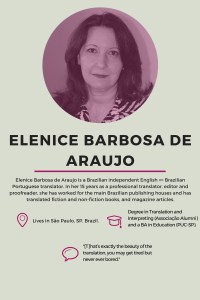
Greatest Women in Translation: Elenice Barbosa de Araujo

^3BD2FAACEAC897D21BE68030808476304DC722B6E37A1C22D8^pimgpsh_fullsize_distr

Welcome back to our Greatest Women in Translation interview series!

Yes, I know, I let you down this past month. No post on the 20. And, this month, I changed the order of the interview and the guest post series; however, there was no guest post either. Let’s see if we can go back on track now.

Now please welcome this month’s interviewee, Elenice, nominated by Nancy Cristina Martorana.


copia-de-elenice-araujo

1. Why not start by telling us how you met Cris Martorana, our last interviewee?

I was blessed to have Cris as my T/I teacher at Alumni. She’s been my English grammar tutor for many years now. I would say she is one of the strongest influences in my career as a linguist. I admire her for her eagerness to find ‘the word’, to learn the precise meaning of any given expression and its equivalent in Portuguese, and how to use it properly. We share the same passion, I guess. She is an extraordinaire teacher and one of the most loving and caring people I know. I was very flattered to be chosen by her.

2. On your CV, you list 42 books you have already translated. On a Google search, I found a reference to your translation of O livro essencial da alimentação infantil. And I can see you translate a lot of nutrition and gastronomy, as well as children books. How did you get to translate for this area?

These are the books I translated that were published. I did a few more that were either intended for private distribution or have never been published. And a couple other translations were sold to other publishing houses and printed under a different title, so I lost track of them. A few days ago I ran into a tittle that seemed familiar only to learn that it’s one of my works. My very first translation job was a fiction book. I’ve got a phone call a week after concluding my T/I course telling me that a fellow student had referred me. Then, by the time I was about to finish it, another fellow colleague who always resorted to me to clarify her culinary doubts referred me to her editor, so I got to translate my first culinary book. After that, I was doing another fiction book when the editor learned that I had a background in Education and had a deep interest for anything related to cooking and nutrition, especially regarding children’s health, and he assigned me a book on nutrition. He’d been looking for someone cut out for it, for quite a long time. That translation brought me at least a dozen more. From there the more I translated the more I learned. Wherever I travelled the first place I would visit on a new city was the supermarket, and the farmers market, and a range of local restaurants. In no time I started choosing my destinations based on the culinary experience they would offer me. The greater the diversity of cuisines I would be exposed to the better.   

3. You are such a diversified professional! Besides translating in several areas of knowledge (biology, parenting, health, children and adult literature, multimedia & TV, advertising, marketing, travel & tourism, education, psychology, sociology, software localization, general business, and the ones I mentioned in the previous question), you also work with editing, copywriting, and proofreading, dubbing, voice over and subtitling. Phew! That’s a lot! How do you manage everything? Do you usually work a bit with each area or do you usually naturally focus on a couple?

It might seem a lot, but it’s been now fifteen and a half years of hard work. And that’s exactly the beauty of the translation, you may get tired but never ever bored. Everyday we are faced with new challenges, and I have taken on quite a lot. In all these years I have never applied for a position nor send my resume without it being asked first; I was always approached by a client who came to me, referred by someone who knew that I was fit for that job. But as much as I’m a hard worker — and believe, I am — I only work on two or three projects at a time. Translating books allows me to keep editing and proofreading for my regular clients at a short notice. I’m used to working long hours a day, so it’s refreshing to take a break from one subject for working on another. Instead of distracting me, I’m able to focus more on the subject at hand. And then I return to the previous activity with fresh eyes, so my ideas flow faster. In fact, I find the exposure to a wide range of themes and to varied tasks extremely helpful for professional growth. For instance, translating a book gives me a broader vocabulary, and improves my fluidity of speech (or of text, if I may). Whereas editing subtitles or doing interpreting training makes my mind sharper, and considerably improves my concision, which in turn is a valuable asset while translating. But needless to say, I follow the golden rule: I would never work on a theme or area I do not feel confortable with, or for which I lack the required skills and/or reliable research tools. Other than that, it is my curiosity, my drive for learning and discovering new things, and my passion for the language itself and its rules, which navigate me through my career. Give me a challenging subject and I’ll gladly immerse myself in it and find my way though the text.

4. And, last year, you also found the time to work, for a semester, at PUC-SP, teaching Translation of Contemporary Texts from Portuguese into English. How was the experience as a teacher? Did you learn anything that you were able to apply to your own profession?

It was a fantastic opportunity. I took the course, and then to my surprise, I was invited by the teacher to fill in for her. I was able to combine my two callings, translation and education. Teaching is always a two-way experience, and the exchange with the students was very enriching. In addition to learning a lot from all the work involved in lesson planning, I also acquired a greater self-awareness as a professional.

5. Last year, you also took the Literary Translation Summer School at the City University of London. Could you tell us a bit more about the course and your experience?

It was one of my ‘student career’ highlights. It consisted of a weeklong hands-on workshop with a selected group of translators — all native speakers, except for me — under the guidance of one of the most important translators of the Portuguese literature, Margareth Jul Costa. As always in my life it was a bold move, but it absolutely paid off. Although short, it was worth a year at a regular course. I can’t wait to go back.

6. Now a personal curiosity. On our e-mail communications, you mentioned you were busy concluding a book. Could you tell us a bit more about it?

Indeed, I just finished another translation, and it was invigorating. New editor, new publishing house, a brand new theme. I was very inspired by it. The author opens her heart to speak to the mothers of young children about the worries and challenges of parenting. And she is so candid about her experiences in life, that women of all ages, mothers or not, can relate to it. In translation there is no such thing as the luxury of a generous deadline, that’s for sure (neither we can afford it). But despite the steady rhythm and the amount of effort to craft a beautiful text, it was the kind of job that reminded me how much I love what I do.

7. Now it’s your turn to nominate a woman you admire to be our next interviewee.

That has to be my dear friend and colleague Naomi Sutcliffe de Moraes, a brilliant and accomplished linguist. I’m sure her interview will be a hit.


I would like to thank Elenice, once again, for accepting Cris Martorana’s nomination and my invitation to be interviewed for our series. Now I cannot wait for Naomi’s.

Greatest Women in Translation: Nancy Cristina Martorana

Welcome back to our Greatest Women in Translation interview series!

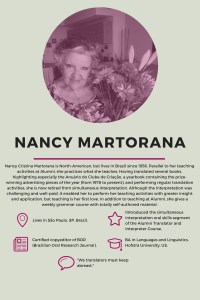
This month’s interviewee is Nancy Cristina Martorana, nominated by Angela Levy.

Welcome, Nancy!


nancy martorana

1. You are American, but moved to Brazil in 1956. Why?
2. Every translator has a different story on how they became a translator. What is yours?

Since the answer to these two questions is interrelated, I will merge my answer.

I came to Brazil with my parents when I was only 10. At the time my Dad was an executive transferred to Brazil from a parent company in the United States. I did my schooling at Escola Graduada de São Paulo, better known as Graded School, and knew early in life that I wanted to pursue a career that involved languages. I had actually been in Brazil before, between the age of 8 months and 16 months, also because my Dad was transferred to Brazil from Romania (where I was born). However, My Dad’s company (ITT) won a bid to install basic infrastructure in Iran (Persia, at the time) and I was to spend the next 3 years in that country. Although it was my first language, I do not remember anything, not even after hearing it spoken by the natives years later. Because of all the countries we moved to, my mother decided to get a French governess, wherever we went to make my language learning more consistent. To make a long story short, I already knew in high school that I wanted to do my college at the translation/interpretation school of Geneva. However, I was rejected because I was too young (minimum age of 18) and had to speak three languages fluently to be accepted. This irritated me immensely to be discriminated, especially because of age. Today, as a teacher, I understand fully – years of experience are needed to pursue a career with any degree of success in translation/interpretation; as I tell my students, layers of knowledge are compacted year after year.

3. Although you teach both consecutive and simultaneous interpreting at Alumni, you have more experience with simultaneous than with consecutive interpreting. Do you prefer one over the other? If so, why? If not, what do you like and dislike in both?

In addition to consecutive and simultaneous interpreting, there are other oral forms, like intermittent and focus groups. Basically, consecutive requires rephrasing and own-writing-deciphering skills and the others are direct delivery of the language. I find consecutive the most difficult of all forms since it requires notetaking and notereading (your own notes!). I have done a total of 3 consecutive interpretations in my career, and although some people do prefer them (to my great surprise), I think that associative learning (memorization of translated word associations) is easier than rephrasing. However, consecutive training is a good learning method.

4. However, you go even beyond and also translate (both technical texts and books). Do you prefer one over the other (translation x interpretation)? If so, why? If not, what do you like and dislike in both?
5. Do you only translate from Portuguese into English (your mother tongue)? Why don’t you feel comfortable translating into Portuguese, even after living for so long in Brazil?

Again I will merge the two ideas since one leads into the other.

Actually, I do not like technical texts or books. If you consider that any text which is not conversational is technical, including literary texts, then I would have to say that I only like certain technical texts, including literary texts, where the technicality comes in knowing the language perfectly. Then, after a translator has sweated many hours looking up technical terms and can say that he/she has relatively mastered the subject, even though he did not do 5 years of college to learn the terminology, he is comfortable enough to say that he likes technical translation, but, mind you, only in that particular subject that he has mastered. I, for one, love to do cosmetics (actually very technical) because I have been translating its terminology for many years, and, even though I don’t know all the terms, I am comfortable to accept, even welcome, the challenge of finding those I don’t know. On the other hand, I will promptly refer any engineering or equipment maintenance texts to my colleagues who now master and welcome these fields, because of their years of exposure.

Books was the second question and my answer was that I don’t prefer them either. I think it all depends on your customer base. All my customers have short deadlines, and I don’t mean “for yesterday,” but short texts, commonly institutional, that don’t take more than a few days to complete. Because of the fast translation turnover of my customer base, I must give anyone wishing to translate a book a l-o-n-g delivery date, since I must translate the book at the same time as I fulfill the translation needs of my regular customer base. Sometimes it works out, and books authors accept the terms.

Lastly, you broached the issue of translation versus interpretation. This depends on one’s personal vision of one’s career. For example, it is difficult to be a teacher and also available for simultaneous interpreting, because you cannot miss too many classes. I saw many students invited to join the Alumni faculty after they graduated, but, since they were excellent interpreters, and the pay is much different, they chose to pursue a better paying and more personally satisfying career in interpretation, and very rightfully so, since they were very good at a very difficult profession. As for me, I was frustrated at the beginning of my profession by a colleague whom I was practicing my Portuguese (and she, her English) with. After scrutinizing my second translation into Portuguese, she had marked my paper with only a dab of red ink. However, all the joy I felt in seeing the few corrections (mostly commas), were abruptly crushed by the words, “It’s all grammatically correct, but it isn’t Portuguese.” I had failed to realize that Portuguese is very nominal, whereas English is very verbal. Now that I know, I can’t really say that it is too late, because my customer base has always been avid for translations into English, which I was better at than Portuguese, so why sweat it?

It is better to go with what you know!

As for the pay, my students reward me in so many other ways; I embrace teaching with great satisfaction – I love to teach; I found my core in teaching translation/interpretation.

6. You introduced the didactic material of the simultaneous interpretation oral skills segment of Alumni’s Translator and Interpreter Course and are responsible for updating it throughout the years. In your opinion, what topics should every interpretation course cover?

Yes, when Alumni added another day to its course to cover oral skills like simultaneous interpretation, I and the teacher responsible for “the other way around,” namely from English to Portuguese, asked how we should put together this course, what should be given. The answer we received was whatever and however we thought best. After many, many, many hours of toilsome thought, I decided that the best place to start was filling in the gaps of what was needed in the original Alumni course (creating a glossary based on the pertinent terminology of the interpretation job) and this led to organizing and managing the target of oral delivery. As mentioned before, I prefer associative learning (memorizing basic translation associations) to what I would call a “philosophical” didactic approach, but admittedly with tips on how to enhance delivery of the know-how.

Updating? Always, since language lives and breathes, always changing and updating itself. We translators must keep abreast.

Topics? Those that all translations and interpretation require, i.e., all involve some degree of marketing, management, economics and business. No matter what the topic, these are always addressed, because we are taking about companies that want to make money selling their wares. Apart from these, interpreters must know a little (or perhaps a lot!, but a little is good for starters, and experience provides the lots) of everything, because one never knows when a lecturer will make an example from a totally different field, or cite a current event from today’s newspaper. We interpreters always have to stay on our toes. For those more interested in literary translations (I would say that you practically have to choose between one or the other), the prerequisite is definitely knowing one’s own language. Even with all my college English and reading, and the many layers of knowledge that I have accumulated over the years, I could never equal this with the same dose in Portuguese, never! Moreover, I have to constantly update myself in my own language, as it lives and breathes at a heartbeat that I passionately desire to grasp.

7. Now it’s your turn. Who do you nominate as our next great woman in translation?

I would have to say it is Elenice Araujo. Hopefully she will accept.


And she has! 😀 Thank you, Nancy, for accepting Angela Levy’s nomination and my invitation, and for kindly taking the time to answer my questions. It was a pleasure to e-meet you!