Guest post: The power of introversion

Welcome back to our guest post series, dear readers!

This month, I’d like you to welcome Greek translator and interpreter Vasiliki Prestidge, from Greek to Me Translations.

Welcome, Vasiliki!

thought-catalog-214785-unsplash

Source: Unsplash

Translators and the secret power of introversion

“Not enough classroom participation.”
“She has the answers to the questions, but she never puts her hand up. The other children are not benefiting.”
“She’s excellent, but she has to try harder to share.”

My parents always received the same feedback from my teachers.

The thing is, there was nothing wrong with me. I was simply an introvert.

There’s so much negativity attached to introversion. So many misunderstandings. Decades later, I am still an introvert. I am also a translator, interpreter, blogger, consultant and founder of Greek to Me Translations. Did my introversion stop me from becoming who I am today? No, to the contrary. It has pushed me in the right direction.

But let’s take it from the start. Reading this, you are probably a translator too. And you may consider yourself an introvert too. Do you feel like not going out, talking to people, or picking up the phone? Are you terrified of conferences, and making contacts during events? Welcome to the world of introversion. Hey, it’s really not that bad.

I want to clarify that I use the word ‘introversion’ within the context of MBTI, the Myers Briggs Type Indicator. Many of you might be familiar with it, some not. In this framework, introversion is not about shyness. It’s about energy. Some people take their energy from others (extroverts) and some from within themselves (introverts). Think of the sunflower; it always turns to the sun. Now think of a cactus; it conserves its energy within it and requires few external stimuli.

Extroversion doesn’t make you better and neither does introversion. However, what makes you the best is a balance of both traits. Naturally, you are more comfortable with one of the two personality preferences. But perhaps, your job or culture has pushed you toward adopting features of the opposite side. These are your coping mechanisms and they are great. They turn you into a fully-grown personality.

But these definitions are not about putting people in boxes and locking them there. They constitute a common language offering you the opportunity to understand yourself, accept your gaps and find ways to develop. Isn’t that liberating?

There are two tools that can help you identify your preferences. MBTI Step I gives you a first taste of your preferences. MBTI Step II allows your palate to discover the full range of tastes. Maybe you know you like fish in general, but you might not like salmon or maybe you cannot eat scallops.

Similarly, there are different facets to introversion. Maybe you are an introvert who enjoys running their business from home, on their own, but you don’t mind initiating conversation with potential clients at events. Maybe you feel uncomfortable getting to events by yourself, but once you are there, you’re fine. Or, you find it difficult to initiate conversation, but once someone starts speaking with you, you cannot stop talking.

Introversion is far more complex than we think, and it certainly doesn’t put you in an inferior position. Did you know that introverts make the perfect freelance entrepreneurs and great leaders? Introverts thrive in solitude. They read others and they can listen. I mean they can properly listen.

Then thinking of marketing ‒ an important side of running a business ‒ social media has empowered introverted entrepreneurs to share without feeling exhausted. And did you know introverts are better with social media? That’s because they focus on the internal ideas and feelings which means they are more likely to process before publishing. And that sometimes is truly valuable.

But of course, having the best of both worlds requires effort. The first step to achieving balance is acceptance. Accept you are an introvert and that that’s OK. Then, you invest in understanding your introversion. Everyone is different. We all come from different backgrounds and cultures. Sometimes, a temporary life event could be impacting your core personality preferences. So, self-awareness is key.

Then, you can start learning. And you can learn from extroverts. Think of those instances where being an extrovert could benefit you. Do you have gaps? Identify your goals and keep them in a notebook. This can become your extroversion workbook. The important thing to remember is that you can’t do too much too soon. And by that, I mean take it one step at a time.

For example, if your biggest challenge in running your business is networking with potential clients at conferences or trade fairs, then start small. Go to a local meet-up. Find an event with fewer people. Then, you scale up. Find your “event-buddy”; someone you go to events with. But be careful as this is dangerous. You may end up talking only to your “event-buddy” and that’s not helpful.

And remember, you are definitely not alone in this. I have a secret suspicion that most translators are introverts. So, give yourself a pat on the back. Don’t forget your natural preferences. Allow yourself quiet, me-time. It’s how you thrive.

Do you feel exhausted after a 2-day conference? I’ll let you into a secret: most people do. Don’t beat yourself up. You have the secret power of introversion. Own it.

About the author
VasilikiVasiliki Prestidge is a Greek into English and English into Greek translator and interpreter. She specialises in legal, marketing and psychometrics. She is an MBTI Step I and Step II qualified practitioner. She is the founder of Greek to Me Translations and blogs on www.grtome.com/blog. She often gives webinars and talks in conferences and she enjoys networking. (Believe it or not, she is an introvert). You can follow her on Facebook, Twitter, LinkedIn and Instagram.

Inscreva-se no Congresso da Abrates e concorra a dois sorteios!

E aí, galerinha, já fizeram a inscrição para o próximo Congresso da Abrates? Eu já garanti a minha no early bird, mas não se preocupe! Tenho ótimas notícias!

Fiz uma parceira com os organizadores do congresso e com meus parceiros de divulgação de conteúdo, a Translators 101 e o Descomplicando o Inglês Jurídico. Veja o que temos a oferecer a vocês, seguidores de todos os meus canais:

– Valor do segundo lote garantido até o dia 30 deste mês (o segundo lote normal vai até o dia 12 apenas).
– Participação em dois sorteios:

  • e-Book Peças processuais em inglês e sua tradução, do Descomplicando o Inglês Jurídico, de R$ 199,00 por apenas R$ 1,99.
  • Acesso gratuito ao evento online imperdível de dublagem que será realizado pela Translators 101 no dia 29 de junho, com Mabel Cezar e Rayani Immediato, e a uma palestra gravada de eventos passados a ser escolhida pelo sorteado.

O sorteio e a entrega dos prêmios serão realizados durante o Congresso da Abrates por mim e pelos meus respectivos parceiros, Bruna Marchi e William Cassemiro, que tão gentilmente aceitaram oferecer esses presentes especialmente para vocês!

O 10º Congresso da Abrates será realizado de 31 de maio a 2 de junho no Bourbon Convention Ibirapuera Hotel em São Paulo. Alguns palestrantes já confirmaram presença, inclusive internacionais! Dá uma espiadinha aqui.

Para concorrer aos dois sorteios e aproveitar o valor de segundo lote, faça sua inscrição pelos links abaixo (respectivo à sua categoria):

Associado da Abrates: https://pag.ae/7UMShv1-m
Não associado da Abrates: https://pag.ae/7UMShX3zm
Estudante/Idoso: https://pag.ae/7UMSis82G

Para validar sua inscrição e participar do sorteio, envie o comprovante de pagamento do PagSeguro e seus dados (nome completo, CPF, RG, data de nascimento e endereço completo) para o e-mail congresso2019@abrates.com.br com o assunto PROMOÇÃO ALBERONI. Informe também se participará da escala de intérpretes e se tem alguma necessidade especial.

Dia 21 embarco para a Europa de férias e para participar de dois congressos (apresentarei palestra em um deles), mas reorganizei toda a minha viagem para que eu conseguisse voltar a tempo para o Congresso da Abrates. Portanto, espero ver você lá, hein?

Espero que tenham gostado do presentinho especial que eu e meus queridíssimos parceiros oferecemos a vocês. Aproveitem! E nos vemos no congresso!

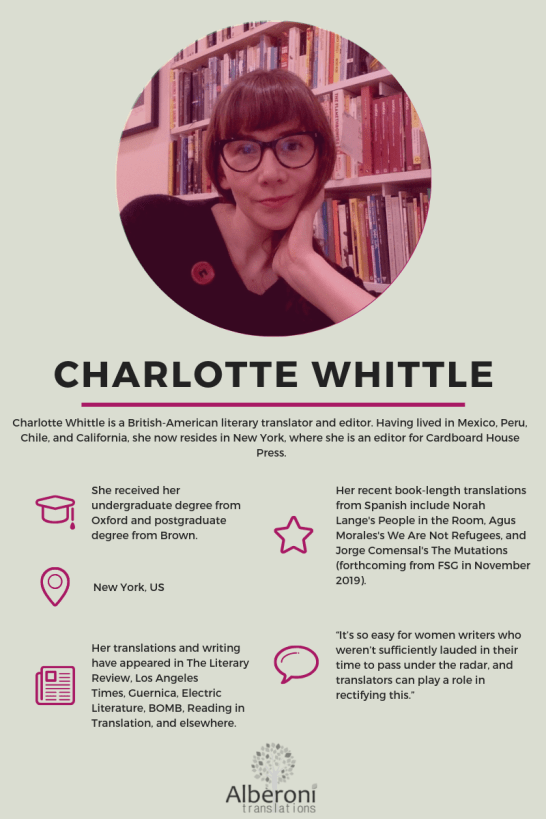
Greatest Women in Translation: Charlotte Whittle

^3BD2FAACEAC897D21BE68030808476304DC722B6E37A1C22D8^pimgpsh_fullsize_distr

Created by Erick Tonin

Welcome back to our Greatest Women in Translation interview series, dearest readers!

This month, our Great Woman in Translation is the British-American literary translator Charlotte Whittle, nominated by Julia Sanches.

Charlotte Whittle

Created with Canva

1. I always love to learn about translators’ beginnings in translation. How about starting by telling us yours?

My path into translation wasn’t exactly a linear one. I grew up in a monolingual family, learned Spanish in Mexico when I was 18, studied Spanish and literature in college in the UK, and lived in Peru and Chile. The first translations I remember doing were of César Vallejo, when I was still an undergraduate. I was living in Peru and became obsessed with his work. Translating poems seemed to me like the best way to engage with them, to get inside them and see how they worked, and there was something really thrilling about making them breathe in another language. A couple of years later, I did a diploma in translation studies in Santiago de Chile, but this was an experience that closed doors as well as opening them. My final project was a translation of a story by the great Peruvian writer José María Arguedas. I was so happy thinking about and doing translation, but I remember the instructor saying in very clear terms that it was impossible to make a living from literary translation. Being young and inexperienced, I took his word for it, and I didn’t pursue translation seriously for a long time after that. I took the academic route, and translated poems for fun. I discovered that I loved teaching, but after a few years, I found it didn’t leave me enough time for creative projects. I finally realized that translation was the activity that brought my skills, experience, and interests together under one umbrella, and that was when I decided to make it my focus, despite the dire warnings of penury.

2. Could you tell us why your translation of Norah Lange’s People in the Room can be considered important for the gender imbalance in literature?

The data collected on this subject – for instance, by the Three Percent Translation Database, now housed by Publishers Weekly – tells us that of all the books translated into English, as many as three fourths are by men. Why is this? Partly because of the implicit bias that male writers are somehow more “important,” partly because of the lack of gender parity in publishing in other countries as well as our own, and partly because, while women translators translate both men and women nearly to equal degrees, male translators seem to be more disposed towards translating men.

 People in the Room was published in English 68 years after it first appeared in Spanish; during that lapse, Lange received significantly less critical attention in her home country than her male peers (who were also more often translated), despite the importance of her writing. It’s so easy for women writers who weren’t sufficiently lauded in their time to pass under the radar, and translators can play a role in rectifying this. Obviously, I’m not claiming to be able to shift the canon with a single translation, but the fact that I was able to find a publisher for this novel and that Lange’s work has been well received in English, demonstrates that there has been a small change in the tide, at least in the world of literary fiction in translation. I think there is more interest than there’s been in the past in projects that draw attention to women writers who’ve been overlooked. Recent books such as The Houseguest by Amparo Dávila, translated by Audrey Harris and Matt Gleeson, and The Naked Woman by Armonía Somers, translated by Kit Maude, are further evidence that there is now an audience for this kind of work. All these projects are significant because they go some way towards rebalancing the gender inequality in translation. Of course, there’s a lot more to be done and there are multiple forces at play, but things are slowly evolving in a positive direction.

3. You are currently working on the translation of Jorge Comensal’s The Mutations. Do you feel there are any particularities between translating men x women?

Norah Lange and Jorge Comensal could hardly be more different: People in the Room is somber and full of mystery, while The Mutations is satirical and hilarious, but I would trace differences between authors to geographic region, time period, and individual authors’ concerns and idiosyncrasies before making sweeping statements about gender differences. In the cases of both these books, their style captivated me, I felt a deep, personal draw to their subject matter, and an urgent need to share them with English-language readers. In terms of the practicalities of the two translations, perhaps the biggest difference was that one author was dead and the other alive. Sometimes, when translating Lange, I wished I could hold a séance, or a table-tapping session like the one described in her book, just to be able to ask her if she thought I was on the right track. In contrast, I talk to Jorge often, and think our conversations have enriched the translation process. But to go back to the question of gender, the concerns and idiosyncrasies that make writers unique may result from their experience, and gender can certainly be a factor in that. A woman writing in the mid-C20th is working under a different set of constraints than a man writing in the present. As a translator, I think about gender less in terms of the characteristics of the writing, and more in relation to the conditions that determine how writing by men and women is read and received, and the conditions that allow them to write in the first place.

4. Could you also talk a bit about your translation of Agus Morales’ We are not Refugees?

Morales is a Spanish journalist who has spent most of a decade gathering the stories of members of displaced populations in different parts of the world. We Are Not Refugees is the result of his intensive exploration of the factors that cause mass migration, and the real-life experiences of those who are forced to flee. The book describes the situation of multiple displaced communities: Central Americans fleeing northwards from violence, Afghan and Syrian refugees in Turkey, internal displacement in the Central African Republic and South Sudan. Few writers have such breadth of experience when it comes to mass migration, and Morales identifies the specifics of a range of cases, while also finding commonalities between them. He writes movingly of his subjects, while letting those he encounters tell their own stories, so readers can get to know some of the faces behind the headlines to which we are often numb. I came away from this project with so much admiration for writers and journalists who have the emotional stamina to tell these stories in a clear-eyed manner.

5. What have you learned so far about being a (literary) translator that you could pass on to newbies?

I’m still learning! But here are a few things that come to mind: I’ve learned that it’s difficult, but not impossible, to pay your bills as a translator; that there are many different ways a book can happen; that there’s no limit to how much a translation can change during the first few drafts; and that the editor is not the enemy.

But the most important thing I’ve learned so far is that as translators, we have to create our own community.

Translating books requires hour after hour of solitary work, week after week, month after month. Without an office to go to or a cohort of colleagues you see every day, it can get lonely. That’s why I’m so incredibly grateful for my translation colleagues, both in New York and further afield. I have regular workshops with translator friends where we discuss everything from tricky sentences to how to collectively improve working conditions for translators. It’s important to see your colleagues as allies rather than competitors, and the brilliant and fascinating people I’ve met through this work are one of the things I most treasure about it.

6. Now it’s your turn to nominate our next Great Woman in Translation.

I’m nominating Robin Myers, a translator from Spanish based in Mexico City. Robin is a tireless translator of poetry and prose, and an extraordinary poet in her own right. I recently devoured her translation of Empty Pool, a collection of gorgeous, luminous essays by Isabel Zapata. I also had the pleasure of editing her translation of Ezequiel Zaidenwerg’s Lyric Poetry Is Dead for Cardboard House Press, where we publish bilingual editions of Latin American Poetry. Robin’s handling of rhythm and meter in that collection is a masterclass – I’ll leave it to her to tell you more about it!

Robin’s interview will be published on June 3, as I’ll be on vacation from April 20 to May 19.