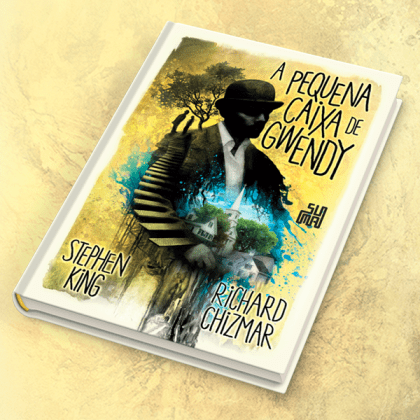
Guest post: Stephen King e sua tradutora

42581041_10155514029641050_5189709919783223296_n

Crédito: Editora Suma

O mundo sombrio de Stephen King

Desde 2013, minhas aventuras por esse mundo ganharam uma nova dimensão; no entanto, já o frequento há muitos anos, desde bem antes de pensar em ser tradutora. Quando ainda adolescente, descobri o autor por acaso, em um conto publicado na revista Speak Up, e mesmo aos 14 anos fiquei tão fascinada com a capacidade do autor de se aventurar pela natureza humana usando elementos de terror que simplesmente tive que descobrir mais.

Esse conto se chamava “The Boogeyman” e foi publicado no Brasil com o título “O fantasma”, parte da coletânea de contos Sombras da noite (tradução de Adriana Lisboa). Três décadas se passaram e eu ainda acho esse conto uma das coisas mais incríveis que ele escreveu. Tenho certeza de que há pessoas pensando: “Natureza humana? O cara é escritor de terror!” Mas essa foi uma das descobertas mais incríveis que eu fiz e que tenho certeza de que muita gente não fez por preconceito: o terror do King não é de medinho, sustos e sangue (embora alguns desses elementos costumem estar presentes nas histórias). Porque, afinal, o que realmente pode dar medo não é um fantasma, um monstro, um alienígena. A coisa mais assustadora que existe no mundo é o homem.

Em 2013, recebi a proposta de traduzir It – A coisa, que é uma das obras icônicas do autor. É um calhamaço de pouco mais de mil páginas que conta sobre o horror que assola uma cidadezinha do estado do Maine, nos Estados Unidos, e um grupo de sete crianças que se juntam pra combatê-lo, com trechos se revezando num intervalo de quase três décadas, quando as mesmas crianças, agora adultas, voltam à cidade para o embate final. Para os desavisados, para os que conhecem apenas a capa, para quem viu o trailer do filme, parece a história de um palhaço assassino. Mas It aborda horrores muito mais sombrios: homofobia, violência doméstica, abuso infantil, abandono, racismo, tantos desses horrores humanos dos quais a gente sempre ouve falar e que são sempre contemporâneos e familiares.

O trabalho hercúleo de traduzir um original com 450 mil palavras trouxe frutos; logo vieram outros livros do autor, que eu já admirava tanto e conhecia tão bem. Mas conhecia mesmo? A sensação que tive foi de que comecei a examinar Stephen King com uma lupa, em vez de apenas com meus olhos. Comecei a desbravar nuances, detalhes, recursos, e a conhecer o autor por um viés diferente. A conta até o momento é de 11 livros, um conto gratuito disponível online aqui e o prólogo e o epílogo nunca publicados anteriormente de O iluminado (tradução de Betty Ramos de Albuquerque), que saíram na edição pertencente à coleção Biblioteca Stephen King. O trabalho continua firme, pois o King não para: em 2019, teremos mais.

Curiosamente, quando comecei a leitura, láááá na adolescência, o que mais me fascinava era mesmo o terror puro e simples; meu eu adolescente queria descobrir como sentir medo, os monstros que poderiam tirar meu sono. (Spoiler: não deu certo, eu não sinto medo de monstros.) Acredito que se não houvesse esse outro lado mais profundo nos textos dele, eu teria deixado seus livros para trás, como deixei alguns outros autores; mas a questão da natureza humana é a que mais me fascina agora e é o que me prende quando trabalho em um livro como Outsider, por exemplo, em que um policial eficiente e prático é obrigado a enfrentar suas crenças quando se depara com um assassinato brutal e um assassino improvável, ou como Belas adormecidas, que trata do papel da mulher na sociedade por meio das estruturas habituais e conflitantes de comunidades pequenas (no caso, uma prisão feminina e uma cidade) que são recorrentes do King. A propósito, poucos constroem personagens como o King, e poucos os matam como ele.

Para quem gosta de ler, mas nunca se animou a enfrentar os calhamaços habituais do autor, seja pelo tamanho ou pelo tema, sugiro que experimente. Vale começar por um dos pequenos que fogem da linha terror, como Joyland, ou pelos livros de contos, como Bazar dos sonhos ruins ou o próprio Sombras da noite, que são um ótimo portão de entrada para entender como funciona a cabeça e o estilo dele. Ah, e uma última dica: não usem os filmes baseados nas obras como parâmetro para avaliar os livros, pois eles raramente abordam o viés humano dos personagens que encontramos nas histórias.

Enquanto o autor continuar escrevendo, espero continuar traduzindo seus livros, até o dia em que, quem sabe, os horrores humanos estejam mais próximos da ficção sobrenatural do que da realidade do nosso cotidiano.

Sobre a autora

13346792_1198107916880645_2973286513876119150_nRegiane Winarski é formada em Produção Editorial pela ECO-UFRJ e tradutora de inglês para português desde 2009. Especializada em tradução literária para editoras como Suma, DarkSide, Rocco, Intrínseca, Record e outras, com mais de cem livros publicados. Trabalha com uma ampla variedade de gêneros, como fantasia, suspense/horror e romances para adultos e jovens adultos, de autores como Stephen King, Rick Riordan e David Levithan. Tradutora do premiado livro de 2017 “O ódio que você semeia”, de Angie Thomas, publicado pela Galera Record.

Greatest Women in Translation: Heather Cleary

^3BD2FAACEAC897D21BE68030808476304DC722B6E37A1C22D8^pimgpsh_fullsize_distr

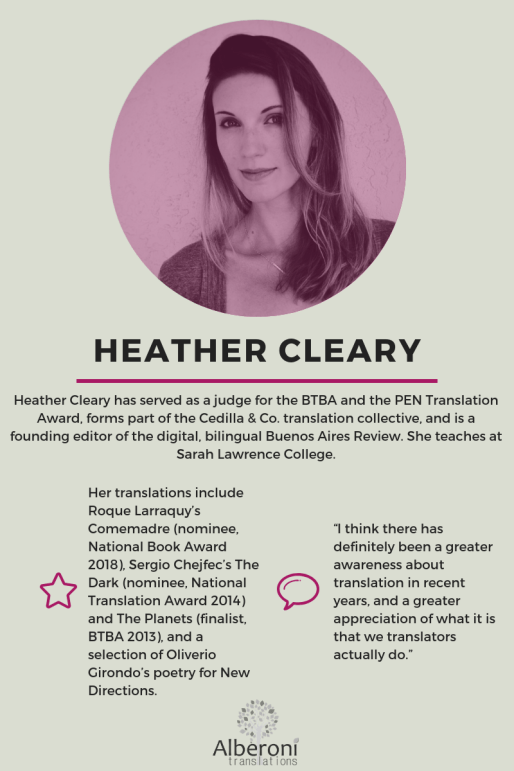
Image created by Érick Tonin

Welcome back to our amazing Greatest Women in Translation interview series!

Please welcome this month’s interviewee, Heather Cleary, Spanish into English literary translator nominated by Allison Markin Powell.

Heather Cleary

Image created with Canva

1. First of all, it’s a pleasure to be talking to one of the nominees for the inaugural National Book Awards in the category of Translated Literature. Congratulations, Heather! Could you tell us a bit more about the book that rendered your nomination, Comemadre, by Roque Larraquy?

Thank you for the invitation! And for your kind congratulations. Roque and I are very excited about the NBA nomination; the longlist is full of wonderful books that your readers might enjoy checking out. Comemadre is a short novel—very dark, very funny—about our collective obsession with progress and with leaving our mark on the world; it’s about hubris, violence, and love (specifically, the violence inherent to different kinds of love). The title refers to a plant that releases carnivorous spores, which plays a key role in each section.

Comemadre is divided into two parts, the first of which takes place in 1907 in a sanatorium near Buenos Aires, Argentina. A group of doctors has decided to experiment on unwitting test subjects to determine what happens in the moments after death (I don’t want to ruin any surprises, but there are guillotines involved). When they’re not trying to swindle their patients into signing away their lives, these men are busy stabbing one another in the back professionally and romantically; a number of them are infatuated with Ménendez, the Head Nurse. Unsurprisingly, things end badly. We then flash forward a hundred years to drop in on an artist who made a name for himself with a piece involving a two-headed baby, and then teamed up with his doppelgänger to develop performance pieces that involve physical mutilation. Think Damien Hirst on acid. This second part of the novel addresses, through the lens of art, many of the ethical and philosophical questions raised in the first section through science.

This book was extraordinarily fun to translate. It’s grotesque, insightful, and perversely hilarious. It’s full of dirty puns, which I love, and presented other interesting challenges. For example, the “oracles” in the first section of the book occasionally blurt out snippets of text from the second section; finding a way to make this continuity clear without giving too much away or slipping into anachronism was a delightful puzzle.

2. After having two Japanese translator nominees, Allison Markin Powell and Ginny Takemori; a Scandinavian, Nicky Smalley; and a German translator, Jen Calleja, we are back to Latin language translators with you, who translates from Spanish. How did your connection with Spanish start?

It was peer pressure, really. I was in seventh or eighth grade, I think, and my friends were studying Spanish at school. So I joined them. But most of them stopped after a year or two, and by that time I had already fallen in love with the language. I studied it straight through high school, then spent the following summer (and a semester in college) in Spain. After that, I spent some time in Mexico, and later lived in Buenos Aires for almost two years. I kind of stumbled into literary translation in a similar way: I had been frustrated with the shape my undergraduate honors thesis was taking when Richard Sieburth, a professor in the department of Comparative Literature at NYU and a gifted translator of French and German, suggested I switch gears and try my hand at translation. I was immediately hooked, and ended up organizing my life around my desire to do more of it.

3. I noticed your name is placed in a highlighted position on the cover of Comemadre. As far as I know, not all publishers display the translator’s name on the cover, right? At least not in Brazil. So, besides being on the cover, you are highlighted! This is fantastic! Do you think this is something that has been changing lately? What role do translators play in convincing publishers to recognize the translator on the cover of translated books?

Thanks! It has been an absolute delight to work with Coffee House; it really is a press that values translation. As for how common it is here to note the translator’s name on the cover, it varies from publisher to publisher, with independent presses tending to be a bit more open to the idea than the bigger houses. There are always exceptions, though. I think there has definitely been a greater awareness about translation in recent years, and a greater appreciation of what it is that we translators actually do. For this, we have a number of vocal advocates and organizations, like the PEN Translation Committee, to thank.

4. I have already heard of the Japanese term ikigai, which is about finding your purpose in life. Now I see you translated a book called Ikigai: The Japanese Secret to a Long and Happy Life, by Héctor Garcia and Francesc Miralles, also from Spanish. Something interesting is that the authors describe the term as “the happiness of always being busy.” Now I am curious. Could you tell a bit more about this book?

Héctor García and Francesc Miralles both spent time in Japan and discovered a shared fascination with certain aspects of the culture there, above all with the value placed on staying active and engaged with friends and family in some of the longest-living communities in the country. In the book, they combine their personal experience talking with centenarians in Okinawa with research from different parts of the world into the benefits of staying active by finding a passion to pursue. From what I understand, the book has done very well.

5. The books you have already translated vary from non-fiction, fiction and poetry, in diverse topics. Do you have a favorite genre?

I wouldn’t say I have a favorite genre, necessarily, but rather that there are certain things I look for in a project. I love working on books that are linguistically complex in one way or another: one of my earliest translation projects was of the work of an avant-garde poet from Argentina named Oliverio Girondo. His later collections are full of neologisms and derive much of their meaning from the sound of the words, the way they ricochet off one another. Sergio Chejfec’s novels are marked by long, intricate sentences that require juggling nested clauses, and Roque Larraquy’s Comemadre, as I mentioned above, is full of puns and wordplay. In this last case, I also enjoyed the challenge of establishing two distinct narrative voices that evoked two very different historical moments. One of the writers I’m working with now, Fernanda Trías, is fascinating for a different reason: she writes emotionally charged narratives with absolute restraint and precision.

6. You are a founding editor of the digital, bilingual Buenos Aires Review, where I found a link to Brasília, among other worldwide cities, and other fiction writings from Brazilian authors. Could you tell us a bit more about this project?

Ah, the BAR! I’m very proud of the work we’ve done, though our production schedule has slowed down [clears throat] significantly. In late 2011, I picked up and moved to Buenos Aires, where Jennifer Croft (winner of this year’s International Man Booker Prize for Olga Tokarczuk’s Flights) was living. She and I spoke extensively about all the wonderful writers around us who were entirely unknown to readers of English; we decided that we wanted to do something about it by creating a platform that was more nimble than print publishing, and able to take more risks. She then invited the writer Maxine Swann, who also lives in Buenos Aires, to join us, and Maxine brought in Pola Oloixarac. And so the magazine was born. It was our hope that it would serve as a launching pad for writers and translators, alike; we’ve also had the privilege of publishing new work by luminaries like Ishion Hutchinson, Ada Limón, Mario Bellatin, and Carol Bensimon. We started with a focus on creating an exchange between English and Spanish, and then broadened our scope to include Portuguese, Chinese, German… the list goes on. Every text on the website appears in at least two languages. It has been a (huge) labor of love that wouldn’t have been possible without our rock star editors, Martín Felipe Castagnet (whose Bodies of Summer was published last year by Dalkey), Lucas Mertehikian, Andrea Rosenberg (see Aura Xilonen’s The Gringo Champion, among her many fabulous translations), and Belén Agustina Sánchez.

7. Now it’s your turn to nominate our next Great Woman in Translation.

I’d like to nominate Elisabeth Jaquette, who—in addition to being a brilliant translator from the Arabic—is also a vital part of the translation community as the Executive Director of the American Literary Translators Association (ALTA)… and as a member of the Cedilla & Co. translators collective, of course. Her work has been shortlisted for the TA First Translation Prize, longlisted for the Best Translated Book Award, and supported by PEN/Heim and several English PEN Translates Awards