Brazilian women writers translated into English

August is Women in Translation month.

The project was created back in 2014 by Meytal Radzinski to raise awareness of women writers translated into English.

Inspired by her and her project, I decided to create our own “Brazilian women writers translated into English” list to raise awareness of Brazilian literature written by women translated into English.

Here’s the list of 44 authors (in alphabetical order) and (some of) their translated books kindly suggested by people on social media:

1. Adriana Lisboa
Translated books and their translators: Crow Blue, Alison Entrekin; Hut of Fallen Persimmons, Sarah Green; Symphony in White, Sarah Green.

Read Alison Entrekin’s interview in my Greatest Women in Translation series here.

2. Alice Brant
Translated book and its translator: The Diary of “Helena Morley,” Elizabeth Bishop.
Interesting fact: This was the only book written by Alice under the pen name Helena Morley. It’s a diary she started writing when she was 13. Her book is considered one of the best Brazilian literary works of the 19th century.

3. Alice Sant’Anna
Translated book of poems and its translator: Tail of the Whale, Tiffany Higgins.

4. Ana Cristina Cesar
Translated book and its translators: At Your Feet, Brenda Hillman, Helen Hillman & Sebastião Edson.

5. Ana Maria Machado
Translated books and their translators: The History Mistery, Luisa Baeta; Me in the Middle, David Unger; From Another World, Luisa Baeta.
Interesting fact: Ana is also a translator and has translated Alice in Wonderland into Brazilian Portuguese.

6. Ana Miranda
Translated book and its translator: Bay of All Saints and Every Conceivable Sin, Giovanni Pontiero.

7. Ana Paula Maia
Translated book and its translator: Saga of Brutes, Alexandra Joy Forman.

8. Angélica Freitas
Translated book and its translator: Rilke Shake, Hilary Kaplan.

9. Beatriz Bracher
Translated book and its translator: I Didn’t Talk, Adam Morris.

10. Camila Fernandes
Translated short stories and their translator: The Other Bank of the River, Christopher Kastensmidt; The Best of the Three, Christopher Kastensmidt.

11. Carol Bensimon
Translated book and its translator: We All Loved Cowboys, Beth Fowler.

12. Carola Saavedra
Translated book and its translator: Blue Flowers, Daniel Hahn (coming on January 2020).

Read Daniel Hahn’s guest post about the TA First Translation Prize here.

13. Carolina Maria de Jesus
Translated book and its translator: Child of the Dark: The Diary of Carolina Maria de Jesus, David St. Clair.

14. Cecília Meireles
Interesting fact: Cecília was also a translator.
P.S.: I couldn’t find any formal translation of her works. Feel free to comment below if you know any.

15. Clarice Lispector
Translated books and their translators: The Besieged City, Giovanni Pontiero; The Chandelier, Benjamin Moser & Magdalena Edwards (read this!); Near to the Wild Heart, Alison Entrekin; A Breath of Life, Johnny Lorenz; The Passion According to G.H., Ronald W. Souza; Complete Stories, Katrina Dodson; The Apple in the Dark, Gregory Rabassa; An Apprenticeship, or, The Book of Delights, Richard A. Mazzare; Discovering the World, Giovanni Pontiero; The Hour of the Star, Giovanni Pontiero; The Stream of Life, Elizabeth Lowe & Earl Fitz.
Interesting fact: Clarice “was one of the first Brazilian women to graduate from law school and to become a journalist.” “Being famous for her striking beauty did not make her popular, which mattered to a woman whose talent was proportional to her sensitivity.” She’s the most widely translated and the best known woman writer in Brazil.

16. Dinah Silveira de Queiroz
Translated books and their translators: Christ’s Memorial, Isabel do Prado; The Women of Brazil, Roberta King.

17. Edla van Steen
Translated book and its translator: Village of the Ghost Bells, David George.

18. Eliane Brum
Translated books and their translators: The Collector of Leftover Souls: Field Notes on Brazil Everyday, Diane Grosklaus Whitty; One Two, Lucy Greaves.

Read Diane Grosklaus Whitty’s interview in my Greatest Women in Translation series here.

19. Fernanda Torres
Translated books and their translators: Glory and Its Litany of Horrors, Eric M. B. Becker; The End, Alison Entrekin.

20. Helena Parente Cunha
Translated book and its translator: Woman Between Mirrors, Fred P. Ellison & Naomi Lindstrom.

21. Hilda Hilst
Translated books and their translators: With My Dog Eyes, Adam Morris; The Obscene Madame D., Nathanaël & Rachel Gontijo Araujo; Letters from a Seducer, John Keene.

22. Lya Luft
Translated books and their translators: The Island of the Dead, Carmen Chaves McClendon & Betty Jean Craige; The Red House, Giovanni Pontiero.

23. Lygia Fagundes Telles
Translated books and their translator: The Girl in the Photograph, Margaret A. Neves; The Marble Dance, Margaret A. Neves.

24. Lygia Nunes
Translated books and their translators: The Companions, Ellen Watson; My Friend the Painter, Giovanni Pontiero.

25. Maria Esther Maciel
Translated stories and their translator: The Meanings of Yellow, Daniel Hahn; The Voice of Silence, Daniel Hahn.

26. Marilene Felinto
Translated book and its translator: The Women of Tijucopapo, Irene Matthews.

27. Marília Garcia
Translated poems and their translator: It’s a Love Story and It’s About an Accident, Hilary Kaplan; Love Story, A-Z, Hilary Kaplan.

28. Martha Batalha
Translated book and its translator: The Invisible Life of Euridice Gusmao, Eric M. B. Becker.

29. Maurinete Lima
Translated poems and their translators: Fear and Its Trajectory, Flávia Rocha & Eric M. B. Becker; Sinhá Rosa; Flávia Rocha.

30. Nélida Piñón
Translated books and their translator: The Republic of Dreams: A Novel, Helen Lane; Caetana’s Sweet Song, Helen Lane.
Interesting fact: Nélida was the first woman president of Academia Brasileira de Letras.

31. Nikelen Witter
Translated work and its translator: Mary G., Christopher Karstensmith.

32. Nina Rizzi
Translated poem and its translator: Mermaid in the Glass of Water, Rafaela Miranda.

33. Noemi Jaffe
Translated book and its translator: What are the Blind Men Dreaming?, Julia Sanches & Ellen Elias-Bursac.

Read Julia Sanches’ interview in my Greatest Women in Translation series here.

34. Patrícia Galvão
Translated book and its translator: Industrial Park: A Proletarian Novel, Elizabeth Jackson & Kenneth David Jackson.

35. Patrícia Mello
Translated books and their translator: The Body Snatcher, Clifford E. Landers; Black Waltz, Clifford E. Landers.

36. Paula Parisot
Translated book and its translator: The Lady of Solitude, Elizabeth Lowe & Clifford E. Landers.

37. Raquel de Queiroz
Translated books and their translators: The Three Marias, Fred P. Ellison; Dora, Doralina, Dorothy Scott Loos; The Three Marias, Fred P. Ellison.
Interesting fact: Raquel was also a translator.

38. Regina Rheda
Translated book and its translator: First World Third Class and Other Tales of the Global Mix, Adria Frizzi.

39. Socorro Acioli
Translated book and its translator: The Head of the Saint, Daniel Hahn. (I read it in Portuguese and loved it! It’s a nice reading.)

40. Stella Car Ribeiro
Translated book and its translator: Sambaqui: A Novel of Pre-History, Claudia Van der Heuvel.

41. Tatiana Salem Levy
Translated book and its translator: The House in Smyrna, Alison Entrekin.

42. Veronica Stigger
Translated book and its translator: Opisanie Swiata, Zoë Perry.

43. Zulmira Ribeiro Tavares
Translated book and its translator: Family Heirlooms, Daniel Hahn.


Hope you like it. If you read any of them because you saw this post, feel free to come and tell us know what you thought of it.

Do you know any other Brazilian women authors with books translated into English? Let us know in the comments below and I’ll add them to the list above.

And make sure to keep an eye out on the hashtag #WiTmonth on Twitter and on Meytal’s list of #100BestWIT, with women authors from all over the world translated into English.


Suggested reading:
Latin American Women Writers: A Resource Guide to Titles in English, by Kathy S. Leonard
One Hundred Years After Tomorrow: Brazilian Women’s Fiction in the 20th Century, edited and translated by Darlene J. Sadlier
Fourteen Female Voices from Brazil, interviews and works selected and edited by Elzbieta Szoka
Wikipedia’s List of Brazilian Women Writers
Benjamin Moser and the Smallest Women in the World, by Magdalena Edwards, Clarice Lispector’s translator, on men taking credit for women’s work
Guest post: Website copywriting

Welcome back to our guest post series, dear readers!

I hope your August is going well so far. Remember it’s Women in Translation month and help support the campaign and spread the word about it. For more information, follow the hashtag #WiTmonth on Twitter. And stay tuned, because my post this month (to be published on the 20th) will be special about it.

Now, let’s welcome this month’s guest, Tanya Quintieri, who is a partner of my monthly newsletter and whom I had the pleasure of meeting back in May this year, during the BP19 Conference, in Bologna, Italy.

Welcome, Tanya!

MrsDivi_Featured-Image_Website-Copy-101

Image provided by the author

Mrs. Divi about writing website copy

First, let me thank you for clicking the link to this post. It means a lot to me to be featured on Caroline’s blog. After all, we read all the big names here and I am honored to join their ranks.

Aside from being a translator (since 2002 — gosh, now I feel old), I am also a web designer and my background is in marketing. In fact, back in 2010, one of my first freelance spinoffs was a consulting agency for social media marketing. Our clients were businesses looking to harness the benefits of social media.

Fastforward to today, I coach my web design clients in writing compelling copy for their websites. I hear you… Why not just hire a copywriter? Well, truth is, most already have perfect copy. They just need a little help adapting it for their websites. As a medium, websites work differently from paper (brochures, social media profiles, etc.). One aspect is SEO. But to me, and this is far more important, focusing on UX is decisive.

But what is UX?

Well, it stands for ‘user interface’. Some even call it ‘user experience’. And that’s the term I’d like to stick to now.

To be found on Google is a noble goal. But doing business online is about more than just being found. Just because someone lands on your website doesn’t mean that they will actually buy from you. I always smile when clients come to me and say: The goal for my website is to land on page one of a Google search when people search for my keywords. To be honest, if you know what you’re doing in SEO, that is the easier part. Actually, converting those website visits is the holy grail. And it’s hard.

Converting visitors with the power of copywriting

Your ultimate goal is to guide your visitors from that first moment they land on your website. Be it through a Google search or by clicking a link to your blog post.

For the latter, it might seem reasonable to ask your visitors for a comment. But that won’t pay your rent. And if your content is worth commenting (i. e. their time), then they will comment or share anyway, even without you asking them to do so explicitly.

For the former, it’s pretty much evident that you won’t turn them into a customer or client after the first visit. Provided they are not pressed for time and their options are thus limited.

What you will want to achieve is the possibility to nurture them as leads. Ask them to sign up to your email list. Offer a freebie that solves their most pressing problem. Get them to book a call with you.

Writing your copy cleverly, with that user experience in mind, you are more likely to gain their attention in the long run. A clever marketing pro once said that a conversion bases on “know, like, trust”. Which is why it usually takes seven touch points for your potential clients or customers to buy from you.

Again, guide your website visitors. From your Home page to your Services/Product page. From your Blog page to your Resources page. From your About page to your Subscribe/Buy page.

“Do this or that” won’t cut it here. Ask questions. Engage your visitors. Rather than saying “Subscribe to my newsletter”, ask them “Are you ready to up your game in Spain?”

Writing copy for a translator’s website

Assuming that your website is up there to attract direct clients (because we all know that agencies have their own onboarding procedures and ask for CVs), focus on how you can make their lives easier. Envision the person looking for what you have to offer. Don’t dwell on diplomas and CAT tools. Explain how your offering saves them time (and thus cash), state that you are responsive, ensure them that you know their business sector (if you are specialized), take away their pain. No direct client wants to see your CV in more words when they come to your website. They want to know how you can make their lives easier.

Learn about writing copy for your website page by page

I’ve coached many of my own web design clients on writing the copy for their websites. Many of them are, in fact, on page one in Google’s search results for their respective keywords. But I also make sure that their success in digital marketing doesn’t stop there. In my course Website Copywriting 101, I explain the purpose of each page on your website, how to write copy for the body and the meta data, what kind of CTAs (Calls to Action) they need, and how to harness the power of copywriting for their onpage SEO.

You can find out more about the course at Website Copywriting 101. If you subscribe to Caroline’s newsletter, you can get a 25% discount.


Aren’t you a subscriber of my monthly newsletter yet? Then subscribe now to have access to exclusive discounts and draws, and be kept in the loop of what is happening in the translation/interpreting market.


About the author
Mrs Divi ProfileTanya Quintieri is a ProZ Community awarded mentor and German/English translator based in the Czech Republic. She’s the initiator of the 1,000,000 Miles Challenge, the Be The Change initiative, contributing member of The Language Mastermind and The Translation Mastermind, and a mother to three beautiful children. She loves Corsica and Salsa, dislikes online bullies and low quality food, and enjoys networking both online and offline. For more information about her, visit her website.

Greatest Women in Translation: Sophie Hughes

^3BD2FAACEAC897D21BE68030808476304DC722B6E37A1C22D8^pimgpsh_fullsize_distr

Created by Érick Tonin

Welcome back to our Greatest Women in Translation interview series!

It’s August, Women in Translation (WiT) month! Let’s start celebrating it in great style by welcoming our next interviewee, Sophie Hughes, nominated by Juana Adcock. And stay tuned, because this month’s monthly post will also be WiT-related.

Welcome, Sophie!

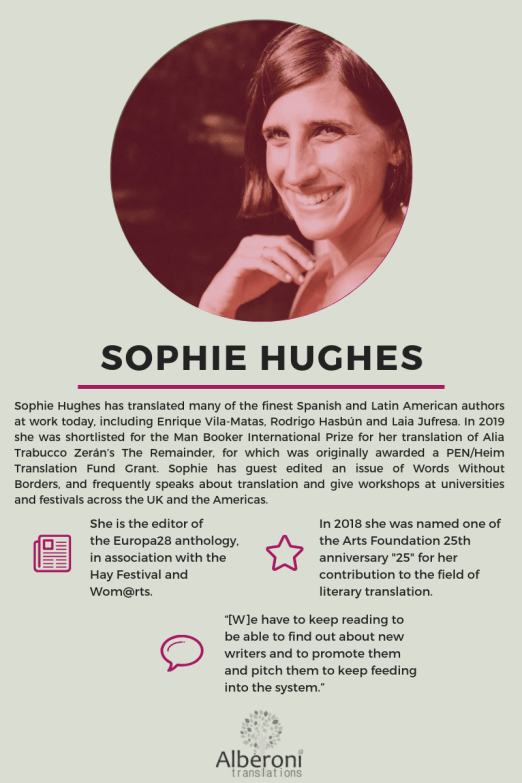
Sophie Hughes

Created with Canva

1. Back in 2017 you contributed to a Literary Hub series calling for more women authors to be translated, suggesting books in Spanish by Latin American women writers that you would love to see in English. Since it has already been two years, has any of them been translated meanwhile since then? Would you add any other to the list now?

To my knowledge, these are the three that are either forthcoming or now published, which in itself isn’t a bad number, but it’s also possible that there are more in the pipeline (perhaps a translator beavering away somewhere to make it happen by producing an irresistible sample).

Humiliation by Paulina Flores (forthcoming Catapult; Oneworld Publications, tr. Megan McDowell)

Nona Fernanda’s Space Invaders (forthcoming Graywolf, tr. Natasha Wimmer) and hopefully The Twilight Zone will follow now that she has “broken into English”, a horrible phrase.

Alia Trabucco Zerán’s The Remainder (And Other Stories; Coffee House Press, tr. Sophie Hughes) and for which I’m proud and even more delighted to say we were shortlisted for the Man Booker Prize 2019.

I think that if I don’t keep adding to these lists in my head, I’m not doing my job properly, because we have to keep reading to be able to find out about new writers and to promote them and pitch them to keep feeding into the system. I see my brief as a literary translator as very wide (this is part of its appeal!). I understand myself as being part of the publishing biosphere where each organism works in delicate balance with those around them. So as a translator I support authors by reading them; I support agents by producing paid samples or simply writing to say how much you liked x book before they go off pitching it; I might support a literary scout by reading for them and doing paid reports; literary journals by writing articles for them; publishers by translating and promoting for them; real booksellers by buying from them, etc.. I suppose there’s also a fear of falling behind in my reading. I live in the UK now, and only visit Latin America once a year if I’m lucky. I’d feel a real fraud if I didn’t try my hardest to keep up to date with what is being read and published and how it is being received there.

WiT month is nearly upon us, so perhaps there will be a repeat or an update of the series. I’ll look into it! 

2. This 2016 article you wrote on the then Man Book International Prize winner is really touching! Could you elaborate a bit more on what exactly you mean when you say “perhaps authors never have quite such an attachment to their books as the translators working them into other languages do”?

That is a great question, and I’m very happy to return to my comment and think about it again, three years on. They are two very different kinds of attachments. Since writing that article, which talks about the translator as a kind of surrogate parent to the text, I’ve actually had a child myself. And I’m pleasantly surprised to find that I feel the same way; I think the metaphor still stands. It’s about responsibility, different levels and senses of responsibility. As a parent (as the author of the text), after the initial feeling of “Shit, I really don’t know what the hell I’m doing with this newborn thing that needs me for everything” (the outset of writing a book), these children (or brainchildren) start to look after themselves a bit more: you grow into your child or text and relax into rearing or writing them because you know them so, so intimately; they are a part of you because they were born of you and bred in your home. By the end, you know them better than anyone.

Enter stage the literary translator! I approach a text that is already complete, mature, sure of itself, and it’s my responsibility to look after it, to respect it for what it is (its nature or essence), whilst protecting it from linguistic butchery, from translationese, from too many mistakes or outlandish mis- and reinterpretations. The anxiety produced from working on a brilliant piece of writing and knowing that it has to be brilliant in English is sometimes overwhelming. Speaking, as that article did, of tears, I cried many times translating my latest novel, Hurricane Season by Fernanda Melchor, and not only because the novel is heartrending. To someone who does not translate, it is hard to express how deeply you have to tap into both the author’s and their characters’ minds, into the world described, into the fabric of both the source and target language, and how exquisite but also acutely discombobulating and visceral and draining that can sometimes be. Read this piece in Words without Borders by Julia Sanches on translating the Brazilian writer Geovani Martins’s O sol na cabeça (The Sun On My Head) and then read her translations of the stories. That is extreme attachment. That, in my opinion, is assuming her translator’s responsibility wholeheartedly (heart being the operative morpheme). And it’s why she’s one of the best.

As a final note, I’d add that if I could amend that article, I might now clarify: “perhaps authors never have quite the same attachment to their books as the translators working them into other languages do”. After all, it’s not a competition! 

3. In this article, you say “In my personal utopia, our English evolves thanks to translation.” Do you still think so? If so, could you elaborate more on this idea?

Oh, absolutely! I think it at a most basic logical level in that if literature helps language evolve, and translated literature falls under ‘literature’, then English evolves thanks to translation. To give a practical example, I like the idea that translators carry across source language punctuation traits. The punctuation system in English as we know it (including words like comma and semi-colons) was still only coming into existence at the end of the 16th century. It isn’t really very old at all. We tend to think that it has sort of settled down, and publishers and editors and writers adhere to norms without really thinking (for practical reasons), but translators have to think about it differently, creatively. I like the idea that translation can create unruly (and often very sensible and correct-feeling) instances of punctuation. It frees up English in this sense. We marvel when, every now and then, ‘revolutionary’ or even ‘genius’ English-language writers do the same thing (the first contemporary writer that comes to mind is Eimear McBride). I marvel every time I notice a translator has stuck closely to the source language punctuation at the expense of English ‘correctness’. Not revolutionary maybe, but certainly evolutionary!

4. You are a member of various associations, West Midlands Literary Translators Network, Society of Authors’ Translators Association, and Emerging Translators’ Network. In your opinion, as a (literary) translator, what are the advantages of becoming a member of professional associations?

The benefits of being a member of each of these associations differ depending on what they offer, of course, but essentially it all boils down to company, solidarity and support in a profession that is filled with lovely people, but is also something of a minefield (from complex clauses in contracts to the dubious ethics or even sometimes safety threat of translating a certain text). I highly recommend translators join local and national professional associations where they can.

5. Are you working on any translation now? If so, tell us a bit more about it. If not, tell us about your last translation. Or talk about both, if you like. 

I’m working on a sample of Rodrigo Hasbún’s next novel, which is wonderful. Very different to his first novel to be translated into English (by me in 2017), Affections. I’ve missed translating his careful, quiet prose. I’ve just delivered two novel translations: a co-translation for Charco Press with Juana Adcock of the marvelous Colombian writer Giuseppe Caputo’s An Orphan World (a more poignant portrait of a father-son relationship would be hard to come by), and a translation of Mexican author Fernanda Melchor’s Hurricane Season for New Directions and Fitzcarraldo Press (one of the best contemporary novels I’ve ever read). Next up: a new writer to me (and to English readers), another Mexican, Brenda Navarro, for Daunt Books. It’s a book about motherhood and disappearances of various kinds.

6. What translated book into English by a woman writer and/or woman translator do you recommend us?

That’s impossible because I don’t know you! To anyone reading this who has just had their heart broken (or ever, I suppose –it always smarts), read ‘Poem of the End’ by Marina Tsvetaeva in Elaine Feinstein’s translation. Read it and weep. 

7. Now it’s your turn to nominate our next Great Woman in Translation.

Translator from the Norwegian, Kari Dickson, who I was lucky enough to get to know on a blissful residency in Cove Park in Scotland. To meet her is to be reminded that literary translation is never a solitary act if you embrace the profession and the brilliant, life-hungry people in it.


Sophie, thanks a lot for such an interesting interview filled with great tips of books to read and how to support writers, translators, publishers, etc. It was a pleasure e-meeting you and getting to know you a bit better. Congratulations on the amazing job you do!