Greatest Women in Translation: Regina Alfarano

^3BD2FAACEAC897D21BE68030808476304DC722B6E37A1C22D8^pimgpsh_fullsize_distr

Dear readers, welcome back to our Greatest Women in Translation interview series!

I doubt anybody else enjoys this series as much as I do. I love it! Meeting new people, learning more about them in order to ask the questions, reading their amazing answers…

And today, once again, it’s with a great pleasure that I introduce you to the lovely Regina Alfarano, nominated by Luciana Meinking.

Welcome, Regina!


melissa harkin

1. Let’s start talking about your “firsts”. You were part of the team that founded the second translation university course in Brazil, back in 1971. A few years after that, you also joined the staff starting the translation course at USP. Additionally, you founded the first publishing company specialized in translation publications in São Paulo, Alamo, and the first translation journal in Brazil, Tradução & Comunicação. I can only conclude you had quite an important role in introducing translation studies in Brazil. Could you tell us a bit more about these experiences you had?

Those were very exciting years! And undoubtedly, times of fighting hard battles as well. Translation was not recognized as a specific area. It was seen as a “branch” of Language Courses. So, a university course was considered “unthinkable”. I heard – from active interpreters then – questions like: “Do you really think you can teach students to be translators?” “Do you honestly think Translation can be a course on its own?” Well, I am glad it did not take too many years to see Translation and Interpreting as they were originally thought to be and as they had already been in other countries! The experience was different at Ibero-americana (from 1971-1985) and USP (1979-2000). Ibero-americana held an undergraduate program, while USP held a graduate program in Translation only. Both contributed immensely for the professional development of both areas. The first translation journal – Tradução & Comunicação – was one of my most gratifying achievements. Although aware of the groundbreaking character of such endeavor, I was flabbergasted when right after Volume 1 was launched I received a letter (those were old times [1981], when communication was carried out through letters!!!!!) from the Fedération Internationale des Traducteurs (FIT) with an invitation to present the journal at their International Congress in Vienna, Austria. META was the only translation journal in the Americas (Montréal) at the time, so Tradução & Comunicação was greeted sparklingly and immensely welcomed.

2. According to your own words, one of the most interesting projects you were ever involved in was The translations of William Kennedy in Brazil while being a Fulbright Scholar at the New York State University at Albany. Why was it so interesting?

First of all, being a Fulbright Scholar was, in itself, extremely gratifying. A Fulbright Scholar in the US enjoys high respectability and is recipient of many privileges. Secondly, only in my post-doctorate could I dedicate my research to Translation Studies! USP would not accept translation projects for Master’s Degree or PhD back then. Of course my background in American Literature (Master’s Degree) and British Theater (PhD) were of great help, as was my background in Language and Linguistics. I had visited Albany before, very briefly, after reading William Kennedy’s trilogy – his Albany trilogy. This was 1990. The trilogy was added by a number of books later on. But in 1990 I was absolutely taken by the trilogy – Ironweed, Legs and Billy Phelan’s Greatest Game – and while in the United States, I decided to visit Albany. That visit increased my interest. Back to Brazil I found the translation for the 3 books. Although a trilogy, and practically three books as three chapters of one encompassing work, each was translated by a different translator, and each clearly suggesting to be totally separate. Therefore, the Albany area and its social and cultural scenario – the very core of Kennedy’s trilogy – were lost. Not only that had been lost! I decided to call the publishing house of Ironweed (Vernônia, in the Portuguese version) to try to contact the translator and understand why Kennedy’s language style had been changed (just one example: all swearing names were eliminated). I was informed that the translator could not be contacted. She used a pseudonym and had asked not to be identified! (At a time of such hard struggle for translators’ visibility, rights and copyright.  I was very active both with ABRATES [Associação Brasileira de Tradutores] and SINTRA [Sindicato Nacional de Tradutores], had created ABRATES-SP, and acted as a Director of ABRATES and President of SINTRA ). And worse: she was very religious, and did not approve of swearing, so, she eliminated all the swearing words in Ironweed!!!!!!!!!!!! I was lucky to interview Mr. William Kennedy and was embarrassed to inform him of the unbelievable fact! Mr. William Kennedy had bought the house where Billy Phelan had lived, and not only preserved it but kept it untouched. It was the first and only time I actually visited the physical scenario of a book! The building, the furniture, glasses, lamp fixtures! And William Kennedy sitting in Billy Phelan’s chair and talking about his trilogy! It could not have been more interesting and more of a privilege! I was even more embarrassed, however,  when he said he had never been paid for the copyright of the books published in Brazil!!!!!!!!!!!!!!!!!!  Not one cent! Not one letter! How horribly embarrassing could that be???? I had the opportunity to meet Mr. William Kennedy one more time (although very briefly) in Paraty, at FLIP 2010. As one of FLIP’s guests he had very busy days and of course was highly requested by participants!

3. You describe your first experience with the translation practice as “a scuba diving initiation”. Could you tell us about your experience and how it shaped your translation career?

I was 18 years old and had just returned to my hometown (Limeira, SP, Brazil) from my one-year AFS exchange program in the US. Someone called from a local hospital. They had just received new equipment imported by a wealthy man who, nearly dying, would have his last chance if the equipment could be put to work. So, they had the “brilliant” idea of calling an 18-year-old whom they thought would translate the manual. As much as I tried to tell them – as I already knew back then, in 1965, that speaking a language did not mean I would be able to translate, let alone a manual – the pressure was so high (‘The man will die if this does not work!’) that I went to the hospital. A piece of equipment, a team of medical professionals and technicians and myself, scared to death. As I translated the instructions I thought ‘I will be the next one to need emergency help here…..’. But slowly but steadily the team started activating the commands – the equipment worked and the man was saved! I felt as if a plow had gone over me! Sweating, hardly breathing, exhausted! But relieved! Would that be the reason why I would never, ever come close to translating manuals? The experience may have shaped my translation career in the sense that I do not, by any means, translate technical material, manuals, and the like. But yet, I do translate medical material, so, it may have been the “scuba diving initiation” to show the challenge, the excitement and the gratification translation can offer.

Translation is not only about languages, knowledge, cultures, and all that comes with it, of course, but about those using it for those purposes: people.

4. Besides this first experience you had, you also say you had total immersion experiences that shaped your areas of specialization (poetry and medical translation). Could you tell us a bit more about them?

When teaching translation I used to say to my students that only poets could translate poetry, which explained why I never included poetry in my Literary Translation Courses. At some point in time, Haroldo de Campos asked me to translate the speech he was going to deliver at a ceremony to honor Octávio Paz. The speech included some poetry. I froze when I received the originals, and immediately talked to Haroldo about it. He said he would give me support if I needed – how would anyone in this world refuse a request by and support from Haroldo de Campos? I decided to take the challenge! Of course I said I would send a first version for Haroldo’s reading, suggestions, etc. etc. To my total astonishment, he did not make any changes at all. And to my double/triple astonishment, sometime later I received a call from Régis Bonvicino, who was organizing a poetry anthology for the Brazil Exhibition in Paris. He invited me to translate Contemporary Brazilian Poets, and before I had any reaction, he added: “Haroldo said you would say you do not translate poetry, but that is not true, you do translate poetry, and he has recommended you”! Again, how could anyone refuse such invitation! And Desencontrários (Unencontraries) was my first delightful experience translating poetry. Others – just as delightful – followed, and I am glad to say I truly enjoyed ‘every word/verse/rhyme’. Working with Haroldo de Campos was most enriching, as expected. Sitting with him, reading poems and translations – invaluable and unforgettable!

As for medical translation, I was caught having to check reference material for one of my projects. Those references showed so many translation problems that they could hardly be useful as references. So, I had to search, re-search and re-search for my research! The project I was involved in included doctors’ research, and again and again, high reading volume. Then, it led me to FDA material research. As the project was of high relevance, I was very involved and of course wanted to do a good, reliable job. Extensive reading and research called the attention of the doctors involved and they recommended me for an even larger project that was medical-related. After detailed information I realized I could face the challenge. That was the beginning of a fast-moving dive into medical translation. One day, my husband, a medical doctor himself, came to my desk, saw the material (we used many dictionaries back then, and many typed copies of translation….. and re-typed pages…..) and asked me: “Are you translating medical texts?” I answered I had been, for some time. He was very surprised! So, it all had to do with my own projects – it all led me quite naturally. The long-lasting AIDS projects both in Brazil and in the US were of profound involvement and partnerships. Thanks to my graduate Translation students at USP who helped me, Brazil was the only country to launch AZT on the same day and at the same time as the US. I was honored to have translated presentations by top Brazilian scientists and researchers on the model AIDS prevention project Brazil developed (and unfortunately interrupted in recent years). The bridge between poetry and medical – as odd as it may seem at first…. – reached its apogee when I translated one of Nelson Ascher’s poem – Mein Herz – from Portuguese into English. As soon as he got my version he called and asked me: “Are you a physician?” “Why do you ask?”, was my reaction. “Because you translated this poem so beautifully, and it sounds ‘medical’”! Coming from a translator of such stature, I could not doubt the ‘bridge’ was viable (and enjoyable!).

5. You say stress and adrenaline are integral parts of translation. Why and/or how?

It has been proven that interpreting is the most stressful profession in the world. The study compared interpreters and surgeons! So, stress and adrenaline are part of the very nature of interpreting, of the fantastic decision-making process and rendition. Interpreting is very often referred to as ‘oral translation’. I would say that is too simplistic! But stress and adrenaline are also integral parts of translation. Clients’ turnaround needs, clients’ reviews of originals – so often – clients’ updates for materials already translated, clients’ requests for additions. And, of course, in no time at all! Clients traveling all over the world – all those requests to be delivered on time and wherever they are. The only way to meet those needs is to draw a map and have color pins to show who is where – Brazilians in Asia, Europeans in the Americas, Americans in Europe. Time zones are absolutely crucial, and projects overlap, since changes were requested after projects had been delivered. ‘The project is over’ – wishful thinking! It does come back….. and back again. When it comes to medical projects, that is potentiated. Huge projects come back for updates two, three, four years later. Many a time, clients’ staff has worked on interim versions (‘minor’, as they say…..). Medical records to be translated for patients who must travel for medical care. Documents required to import medications for all sorts of patients (and many times, children). It is an extremely stressful cycle, fighting against time and having to comply with bureaucracy. Interpreting doctors, nurses, patients and family members about very serious conditions can be the most stressful and the most intense of all experiences. Clients, medical staff in Brazil and all over the world watch the very personal, and many times very sad, testimonials, which must be rendered as any other interpreting session. To be honest – not at all like any other interpreting session. Stress and adrenaline can hardly be measured. And although trembling voice must be avoided, an  interpreter is not always successful when others around are already shedding tears.

[The translation profession] rewards the cumulative years of experience, which is to say, age counts positively; it encourages and demands ongoing learning, which is to say, it is intellectually healthy; it also demands recycling and updating, which is to say, it is continuously evolving; it fits in wonderfully with self-employment, which is to say, one can—or tries to!—manage one’s own working days and hours.

6. You give your students two key pieces of advice: 1. Do not charge less than you deserve for your work; never, ever charge more than you believe you deserve for your work.; and 2. Choose what you really like to do as a profession, and above all, have fun doing it. Why do you think these are the most important pieces of advice to give to translation students?

Dignity is crucial in life – personal life and professional life. Every professional deserves to be compensated for the work done, which goes without saying. But competition may interfere, and ‘professionals’ trying to find jobs unfortunately do charge humiliating fees. So, that is the first part of the first piece of advice: do not charge less than you deserve and the professional field finds to be common sense. And how to find out? Very easily: through professional associations, translation unions, international associations, peers. Competition must never interfere with dignity. On the other end, if a professional is aware of how to charge for the work done, that is what should guide his/her attitude – never, ever charge more. Translators are so often, too often in fact, faced by urgency, by extreme clients’ needs (a few examples above), by the literal plea ‘charge whatever you want’. Of course there are urgency fees, but that is a different issue altogether. There are also pro-bono projects, which are extremely important, gratifying, and no doubt made evident by their own nature. As for regular projects, translators must present their fees very clearly, from the start. Clients should ideally receive a document which shows all services to be rendered, all situations under which they can be rendered, and just as translators expect clients to comply, so must they.

As for liking what we do as a profession, and above all, have fun doing it, I pose a question: how do we feel every time we have to do something that we do not find pleasant, or likeable? It is definitely not a good feeling. When involving others, the result will certainly not be satisfactory. When involving professionals, it can be nearly disastrous! Translation in itself is about making decisions. So, the crucial decision is: I want to be a translator, I like to be a translator, I enjoy what I do, and I have fun doing it (despite all the stress). Then, the decision making process at the core of translating will flow more smoothly. It would never flow otherwise, I am sure.

7. Now it’s your turn to nominate someone you admire and that is a great woman in translation.

I can think of a  number of great women in translation. The one I choose to nominate is Angela Levy. A pioneer in interpreting in Brazil, a prominent translator and outstanding translation/interpreting teacher, Angela has trained and inspired so many translators and interpreters. Angela is to be admired and respected as a professional, as an amazing human being, and as a long-time peer and friend.


Regina, I sincerely appreciate you accepting Luciana’s nomination and my invitation, and taking the time to answer my questions. It was an honor to welcome you on my blog. Thanks a lot! 🙂

Greatest Women in Translation: Luciana Meinking

^3BD2FAACEAC897D21BE68030808476304DC722B6E37A1C22D8^pimgpsh_fullsize_distr

Welcome back to our interview series! Let’s start the week and month inspired by another one of our amazing Greatest Women in Translation? Then please welcome another Brazilian translator, Luciana Meinking, nominated by Melissa Harkin.


Luciana meinking

1. Melissa Harkin nominated you to be our next interviewee. You two had a professional partnership that you described as extraordinary and one of those coincidences of destiny. Could you please tell us a bit more about how you two met and how this partnership started?

Melissa used to work for the same company as my sister. By that time she was still living in Brazil. I think one day Melissa might have told her coworkers that she was looking for freelance translators and that’s how my sister came to ask me for my resume. In fact, Melissa and I never met in person, which makes this story even more interesting (we are planning to meet in person this coming November during the ATA Conference in San Francisco!). I sent Melissa my resume and passed the translation test she requested me to submit. With the first job assignments I got from her, our relationship started to develop, and I am glad to say that I am extremely glad to have worked for her. It is hard to find someone who is also very detailed and whose professional standards are very similar to yours. I am extremely grateful to have had this opportunity – she was certainly a great peer and friend!

2. A lot of people treat their peers as competition and do not consider other translators may also be potential clients or even professional partners in the future. What’s your opinion on the subject?

I guess that’s true and it is something you see on a daily basis, especially if you are working as an in-house translator. It is surely conditioned by the difficult market and people’s fear of losing their jobs or clients. It might sound a bit idealistic but I would like to think about this in terms of finding the best professional partner or partners to actually come up with a good final product.

3. You started translating by chance while taking your PhD in Germany and, after that, gave up your area (Literature and Linguistics). Why did you change your mind and decided to venture into translation?

During the final year of my doctorate in Germany I was still figuring out what to do with my life. First I thought I wanted to pursue an academic career in the university, but the market was also not very good for that and the strong competition didn’t seem to me by then to be a path that I was willing to tread. So starting in the translation industry also happened per chance when an acquaintance asked me if I wanted to translate technical texts. It all seemed very interesting, getting to know a CAT tool for the first time, seeing how fast you can translate and how much fun it is to keep a terminological database. I guess I noticed quickly that I enjoyed translating and proof-reading.

4. You currently work as an IT QA tester. Could you please describe what you do exactly?

My work consists basically of localizing strings and running functional and linguistic quality assurance tests for the client’s products. It is very different from what I have been doing so far in terms of content, but it is an opportunity to learn new skills and meet new people.

5. You say a freelance translator’s life working home office is quite lonely. Do you prefer to work in-house as compared to home office? In your opinion, what are the pros and cons of working in-house x home office?

I am not really sure if I prefer one or the other. Right now, I enjoy working in-house because I have met wonderful people who hopefully will become friends. I think one of the cons of working in-house is, for instance, the fact that you have less control on the final product, which consists of patches of texts several other people have worked on and whose standards or linguistic preferences are not necessarily the same as yours. But this is actually also part of the learning process, I mean, learning to negotiate ways of getting to the same goal. I also think that in-house working also produces more unveiled competition. As for the pros, again, meeting people and actually having the opportunity to catch a glimpse on people’s lives is a very positive thing. It’s about having a bit of a change in your daily schedule, really, and having the opportunity to socialize. Home office work is quite lonely indeed and can be really tough. Apart from that, I guess you can produce a much better outcome by working on your own and exchanging information with a professionally trustworthy partner whenever you need help with a specific text or subject.

6. You say you do not have the typical freelance translator profile. What is this profile, in your opinion?

Maybe that is extremely subjective, but what I meant by that is that the typical freelance translator profile is someone who is willing to engage in some self-promoting and marketing strategy in order to find more clients, people who keep blogs and produce interesting socially engaging tools. I admire people who have the energy and especially the time to do this.

7. Now it’s your turn. Who do you nominate as one of our Greatest Women in Translation?

Now, since I cannot nominate Melissa Harkin anymore (oh, no!), I chose to nominate someone I have never worked with before but who was, maybe without even knowing it, a role model for me in my career as a translator. Her name is Regina Alfarano. She was my first instructor at NYU, when I took the online Certificate in translation course offered by that institution. So read this nomination also as homage to good teachers and educators, those you still remember after years have passed by.

Regina was an extremely dedicated and disciplined instructor, but, above all, in these hard linguistic times, you could see that she had that love for the Portuguese language that is, unfortunately, lacking in many people nowadays. You can see that she has a very strong linguistic background and that, without being a purist, she also cares for the language and what people are actually doing to it nowadays.

Greatest Women in Translation: Melissa Harkin

^3BD2FAACEAC897D21BE68030808476304DC722B6E37A1C22D8^pimgpsh_fullsize_distr

Welcome back to our Greatest Women in Translation series! Since our last “interview” was actually a tribute, it was my turn again to nominate someone and restart the thread. Since my first nomination was a foreign translator (Marta Stelmaszak, from Poland), this time, to be fair, I decided to nominate a Brazilian role model. I must confess I’m curious to see where this thread will take us.

Now please welcome Melissa Harkin.


melissa harkin

1. When I created my professional Twitter account, you were the first person I followed. You were my only Brazilian role model. I admired (and still do, of course) your professionalism and your online presence. Could you tell us a bit about your beginning?

Well, I guess my main driver back then was that I was tired of the ‘same old’ pattern in business relationships, regardless of the industry. I was tired of e-mails, machines, lack of customer care, automated replies, etc. I wanted to get personal. However, we are talking about the social media and technology era, so the best way to get personal was to put myself out there using all of that technology, but in a way that seemed I was talking to my clients directly.

That’s when I started adding my picture to all that had my name on it: e-mails, quotes, stationary, social media, etc. I didn’t want to be a logo. I wanted to be me! I wanted people to see a person, an individual, and relate to me.

That was different back then. People in Brazil were not used to business getting so personal. Maybe, that is why a lot of my clients became good friends along the way.

I made sure I replied to everything, even the ‘help me out real quick’ requests from friends that needed to write an e-mail in English and were feeling insecure. I made sure I was replying to everyone’s messages and requests in a timely manner, and I made sure I could add value to their activities on an ongoing basis.

2. You have the most lovely baby boy, Bruno, 1 year old. Although I myself do not have children, I can only imagine how having a baby changes a woman entrepreneur’s life. What advice would you give to a freelance translator who is thinking of having children or is already expecting a baby?

I’m not sure I’m already qualified to give advice in that area. I’m still finding my own new pace and balance. It’s hard, there are a lot of mixed feelings – it’s quite bipolar, actually. One minute you’re dying for some time for yourself, for work and silence, and the next minute you’re feeling kind of guilty about it.

Last year (2015) was a difficult one. I finally realized I coudn’t do all of the things that I did before. I made the decision to focus on getting my job done and decreasing my online presence a bit in order to have more availability to translate. Now that Bruno attends daycare full time, I can go back to adding more activities to my schedule other than just pure translations.

I guess what really helped me out was financially planning my pregnancy ahead of time, so it wouldn’t be a burden when I finally took a break to focus on my son. Two years before getting pregnant I was already buying gender neutral baby items and had two different savings accounts to prepare for the first few months: one for all of the big ticket items and one for 6 months of maternity leave.

There’s not much you can really plan when it comes to having a baby. But the financial part of it is one that you can and I highly suggest you do so. Everything else will probably not go according to plan and you’re either going to have to change your initial plan or just wing it. Whatever happens, don’t lose focus, don’t lose your mind, and ask friends, family and fellow translators for help. I say fellow translators because, family and friends can and will help you on a more personal level, but having good partnerships with fellow translators will literally save your business life when your baby gets sick and you need help with your translations and deadlines.

3. You have recently moved out from Brazil to the USA. Could you share with us the difficulties you faced in the transition and the advantages and disadvantages of working and living in the USA?

I’ve lived here before and my husband is American, so culturally speaking I didn’t really have a hard time moving back. Initially, we were in Florida, and that was hard because we didn’t have any friends there, only my brother-in-law and his family, who lived about an hour away from our home. Having a baby makes the one-hour drive something difficult to take on. We felt quite lonely there, so we decided to move back to Missouri, where my husband is originally from, and to be close to friends and family. That changed everything. We’re happier now, we have people we can count on minutes away from home, we know the place, etc.

When it comes to the translation industry, I can tell you that there are differences in how to do business, such as prices, taxes, ethics, business practices, etc. I’m still learning about all of that here in the US and I do so by networking with fellow translators, attending courses and conferences, reading industry-related publications, etc. It’s been great and business is getting bigger and better on a weekly basis.

4. You work with a pool of translators who usually help you with projects and have already worked as a Translations Manager at a consulting firm. Based on your experience, what are the most common mistakes freelance translators make and, based on that, what advices would you give to translators in general?

Poor reviews and commitment to deadlines. People, please! These are extremely important aspects of being a translator.

How can you deliver a good translation without taking the time to review it? That’s something that drives me nuts. And how can you expect to get more jobs if you keep missing deadlines?

Read the source file before starting your translation so you can get acclimated to the content, take notes on vocabulary, do research, etc. This way, when you start your translation, you’ll not only be more knowledgeable on the content but you will also do a better job translating the material. Take a break after you’re done. Go get some coffee or take a nap and clear your mind. Come back, spell check, read the translation to make sure it ‘sounds’ good and it flows nicely, spell check again, and then deliver your file.

In case of questions throughout the translation that you cannot find the answers to in your research, talk to your client or translation manager. Don’t just send a file with a bunch of comments of what you couldn’t find on your own. Questions need to be asked and answered during the translation process in order to deliver a good product. Skipping this step means you don’t care about that text, the impact it’s going to have on readers, on your client, and on yourself as a translator.

Comply with deadlines! That means you need to plan your day, prioritize, time manage, and make sure your head is clear and focused on the job you’re about to do. Keep track of how much you can translate per day and at what times you feel most productive and use that to your advantage and to plan your work schedule.

5. You are a volunteer translator for Translators Without Borders and also worked for Greenpeace. In your opinion, why is it important to do pro bono work?

It’s important to make this crazy world a better place. It doesn’t matter if it’s pro bono or not. Translators Without Borders is pro bono, Greenpeace wasn’t  ̶ I was an employee there.

Greenpeace taught me a lot, not only about the environment, but about people, community, the future, responsibility and accountability, and all that changed me. There’s nothing more marvelous than helping others, making a difference, and impacting lives. That is why I keep supporting Greenpeace worldwide in any way I can, and that includes having a special discount rate for NGOs that work with causes that are close to my heart, such as slave labor, environmental issues, children, medical procedures for the poor, emergency response, etc.

Translators without Borders (TWB) is an independent non-profit association established in 1993, dedicated to helping NGOs extend their humanitarian work by providing free, professional translations. The funds saved through the use of volunteer translations can then be used by the NGOs in the field, enabling them to extend the scope and reach of their humanitarian work. I fell in love with TWB because it’s not only an opportunity to give back to the global community but also a way of being part of something bigger, something greater, set out to make this a better world for our children and our children’s children.

6. You wrote the English Version of Brazil’s Anti-Corruption Law with Stefano Enepi. Well, you have an educational background in Law and also translate this type of material, right? How is the book useful to law translators? Also, could you tell us a bit more about how you came up with the idea of writing it and how was the writing process?

Because of my legal background, I have always translated all kinds of legal documents and, more often than not, they include quotes from different laws. Throughout the years, I felt there was next  to nothing out there when it comes to Brazilian legislation in English, and we’re talking about a BRIC country that is quite complex to do business with in terms of legal framework. Brazil is also going through a period of sociological change, in which people are tired of corruption and are saying ‘enough is enough’, so when the new Anti-Corruption Law came into effect, it was a no-brainer that it needed to be available in English as well.

I partnered with Stefano Enepi for the review because of his legal background and because he was a resident of Brazil, with deep knowledge of the language and culture behind it all.

It was a great project for us. It put our names out there and it shows potential clients what we can do.

I also chose that particular law for ‘protesting reasons’. I too think that enough is enough. It’s time we come together as a society to make our country a great nation. And fighting corruption is a huge part of that process. I hope our English Version of Brazil’s Anti-Corruption Law helps people, government officials, and companies to do business the right way in my country.

I may no longer reside there, but Brazil is my country and I want to see it become a great nation for our people.

7. What are your plans, goals, dreams, wishes, whatever you like to call them, as a freelance translator entrepreneur, for the short and long term?

Oh boy, where do I start?

Professionally speaking, I’m focused on growing my business and presence in the US right now. In the long term, I’d like to translate more Brazilian laws, work with more NGOs, volunteer more often, and educate others on the Translation and Interpreting market, business, and careers. One dream that I have is to develop continuous education courses for our fellow translators, thereby sharing what I know and have learned thus far as a translator and entrepreneur.

My other focus is my family. My husband and my son are my life and I want to see them happy and healthy every day. I want to grow old with them and be there for them every step of the way. They are the main reason for every good thing in my life.

8. Now it’s your turn to nominate our next interviewee. Who is your role model?

I nominate Luciana Meinking – Brazilian translator with a PhD in Portuguese and English Philology from the University of Freiburg, Germany, and a member of the American Translators Association. She is, by far, the best translator I ever worked with.

Luciana does a great job and far exceeds the ability of an average translator. She always brings her keen analytical skills to the table and is an excellent researcher and linguist. Her many years of study and experience, along with ethics and professional attitude, definitely add value to any translation/localization project. She is trustworthy, consistent, and reliable! I always love working with her and, throughout the years, we learned a lot from each other, especially when it comes to glossary management and researching skills.


Thank you so much for accepting my nomination, Melissa! It’s always such a great pleasure to welcome you on my blog. I loved learning a bit more about you.

Now stay tuned for next month’s interview.


Greatest Women in Translation: Deanna Hammond

Welcome back to our wonderful and inspiring Greatest Women in Translation series!

Our last interviewee, Muriel Vasconcellos, decided to write a tribute to her role model, Deanna Hammond, whose life was cut short by pancreatic cancer at the age of 55.

^3BD2FAACEAC897D21BE68030808476304DC722B6E37A1C22D8^pimgpsh_fullsize_distr

Deanna Lindberg Hammond (1942-1997)

My nomination for this month’s Greatest Woman in Translation is a colleague who unfortunately is no longer with us. More than anyone I ever worked with, Deanna Hammond deserves to be recognized for the breadth of her contributions to the profession. She enriched the field and set an example in many different roles: not only as the head of an important translation service and a hands-on practitioner of the craft, but also as a leader of the translation community in the United States, an author, and a teacher. Her life was cut short by pancreatic cancer at the age of 55.

Best known for her work with the American Translators Association, Deanna held a “day job” for 20 years as head of Linguistic Services at the Congressional Research Service, overseeing translations for the United States Congress. Her section was responsible for translating anything that members of the Senate and Congress, or their offices, wanted to read in English or present in another language, from international treaties to news clippings, from legislation to letters from constituents, with scientific papers and research proposals in between. She also reviewed translations done by other colleagues and contracted the services of private translation companies for large projects and languages not covered by CRS staff. Even after her illness prevented her from going into the office, she remained on the payroll and continued to translate documents at home. She was posthumously awarded the Library of Congress Distinguished Service Award, a high honor granted for “contributions of great significance.”

While shouldering this serious responsibility, Deanna also found time to contribute unstintingly to the advancement of our profession. During her two decades of service with the ATA, she was active in many of its efforts to raise public awareness about the work and professionalism of translators. First elected to its Board of Directors in 1979, she served two terms as secretary of the Association and ultimately held the positions of president-elect (1987-1989) and president (1989-1991). As president-elect, she organized two annual conferences attended by nearly 1,000 members and negotiated contracts for meeting venues for six years into the future. She embarked on her presidency with the intention of putting ATA’s house in order, an effort that included rewriting the Association’s bylaws and moving ATA headquarters to the Washington, D.C., area. In addition, she worked on improving the accreditation program and increasing the number of translation courses and degrees offered by higher learning institutions across the United States. While striving to advance the profession, she also found herself facing challenges that arose with wisdom and integrity. Her contributions were acknowledged in 1992 with the Association’s highest award, the Alexander Gode medal for distinguished service to the translation profession.

Deanna also served the profession in other capacities — for example, as head of the U.S. delegation to the Statutory Congress of the International Translation Federation in 1990 and as president of the Interlingua Institute from 1993 until her death.

She took an interest in machine translation and provided extensive advice during the formative years of the International Association for Machine Translation and the Association for Machine Translation in the Americas. In this role, she and I worked closely together. Her wisdom and experience were key to taking what had been an idea sketched out on the back of an envelope, so to speak, and transforming it into a vibrant worldwide system. We were both committed to seeing that MT was used for appropriate applications and not as a substitute for real translation.

In addition, Deanna published extensively on professional issues in the field of translation, authoring articles in such publications as the Congressional Record, the Modern Language Journal, the Annals of Political Science, and the ATA Chronicle. She was also editor Volume VII of the ATA Monograph Series, Professional Issues for Translators and Interpreters.

Whenever she had knowledge or experience to share, Deanna was a tireless mentor. She was especially committed to supporting aspiring translators. She taught courses in Spanish-to-English translation at The American University in Washington, D.C., in the early 1990s and at George Mason University in Fairfax, Virginia, from 1993 until 1996. In fact, she was a teacher before she was a translator. Her first job was as a teacher at the superior school in Pullman, Washington. She then traveled to Colombia, South America, where she taught English as a second language from 1964 to 1967, first in Medellín as a Peace Corps volunteer and later at the Industrial University of Santander. She also taught ESL at Northern Virginia Community College from 1974 to 1977. In addition, she was an active member of the Association of Teachers of Spanish and Portuguese.

Born in Calgary, Alberta, Canada, in 1942 of a Canadian father and an American mother, Deanna spent her early years in the area of Port Angeles, Washington. She earned a bachelor’s degree at Washington State University, a master’s degree in linguistics from the University of Ohio, and a Ph.D. in Spanish linguistics from Georgetown University. She was a member of the Phi Beta Kappa and Phi Beta Phi honor societies.

Her life of devotion to service extended beyond translation. In the 1990s, as her participation in ATA came to a close, she became active in Zonta International, a worldwide organization of executives in business and the professions working together to advance the status of women. She was president of her local Alexandria Club and was ultimately appointed East Coast International Chair.

Deanna was the consummate professional.  Her energy, commitment, and integrity inspired the people around her to do and be their best. The bar that she set would be hard to match. Yet with all the activities on her plate, she still found the space in her life to be a delightful and loyal friend. Her sunny personality and her willingness to help others never faltered. Another colleague, Jane Morgan Zorrilla, summed her up perfectly:

I have never met anyone so outgoing despite her shy nature, so serious despite her wild sense of humor, so focused despite the thousand ongoing projects in her head, and so compassionate despite the antagonism that her determination sometimes brought out in others.

Source: http://www.bokorlang.com/journal/02obit.htm

The material for this article came from Deanna’s Wikipedia entry, an obituary by Jane Morgan Zorrilla at the link above, other obituaries, and personal recollections.


Since we reached a dead end, our next interviewee will be, once again, nominated by me. This time, I decided to choose one of my Brazilian role models, Melissa Harkin.

Greatest Women in Translation: Muriel Vasconcellos

^3BD2FAACEAC897D21BE68030808476304DC722B6E37A1C22D8^pimgpsh_fullsize_distr

Welcome back to our interview series, dear readers!

Please meet Muriel Vasconcellos, nominated by Allison Wright, and be as amazed as I were with her life lessons.


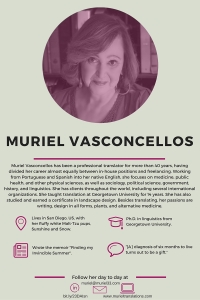
MURIEL VASCONCELLOS

1. You are a translator from Portuguese and Spanish to English with more than 40 years of experience in the fields you mention above. I can see where your expertise in linguistics comes from (you hold a Ph.D. in Linguistics from Georgetown University), but what about the rest of your expertise?

Most of it comes from on-the-job experience, learning while doing, with the benefit of excellent coaching during the early years of my career. After working in administration and translating on the side for several years, I landed my first real job as a wordsmith with the Organization of American States in Washington, D.C. I was both an editor and a translator in the Department of Social Affairs, and the documents covered a wide variety of topics that affect developing countries. My supervisor, Betty Robinson, was brilliant and taught me a lot. In addition, during much of my time in that position I was detailed to the Language Services Division, where senior translators reviewed my work and generously shared their wisdom – always tactfully, never in the spirit of showing off.

After six years at the OAS, I applied for a position with the Pan American Health Organization (PAHO), the World Health Organization’s American regional office, in its Department of Research Development and Coordination. I was responsible for publishing a series of monographs and my work included editing, translating, précis-writing at scientific meetings, and report-writing. My boss, Dr. Maurício Martins da Silva, set aside an hour every morning before work to tutor me in the biomedical sciences. I repaid him by working long hours and on weekends. Dr. Maurício was a born teacher and I owe my understanding of science to him.

2. You also taught translation at Georgetown University for 14 years. How do you think this experience as a translation teacher helped (or still helps) you as a translator?

Teaching translation gave me a whole different perspective on the process. It was the first time I began to analyze the techniques that before I had been using intuitively. I needed to understand what happens in translation in order to empower my students. The tools, formulas, and solutions that I developed for them are constantly in the back of my mind, guiding me in my work.

3. You were the president of the International Association for Machine Translation for two years and founder and president of the Association for Machine Translation in the Americas for six years. You are also the editor of a collection of contributions on the translator workstation and the use of computer aids and full machine translation, entitled “Technology as Translation Strategy”. Besides, during the time you worked at the Pan American Health Organization/World Health Organization, you introduced machine translation and developed strategies to facilitate post-editing. Can you tell us a bit more about MT from your point of view?

Having been up close and personal with machine translation for 35 years, I have a lot of thoughts on the subject. I have expressed them in more than 50 published articles, most of them posted on my website.

My first exposure to MT was a five-year stint as assistant to the director of the Machine Translation Project at Georgetown, Professor Léon Dostert, when I came to know all the key researchers and other players in the field. I wrote about this experience in an article titled The Georgetown Project and Léon Dostert. It’s fair to say that the Georgetown Project laid the groundwork for extensive use of information-only MT by the United States Government. Since the 1960s, MT has been effective as an information-gathering tool. There’s little doubt that it has revolutionized the gathering of scientific intelligence.

MT has also enabled businesses, starting with Xerox, to launch products in multiple markets simultaneously. Over the years, the Xerox model has been replicated by many large companies.

Other applications, like weather reports in Canada, have been successful largely because the vocabulary and syntax are relatively limited.

PAHO began to develop its own Spanish-English MT system in 1978. The office’s managers had been sold on the naïve idea that medical texts would easily lend themselves to mechanization. I was placed in charge of the program the following year and we quickly realized that we were faced with a wide range of subject matter, various genres, and vastly different writing styles. Even the strictly medical texts covered a large number of specialties. The Spanish-English system (SPANAM), developed in-house by a team of Georgetown-trained computational linguists headed by Marjory León, was the first to become operational in 1980. English-Spanish (ENGSPAN) debuted later. Both of them have turned out to be robust general-purpose systems and they continue to be improved under the direction of Julia Aymerich. There is also a system from Portuguese to English that still needs work. I used SPANAM in-house for 12 years, while at the same time supervising a team of contractors, and I have continued to use it as a contractor myself since 1992.

When it comes to professional translators in the role of posteditors, I would say that not everyone can adjust their style to minimize the effort involved. Many of us find it hard not to change the output; the decision to leave it alone is frustrating in itself, as we always prefer our own style. The process is also stressful because MT does not eliminate the need to look at the source text. The translator has to be thinking of strategies for fixing the target output, more often needed than not, while still carefully following the source, like patting her head and rubbing her tummy at the same time. It’s a demanding skill.

PAHO pays its translators well for their effort. The rate is only slightly lower than the level paid by international organizations for “human” translation, and the office has been able to recruit a strong team of professionals working both in the house and as contractors.

Perhaps my years of experience as an editor have given me a leg up. There are times when I get frustrated and times when I’m grateful that “the machine” has made my work easier. I also do regular translation for many other clients, so I have ample opportunity to compare the two processes, which are very different.

One problem is that my vision has deteriorated; working on-screen is increasingly difficult for me as I get older. At this point in my career, I like nothing better than to read a sentence in the source language and then close my eyes to process it in my head while letting the translation flow through my fingers. This is how I work best and make the fewest mistakes. An added benefit is that the result sounds more natural.

To conclude, I believe that MT postediting can be used to achieve polished, high-quality translations under the following conditions: the posteditors are professional translators in mid-career (I don’t recommend it for beginners); they are open to taking on the task; they have good keyboard skills; and they are adequately compensated. Using MT as an excuse to exploit translators or hiring non-translators as posteditors are unfortunate trends that should be discouraged.

4. According to your own words, you are “passionately interested in Brazil.” I know your late husband was a Brazilian in political exile when you met, back in 1970. Was he the (only) reason for this passion for the country?

My passion for Brazil began when I started to learn Portuguese. I had taken a break from my university education and was studying business Spanish at the Latin American Institute in New York City. My schedule had an empty slot and my advisor suggested that I sign up for Introductory Portuguese. What a life-changer that was! I have been in love with the language and the Brazilian people ever since.

Returning to Washington, I transferred to Georgetown University’s newly established Institute of Languages and Linguistics, where I opted for a double major in Spanish and Portuguese in the bachelor’s degree program. While my graduate major was linguistics, I continued with a double language minor for both the master’s and the Ph.D. At Georgetown, all the courses on Spanish and Portuguese linguistics were taught in the respective languages.

I met my Brazilian husband after I finished my bachelor’s degree and before I went back to graduate school. He was definitely a factor in my decision to resume my studies.

5. You wrote a memoir, Finding My Invincible Summer, published in late 2012, about your experience with breast cancer. In your words, “a diagnosis of six months to live turns out to be a gift”. Why?

First I’d like to mention that my book also covers a key period in my translation career. I wanted to give up editing and become a full-time translator. After my cancer diagnosis prevented that from happening (for insurance reasons), I got involved in machine translation – and the rest, as they say, is history.

On a personal level, having cancer totally changed my approach to life. The experience taught me that our thoughts create our reality and that we have the capacity to channel our thinking in positive and constructive directions that promote health, joy, and abundance. It’s not hard. Our lives are enriched to the extent that we are grateful for what we already have.

6. You wrote that you walked away from conventional treatment and practiced gentle approaches to becoming and staying well. Could you tell us a bit more about these approaches?

The turning point in my healing process was biofeedback. Through exposure to machines that monitored my stress levels, I was able to hear the storm of electric static that came up when I was feeling challenged. I learned that stressful thoughts arouse the fight-or-flight response that draws on our emergency reserves and literally beats up our bodies unless we can break the vicious cycle and return to equilibrium, or what they call homeostasis. The biofeedback trainers showed me evidence that keeping the body constantly on edge through negative thinking was one of the main causes of chronic disease.

The key to breaking the cycle is deep relaxation. People get similar help from meditation, prayer, and sometimes acupuncture (massage is relaxing, but it’s too distracting to achieve deep relaxation). Whatever it takes, the idea is to stop the tapes that buzz in the head and connect with the essence and power of the present moment. In the beginning I listened to guided relaxation tapes for two and three hours a day. Later I purchased a chi-machine, which has supported my daily deep relaxation process for over 20 years.

Over the years I have enhanced this practice with techniques that help to keep me healthy. Physically, they include belly breathing, jaw jiggling, stretching, walking, biking, stair-climbing, and any other activity that I really enjoy. I try to maintain a sugar- and grain-free diet, minimize dairy, and emphasize healthy fats like ghee and coconut, MCT, fish, flaxseed, and olive oils. Mentally, I do visualization and constantly question my thoughts using a technique similar to Byron Katie’s “Is it true that …? Is it really true that …?” I have embraced Chinese medicine and homeopathy and I avoid prescription medicines whenever possible. Finally, perhaps most important, I have surrounded myself with like-minded people.

7. According to Emma Goldsmith, in her review of the book, you managed “to study and work as a translator in seemingly impossible circumstances”. How did you do it?

You aren’t the first person to ask that question! I answered it in a blog. I explained that I didn’t have any distractions back then: no e-mail, no Internet, no social media, no cell phone; no radio or television. I was totally immersed in my work. I thought about it while getting dressed, driving my short commutes to the office and school, eating at my desk, walking the dog, and even soaking in the tub – where I often got my best inspiration.

I certainly couldn’t do it today. My focus is pulled in a thousand different directions by distractions that we didn’t used to have.

8. Now it’s your turn. Who would you like to invite to be our next interviewee in the Greatest Women in Translation series?

If it’s all right with you, I’d like to take this opportunity to recognize the contributions of Deanna Hammond, a past president of the American Translators Association whose strong and wise leadership navigated the ATA through difficult waters. In her day job, she was head of the translation service at the United States Library of Congress for many years. Deanna would be here to tell her own story if her life hadn’t been cut short by pancreatic cancer at the age of 55.


I was deeply touched and amazed by your story, Muriel. A million thanks for accepting Allison’s nomination to be part of our series! It was a great honor to welcome you here and to be able to e-meet you.

Since Muriel’s nomination is no longer living, she will write a tribute to Deanna Hammond, instead of our normal interview. In April, we will be back with the interviews featuring another one of my personal role models (this time a Brazilian one) so we are back on the loop. Stay tuned!

Greatest Women in Translation: Allison Wright

^3BD2FAACEAC897D21BE68030808476304DC722B6E37A1C22D8^pimgpsh_fullsize_distr

Happy New Year, dear readers! And welcome back to our (belated) Greatest Women in Translation series! I just couldn’t find the time between the holidays and the hectic beginning of the year to post this month’s interview. But, as I always say, better late than never, right?

I hope you enjoy our new interviewee, the great Allison Wright, nominated by Sabine Lammersdorf.

Welcome, Allison!


allison wright

Thank you, Caroline, for the interesting questions which make up this interview. They certainly gave me food for thought! I do need to mention that I still have a problem with the adjective “great” being applied to me. Perhaps we should edit that to read “most verbose” instead?

1. You were born in Kitwe, Zambia. At the age of 2, your family moved to Johannesburg, South Africa. When you were 8, your family moved again to Harare, Zimbabwe, where you completed your schooling. After that, you spent 4 years at Rhodes University, in Grahamstown, South Africa, where you received a Bachelor’s degree in Translation and a postgraduate Honours degree in French. After your studies, you returned to Zimbabwe, where you remained for the next 22 years working. Finally, in 2008, you moved to Portugal, where you are based now. Wow! That’s quite a lot of moving about. What made you move to Portugal after living for so long in Africa? How did this affect your translation career?

The migration pattern described above is very common for all manner of people from southern Africa; the resultant “diaspora” has spread all over the world. Although my partner of 28 years is Portuguese, I was the one who wanted to move to Portugal because when on holiday here two years before we arrived for good, I felt a strong affinity with the semi-rural village in which I now live, despite only having a handful of Portuguese words in my pocket at the time.

The other motivation was one of survival. Various decisions made and policies pursued by the Government of Zimbabwe, particularly in the ten years preceding my departure, caused a series of successive economic crises each one more severe than the last. The day before I left Zimbabwe in early October 2008, the annual rate of inflation posted at one investment bank I used to visit often was 231 million percent – as if anyone can even conceive of such a figure! Less than five weeks later, the country reached levels of true hyperinflation with an estimated rate of inflation of 79.6 billion percent, comparable with rates experienced under Germany’s Weimar Republic.

We emigrated a mere seven weeks after making the decision to do so. I am a British citizen (one of my favourite jokes is that if I can be British, then anyone can) and my partner is a citizen of Portugal, so moving to an EU country was relatively straightforward. We sold almost everything we had and managed to buy our air tickets and pay for the shipping of a few treasured possessions. Savings (entirely from translation work) equivalent to six or seven months’ worth of living expenses in Portugal and no real idea of how I was going to make things work formed the basis of our fresh start in a new country shortly before I turned 44. I should add that I love living in Portugal and now consider it my home.

As a result of the move, my translation career came to a halt. The bulk of my clients were NGOs active in development cooperation in Zimbabwe and the SADC region. Their various bilateral and multilateral agreements stated that locally or regionally resident personnel had to be used for “support services” of which translation was considered one. Simultaneously, my other large regular client, headquartered in France, experienced a radical organisational restructuring and I was advised by the new managing director that alternative arrangements had been made for their translation requirements.

Nevertheless, within two months of arriving in Portugal I had registered with the tax authorities as a freelance translator – which, coincidentally, is what my passport said I was – and have been bound by law ever since to render unto Caesar that which is Caesar’s, something which keeps my somewhat non-conformist self in check.

2. You are a member of the recently created APTRAD (Portuguese Association of Translators and Interpreters). Why did you become an APTRAD member? 

I have been an accredited member (Fr-En and De-En translation) of SATI, the South African Translators’ Institute since 2001, having joined as a member the year before that. Last year I was honoured to be invited to mark French to English accreditation examinations for SATI, which so far has not been an onerous task. While in Zimbabwe, living 2,000 kilometres from SATI’s headquarters made it difficult to participate in the Institute’s activities, which I would have done had I lived closer.

Until APTRAD was formally constituted in February 2014, there was no comparable association for translators and interpreters in Portugal. All seven of APTRAD’s founders are themselves professional translators of good repute. Its President, Paula Pinto Ribeiro, has long had the dream to put in place a dynamic organisation which assists new translators and interpreters in integrating into the market and provides a platform which will allow issues affecting existing professionals to be addressed more effectively through concerted action. I became a member because I believe that membership of such associations not only gives one credibility as a professional but also enables one to make a contribution to the profession, if only at the level of paying the membership fee. Apart from that, I agree with the objects stated in APTRAD’s Articles of Association and, perhaps more importantly, subscribe to its Code of Ethics.

APTRAD has already held awareness-raising presentations at all the leading universities in Portugal, embarked on a training series in Portuguese, and is currently running its first mentoring programme which is set to last three months in which 8 mentors and 9 mentorees are participating.

There is one other reason why I joined APTRAD  which is equally compelling: I like every single Portuguese translator I have met in person and a good many I have met online. They are a great bunch of people who more often than not encourage each other, and perhaps this is what has motivated me to take part in the mentoring programme, and to torture APTRAD members in the Algarve with my less than perfect Portuguese as their local APTRAD representative. In that respect, I am quite an odd choice!

3. As I was compiling these questions, APTRAD announced that you will be one of the speakers at its first international conference to be held in June 2016. Could you tell us a bit about the topic you will talk about (Collaboration Essentials)?

Other than saying the presentation focuses on examining a people-centred approach to clients and others who populate our technology-driven world, I would prefer to keep the actual content under wraps until the conference itself. After the conference, I shall be happy to make the content freely available.

4. Speaking of collaboration, you mention on one of your blog posts that you think collaboration is key? How and why?

Perhaps I should preface my answer by saying that the job of a translator is to translate. Because it is our job, it is up to us to develop our translation competence constantly. This is a professional responsibility we owe to ourselves and to our clients. It is also something which requires hours of private study, private reading of a host of material from a variety of sources, paying attention to our environment (such as that strange new advert on the side of a bus, for example) as well as a good deal of serious thought.  I am not referring to continuous professional development (CPD) here; I am speaking about the honing of our translation skills alone and in private.

Collaboration, by definition, is not a solitary activity. It is simply working with someone, as opposed to working for someone. I have a rather broad definition of a collaborator, and include in it anyone you work with who helps you achieve your objective which, one would hope, is to translate accurately, well, and by the deadline given for the assignment, whether a one-hour rush job or a large project lasting several weeks or months.

At the level of the translator-client relationship (and I include agencies under the term “client”), I am of the view that despite huge advances in technology, the most effective approach in acquiring and keeping clients is one where you focus on the human aspect. Connecting with people and focusing on working with them to achieve what becomes your mutual objective (getting the job done) seems to me to engender a greater degree of cooperation among all those involved than if you do not. This interpersonal interaction – which often has very little to do with the job of translation itself – is often the driving force behind the generation of more work, and better paid work, as a result of the closer understanding between the translator and the client.

I also dealt with the matter of collaboration slightly differently in a guest blog on Catherine Translates written in May 2012, although the underlying ideas are the same.  As you can see, the “how” part of your question has no single, easy answer.

The “why” is simpler to answer: Collaboration is key because it improves the quality of your translations and, as intimated above, creates opportunities for further collaboration – also known as “more work”.

5. As already mentioned, you also have a blog, That elusive pair of jeans, where, as Sabine Lammersdorf said, you write eloquently. And I do have to agree with her. I really enjoy reading your posts. How do you think blogging can help translators?

There is no doubt in my mind that blogging on translation matters does help other translators. I have gained many insights over the years from content published by other translators, and regularly set aside part of my weekend to enjoy the latest offerings. There is a wealth of information which one can absorb. Reading translation blogs helps us stay abreast of events within our profession and developments in translation-related technology and offers a searchable space for the exchange of ideas which is less ephemeral than Facebook, for example. I especially love the comments section of active blogs, and would encourage more translators to comment more freely. It is an excellent way for translators to get to know each other.

How blogging benefits the translators who do blog is different for each individual. For me, blogging helps me clarify precisely what I think about something.

Blogging is a form of relaxation for me; the taming of stray thoughts which occur but have to be temporarily ignored when chasing translation deadlines. I find it therapeutic! That elusive pair of jeans was never intended purely as a translation blog. My chief intention when blogging is to write things of my own, as a corollary to the writing one must do as part the translation process.   Occasionally, I find myself writing about translation matters, but I do not fit into the category of person who finds joy in writing blogs entitled, “50 Ways to Leave your Lover” or similar − and indeed, I find such blogs hard to read, although they are useful to many readers as checklists.

Since November 2014, I have had a second blog on my translation website where content is restricted to translation matters and the style is slightly more formal. Contrary to conventional wisdom, I never follow a blogging schedule, and only write when I feel like it!

6. Everywhere on your blog and website you clearly state your copyright. Have you ever had any problem related to copyright? Why do you think it is important to clearly state it?

The chief stumbling block in discussing copyright and its nefarious cousin, plagiarism, is that people tend to think of these two as abstract concepts. Abstract they are not. Far from it; they are real.  Asserting copyright is, as the word suggests, a right. Infringing or violating someone else’s copyright is a crime. Plagiarism is an infringement of copyright.

I wrote a blog early in the morning on 16 November 2014 publicising a scam concerning a bogus directory of translators created by perpetrators stealing 43,158 translator profiles from ProZ. It contained the following words of mine:

“There is no such thing as a cheap translation. It may be cheap, but it won’t be a translation.”

Because my words intentionally followed the cadence of the now common saying “that there is no such things as a free lunch”, and therefore sounded familiar to me, I was careful before publishing my blog to search various word strings to ensure that no one had written this before. No one had. Less than an hour later, a young translator in a Portuguese-language translators’ group on Facebook posted these two sentences of mine without inverted commas, without attribution to me, and without any link or reference to the blog in question, and certainly without my permission. Just those two sentences in a Facebook “update” bearing her name; nothing else. I called her out on it straight away quite plainly and said that I had just written those words on my blog and she should acknowledge her source. In response, she was unapologetic, asked me how I knew they were my original words (!), embarked on a stream of uncalled-for rudeness, and refused outright to acknowledge that she had done anything wrong despite other group members urging her to do so, and despite the several “chances” I gave her, as well as providing her with numerous definitions of plagiarism cited from authoritative sources on the web. Her utter lack of respect for copyright (and for me, I suppose) resulted in her being barred from the group. It is since that day that I have clearly stated my copyright in more than one place on my blog.

I have also come across plagiarism in translation. The first time was when I took on a “rephrasing” assignment, ostensibly to improve the English of the writer, whose native tongue was Arabic and who had written an article intended for submission to an academic journal. He had, it would appear, received his doctorate based on a thesis (in Arabic) on a similar topic. Since I am a stickler for correct terminology, I was once again methodically searching word strings of the English text which I had rephrased to ensure that the edited version conformed to standard terminology within the subject field concerned. I repeatedly encountered academic articles by one particular writer in English. Whole paragraphs were strikingly similar, if not lifted wholesale. The only non-plagiarised part of the article was the section containing the Arabic author’s own research data. I phoned the agency. The project manager was as unconcerned as the end client, evidently, about this problem, and instructed me to “change the English text some more” so that one could not tell that the text was basically the same as the original author’s. I refused on principle, and sent the unfinished mess back straight away. I was paid a token for my troubles. That was the one and only time I ever worked with that agency. It was long before I had a website or a blog. My first website (July 2011) included a section on plagiarism in my terms and conditions as does my current one.

I find plagiarism abhorrent and would certainly defend my copyright were I ever to discover that it had been violated. I respect everyone else’s copyright, and am careful not to misquote. It is not too much to ask others to do the same.

7. I really enjoyed learning more about you on your LinkedIn profile. You mention extra information in your job descriptions that makes it interesting to read. For example, I especially liked that you mention an experience as a laundry worker, explaining the reason for that (lack of the Portuguese language knowledge when you moved to Portugal) and saying that it confirmed what you had always known – that translation was your thing. Do you think the way you present yourself online helps you be noticed and differentiate yourself from other translators?

I had to mention that jolly laundry, since it accounts for 18 months of my life, and it is unwise to leave great gaps on one’s CV! The fact is that I knew from the age of 15 that I definitely wanted to be a translator. LinkedIn is useful, as it serves as a repository for the details of my corporate career (laundry work apart, I mean!) spanning 22 years. I worked in-house as a secretary and translator for three years in my first job, and for 20 of those 22 years, I worked part-time as a freelance translator. The term “part-time” is somewhat of a misnomer, since soon after starting to freelance, I was frequently clocking over 40 hours of translation work per week in addition to my full-time job, and in 1995 and 1996, weekly translation hours in excess of 60 were not unusual. I gave up playing golf, which I had been doing since the age of 12, because I preferred translation. I suppose I can identify with that freelance translator definition of a weekend: two working days before Monday.

I think a presence online is necessary for most freelance translators, although I can think of dozens for whom online visibility would not generate them additional work nor is it desirable, given the highly confidential work that they do.

I am not particularly concerned about whether I am “noticed” online or not, and apart from sharing blogs I write, I have never adopted a targeted marketing strategy online to acquire clients. When other translators do share a blog of mine, I am gratified to the extent that they have found something in that blog worth sharing.

That I am to some extent visible online does, I believe, assist in verifying my bona fides when potential clients follow the links I supply them in job applications, and so on. Where perhaps I do come across as a little different from many is that I try to present myself as honestly as possible rather than portray a strictly “professional” image − hence the always very up-to-date photographs, due for across the board renewal soon. What you see is definitely what you get, except in real life I tend to swear more and laugh more.

As far as differentiating myself from other translators is concerned, I think this is more properly the ambit of my clients, and I would hope that they base their opinion on the translations and other work that I do for them and the manner in which I communicate with them.

While obviously and justifiably I do put my best foot forward when trying to acquire a potential client, as does everybody else, I do not see myself as being particularly competitive, since I honestly believe that there is abundant work for everyone. We simply have to find it!

8. You translated Vine Atlas of Spain and Portugal – History, Terroir and Ampelography from German into English (125,000 words) which later appeared on the Vine to Wine Circle portal together with additional material (over 80,000 words) from Portuguese into English. Could you tell us briefly how you found this experience?

Demanding, interesting, exhausting, exhilarating and extremely rewarding! I translated those 125,000 German words without the use of a CAT tool, you know. Although I did the Portuguese to English translation in Trados one year later, I had no TM and only De-En glossaries of my own in Excel to help me. It was also a strange experience: during the four months actually spent doing the De-En translation, I only ever dreamt in Portuguese; I went to sleep thinking in Portuguese and woke up the same way. As soon as I was awake, the German and English parts of my brain revved up to full throttle (except when reading articles in Spanish – not one of my languages! – in the course of research). Through that experience I also learned that I cannot translate for 8 hours or more per day for longer than 23 consecutive days without a break, and I have not tried to break that record since. It is good to know your limitations.

9. Now it’s your turn. I’m curious to know who your role model is and who you have nominated for our next Great Woman in Translation.

Well, my true role model is neither a woman nor a translator, but a former boss in the corporate world with whom I had the very great privilege of working for four years, and with whom I maintained a friendship after his retirement until he died in 2006. He also swore and laughed a lot.

I will play by your rules, though, Caroline!

There is a female Brazilian Portuguese to English translator based in California whom I have admired for many years and who has graciously accepted my nomination. I gather from various private enquiries I have made of several colleagues that she is little known among the younger generation of translators. I admire her for the sheer volume of the body of work she has translated; her significant contribution academically and in practise to the translation profession; her sound, measured advice in ProZ forum discussions and elsewhere for many years ; and her tenacity and stamina in the face of enormous challenges in her life. Above all, I admire her for her crisp, honest and evocative writing style in her published memoirs, “Finding My Invincible Summer”. Her name is Muriel Vasconscellos.


Thank you so much for accepting Sabine’s nomination and my invitation to answer the interview for our blog series. It was a great pleasure hosting you here, since you are such an avid reader and commenter of the blog. I loved to get to know you a bit better! 🙂

I wish an amazing 2016 to you and all my dear readers! 🙂


Greatest Women in Translation: Sabine Lammersdorf

^3BD2FAACEAC897D21BE68030808476304DC722B6E37A1C22D8^pimgpsh_fullsize_distr

Welcome back to our Greatest Women in Translation interview series – the last one of 2015.

As it’s been happening with this series, I didn’t know today’s interviewee. So I’ve been thinking that it has been a sort of networking for me. I get to e-meet the person and to know more about her in order to make up the questions. Fantastic, right?

Now, let’s welcome today’s interviewee, Sabine Lammersdorf, nominated by Giselle Chaumien.


sabine lammersdorf

1. You have two ferrets, Luciano and Mephisto. How is it like to have them around the house being a freelancer?

They are pure joy, fun and distraction. They allow me to escape from my desk and take breaks, although this is not the reason for having them around. I spend many hours at my desk and so Luciano and Mephisto provide the much welcomed mischief, laughter, carefreeness in an otherwise serious work environment. As any other pet would wish for, I take good care of them and attend to their needs; in other words: They enable me to forget work for a little while and help me clear my mind.

2. After your son was born in 1993, you used your long-term maternity leave to attend lectures in mechanical engineering as a guest student and do your Abitur (A levels). How did you manage to study and raise a kid?

Doing my A levels and attending guest lectures in mechanical engineering was part of a long-term plan. After giving birth to my son and at the time I was convinced that he would be content with someone looking after him for several hours, I put a schedule together and started looking for a babysitter. I was very lucky to find a wonderful elderly lady who not only agreed to take care of him whenever I attended night school or lectures, but also became an additional grandmother for my son.

3. What made you decide to attend lectures in mechanical engineering after having worked for 11 years as an in-house translator and interpreter in IT?

My father was a passionate mechanical engineer and I used to spend the better part of my childhood together with my father at his drawing board. I was fascinated to see the sketches on his drawing board come to life, first as small scale models and later as huge and live equipment. He constantly encouraged me to experiment, to play with the most basic laws of physics explaining why they worked – or not (more often than they did).

After completing my studies, I happened to land my first job at a company selling and servicing, including repairing, hard and floppy disk drives. Back then in 1982, hard and floppy disk drives were very expensive, so they actually repaired them. The parent company was Indian, supplying all the then big players in the industry with their hard and floppy disks. My main task was to translate the complete documentation into German and act as an interpreter for the trainer during training sessions and conferences. In order to understand what I was talking and writing about, I spent quite a while in the workshop actually repairing disk drives. Admittedly, I enjoyed this combination of “theoretical” and hands-on work – which is entirely based on physics and mathematics, just as mechanical engineering is.

As disk drives became more affordable and the development focussed more and more on software it was fascinating to learn how strings of electrical impulses made things happen on the screen, offering the possibility to scale down the necessary hardware. I never got round to learn how to programme; at that time, I still worked as a translator and interpreter with a gradually changing focus on software, as I did not feel that my knowledge was sufficient enough at that point to specialise in mechanical engineering. It was really fascinating to learn how computers and large machinery items were combined, especially in the area of high precision machinery.

4. Why have you decided to relocate to Spain after your son was born, after having lived so many years in Germany?

Well, the long-term plan had always been to work as a translator and/or interpreter for a major multi-national company and to relocate to Asia. For many reasons, I found this too difficult with a small child, so I began thinking about European countries which could provide career opportunities for me and a stable, safe environment for my son. As I did not want to learn another language and because I loved the Mediterranean, Spain and France were on the cards. The dice fell on the Spanish Mediterranean Coast which is where we now reside, within a multi-national environment which I actually enjoy. The internet and computer era not only liberated us from typewriters, they also granted us the opportunity to allow us to live and work wherever we wished or to travel the world whilst working, as some colleagues actually did.

5. You and Giselle Chaumien have a blog together, Wissenswinkel, where you both share lots of information for newbies in the translation industry. Why do you feel it is important to welcome and help newcomers in the translation industry?

“Wissenswinkel” is in fact the result of a failure. It all originated from a discussion about mentoring in general on Facebook and as a result of some newbies informing us that they would appreciate guidance and support when starting their own careers. And thus I founded a mentoring group on Facebook, which was in fact far too spontaneous – without any planning in advance. Giselle Chaumien became a member of this group, this is where we actually met and soon discovered that we both felt the same about sharing our knowledge with newcomers. The former Facebook mentoring group failed, and Giselle Chaumien and I decided to find another way of relaying our knowledge and experience free of charge – that is how “Wissenswinkel” was born.

Generally speaking, newcomers leave university or any language institute with plenty of theoretical knowledge; they usually learn everything connected with the translation and /or interpretation process, but are not introduced to real-world practicalities such as company procedures, processes, organisational issues which inevitably arise when being self-employed. This has not changed since I passed my exams, and having had something like “Wissenswinkel” at hand would have saved me a lot of time and would have helped me to avoid many mistakes. 

There are countless workshops, conferences, webinars, etc. subject to attendance fees. However, a newcomer with very little income, if any, might not be able to afford to attend them. The number of limited resources available which are free of charge mostly focus on marketing aspects. Marketing is undoubtedly an important topic, however, there are many more equally important topics which are hardly ever covered and newcomers might find it difficult to obtain further information or answers to their questions. I had the opportunity to learn so much, gather so much information, sharing this is my pleasure and joy.

“Wissenswinkel” continues to grow at a steady pace. We want it to become some sort of knowledge database covering topics from advice and pricing to case studies to explanations of technical terms and terminology. Our aim and hope is that it shall be helpful and that newcomers will not find themselves completely lost at the beginning of their own working careers. Besides that, newcomers are always welcome to contact us via other channels.

6. Giselle describes yourself as “very reliable”. Do you think reliability is an essential quality as a translator? Why (not)?

Well, the translation industry belongs to the service sector and everything related to service in its broadest sense is based on trust and reliability. This is even more important if someone works in a field where they never (or hardly ever) meet their clients. As we all expect our clients to pay our invoices, so they expect us to deliver our product – the translation – as to the specifications agreed beforehand. 

Reliability, trust, and the delivery of mutually objectives are the foundations of any business – and the translation business does not differ from any other business within the service sector.

7. Contracts and other legal documents were always part of your work, so you recently decided to study Business Law. Do you think it has helped doing a major after already working in the area?

I adore legal language and I very much like translating such documents. Legal language is beautiful and sometimes a challenge, as one single sentence may cover an entire page. The more contracts I translated over the years, the more interesting they became and I began researching the possibility to broaden my horizons without having to interrupt my career. Thanks to modern technology and “newish” types of study courses this is now possible, providing me an option to further dig into this very interesting subject, and to explore new fields of business in the long run.

Contract translation work is the somewhat logical consequence of technological product translation work, as whatever the result of a development is going to be sold. I would not say that this helped to take this decision to study, but love of legal language was certainly its root and the beginning of a very interesting open-ended journey 🙂  

8. One can hardly find information about your business online. Your website is still under construction. Do you think that not being visible online hinders your possibility of being found by potential clients?

Actually, I do not think so. A website is nothing but an extended business card or an extended entry in the yellow pages. Just as back in the pre-internet days nobody would actually file through the yellow pages to find a translator, nobody, nowadays looks at the numerous translator websites available. For sure, access to a website certainly makes it easier to showcase one’s work and capabilities, and thus the marketing element becomes easier; however, I personally do not consider it as a major pre-requisite. I do believe in the principle of meeting potential clients where they are visible, for example, at conferences, trade fairs, specialist forums, etc. My approach might be very old-school, however, this approach allows me firstly to establish the client contact and then explore the needs of a potential client somehow more detailed than just being contacted through a website without really knowing anything about the background of such an enquiry. I find it easier to establish long-term business relationships via my old-school approach, many of my clients come through recommendation anyway.

Nevertheless, my website will be completed sometime next year, and I will then see what it can do for me and how to use it. 

9. Now it’s your turn to nominate a Great Woman in Translation. 

I would like to nominate Allison Wright, she is a German, French and Portuguese to English translator based in Portugal and an accredited member of SATI/SAVI (South Africa), and more recently became a member of the Association of Portuguese Translators and Interpreters, APTRAD. Besides her translation work, she has her own blog “That elusive pair of Jeans” and I really enjoy her eloquent writing.

I feel a bit like standing on the red carpet and I would like to thank you, Caroline, for this forum and also I would like to thank Giselle Chaumien for nominating me. A special thanks goes to Isabel Wilkins, who took on the task of putting my “Germlish” thoughts into proper English. She is a market researcher, a true professional in her own field and a very dear friend.


Thank you, Sabine, for promptly accepting Giselle’s nomination and my invitation to be interviewed for our series! It was a real pleasure e-meeting you and getting to know you better. 🙂


Greatest Women in Translation: Giselle Chaumien

^3BD2FAACEAC897D21BE68030808476304DC722B6E37A1C22D8^pimgpsh_fullsize_distr

Welcome back to our interview series Greatest Women in Translation! This month the interview is a bit later than usual because yesterday was a local holiday here, so I took the day off. 😉

Please welcome this month’s Greatest Woman in Translation, Giselle Chaumien, nominated by Nicole Adams.

Welcome, Giselle!


GISELLE CHAUMIEN

1. Your mother is German and your father is French. Was your upbringing bilingual at home? If so, how was the experience?

Yes, we spoke both languages at home – with our dogs as well, who understood the commands in both languages. I believe that bilingual upbringing works well only when both parents speak both languages well and use them with the family. Time and again we hear or read that it’s difficult for children, but I can’t confirm that for me and my siblings. My mother told me that we spoke a mishmash of both languages in our first few years, but then at the age of 3-4 everything straightened out. We lived in Germany, and I attended a private boarding school in France. Today, when I count or do arithmetic, it’s always in French, but I dream in both languages. Oh, and with my office assistant Filou I speak only German. Do you think that’s a mistake? 😉

In my opinion, there’s something that’s much more important than a bilingual upbringing: our parents taught us that random acts of kindness enrich your life. That’s something that’s much more widespread in the United States and the United Kingdom than in Germany. This principle has come to play an increasingly important role in my life – perhaps it has to do with my age. The life that we share with everyone else is like a big pot of soup, with chunks of meat, slivers of vegetables and noodles floating in it. You pick something out of the soup that you like or need, and that makes you happy. And you should put something else back into it, so that others find something good as well. Thus, in my own small way, I try to give back some of what helped me in earlier years and from which I still benefit today. This approach to life is the real legacy of my parents.

2. You studied in Germersheim, at Johannes Gutenberg-Universität Mainz, Faculty of Translation Studies, Linguistics and Cultural Studies (one of the best universities for translators and interpreters in Germany), where you later became a lecturer. What was it like to switch roles and become a lecturer where you were once a student?

I had already held a teaching position while I was studying there, as one of the instructors who headed the tutorial for German/French legal translation became seriously ill and it was not possible to find a regular substitute so quickly,  so that was not a problem for me. In the early 1980s I then had a half-time position on a two-year contract; my employment contract with Michelin was reduced to 60% during this period – otherwise I would never have managed such a full schedule. I was teaching German/French legal translation and French commercial correspondence to 3rd and 4th semester students on the one hand, and on the other I was in charge of the tutorials in German/French technical translation for those students taking their comprehensive examinations. I also supervised a number of diploma theses. I greatly enjoyed working with the students. Unfortunately there are hardly any permanent positions at German universities. Teaching people, awakening their enthusiasm for a subject, accompanying them through a part of their professional development – that’s very fulfilling.

3. You have been working for Michelin for nearly 30 years! You began as a French and German teacher for managers, but then had the chance of implementing a translation department there. How cool is that? You programmed CBTs (computer-based training courses) for factory workers, organized professional development courses for managers, installed an intranet for Michelin Germany, Switzerland and Austria, and implemented an Internal Communications department in those three countries as well. I clearly see why Nicole nominated you! How does this impressive professional experience help you nowadays as a freelance translator?

I had the privilege of pursuing an unusual path at Michelin. I gained incredibly valuable experience from the implementation of the projects you mentioned as examples, and I still reap the benefits from that on a daily basis. When you manage a project and you’re responsible for a budget of six figures or more, and you have to procure external services and manage and monitor the implementation in multiple plants, you learn what doing business with an entrepreneurial approach really means. Nobody can ever take that away from you. I should add that Michelin is a very special company, in which people are given numerous opportunities regardless of where they come from, their gender, their disabilities, etc. I had the great good luck and the honor to accompany the executive directors at that time on numerous business trips in Germany and to interpret for them: François Michelin and his son Edouard, two unique and impressive human beings. And yet I took the risk of going into business for myself, because I wanted to put myself to the test once more.

4. Giselle, you have your “Rüsterweg” blog, the knowledge database “Wissenswinkel” and the “Tips for Translators” on your website; recently you also began your newsletter “Café Umlaut”. Honestly, that’s an amazing amount of work. What motivates you?

As I just explained, I had the good fortune to learn a lot and gather valuable experience over the course of my career. I’d like to share all this experience with those who are interested, or, to return to the example of the pot of soup, I simply want to put a few good pieces of meat into the broth so that others benefit from it as well.

It all started with the section “Die Welt des Übersetzens” (“The World of Translation”) on my “Rüsterweg” blog. At some point I wrote about a subject specifically for translators – that was the article “Langatmig, aber zielführend” (“Tedious, but Productive”), about customer acquisition, and suddenly I had loads of subscribers. My post entitled “Honorarfreie Übersetzung” (“Pro Bono Translation”) – an article that was translated into English, Italian, Spanish and Russian and which I translated into French – is surely the most popular of my blog posts with 1,660 “likes”. In spring 2015, I launched the “Wissenswinkel” website – a knowledge database for young language professionals – together with my colleague Sabine Lammersdorf. And then in July 2015 I began writing my “Newsletter”. None of this is aimed at customers – it is neither sales-oriented nor is it financed by advertising or similar means.

Since you asked about the time involved – yes, of course it is a lot of work, but it’s worth it, because in the meantime so many interesting contacts to younger and older colleagues in the translation industry have developed that I really enjoy it.

5. You don’t use CAT tools and never have – why not? Don’t you think it could help you be more productive?

Well, many of my texts are simply not suitable for them, and in many cases my translations are adaptations. Quite honestly, I can’t say much about CAT tools. I hear about “segments” and imagine that in the end, the work of the translator consists of inserting the missing pieces of the puzzle – that’s not my style at all. My translation memory is my brain, and yes, a few glossaries I put together myself. I’m an avid user of the voice recognition program “Dragon Naturally Speaking” and with that I am extremely productive. In my specialist fields such as tire technology, financial reporting, plastics technology, etc., I rarely have to do any research any more – I can simply start dictating and wander around my office while doing so – yet it’s not at all boring. Besides, translation is only one of my sources of income. I also work as a freelance author for several companies, e.g. for corporate blogs, customer and online magazines, and so on, and for many years I’ve done intensive writing coaching for top-level managers. I’m currently expanding the two latter activities and reducing my translation work slightly. And I’ll let you and your readers in on a secret: I’m also working on two of my own books. I can’t tell you anything more about that at present.

6. You are an advocate of high(er) rates, premium markets and the like. Could you tell us a bit more about those topics?

Well, I’m firmly convinced that there’s a place for everyone in the global translation market: the big full-service agencies for the so-called bulk market, the smaller SME service providers that operate in defined market segments and/or have their regular customers in niche markets, and of course for the individual translators who provide their services in their (premium) market, in their own particular playground, so to speak. The market has all those elements, no question about it – just like there are premium tires and low-budget tires. And here we’re not debating what’s “better” or “not as good” or “worse”. As a customer, I have to decide what I want, no matter what the product is: a 13-cent roll from a discounter or bread from a baker who still grinds his whole-grain flour himself; a low-priced tire, because I only drive my small car to town, or a premium tire for a powerful car and long drives on the autobahn; an 11-euro haircut by a hairdresser who doesn’t give appointments, where I have to blow-dry my hair myself; and last but not least the translation of an internal working document or of the financial report that’s sent to shareholders, the customer magazine that’s really an adaptation rather than a translation, and so on.

What makes the difference (and I am speaking here exclusively for “non-literary” translators, as I have no experience with literature translations), is, in addition to the talent required for this profession, outstanding qualifications in the relevant field and above all specialization, which however becomes increasingly differentiated and narrowly focused. I don’t work for agencies, but once in a while agencies contact me because they can’t find anyone for certain niche specialties in my language combination (French/German or German/French – I don’t work in any other languages). Then they are willing to pay nearly my direct-customer price.

Of course, the so-called soft skills are just as important. I conducted a small, non-representative survey on this subject in summer, and described the results over the past few weeks in a three-part blog post on “Rüsterweg” (in German). The major German professional associations and even the FIT shared the article in the social media. This series has now been reprinted by the magazine of the German professional association ADÜ Nord.

In general, the following can be said of the market: there are more and more translators willing to work for very low prices. I’m not talking about countries or continents where the prices are low due to the low cost of living. The agencies are under pressure and competing with platforms via which even students are offering their translation services for little money. On the one hand, I believe our colleagues have an obligation to persuade customers to accept reasonable prices using appropriate arguments. That is possible – I am speaking from experience. But there are many agencies as well that need to educate their customers about the complex process of translation. If all of the discounters in Germany priced their rolls at € 0.26, i.e. double the present price, they would still be cheaper than the rolls of “real” bakers, but the producer and his employees, suppliers, etc. would be happy. The key word here is fair working conditions. I always ask myself how it affects us when we see a T-shirt for € 2.99 in a shop. Doesn’t anyone think about that?

7. On this same topic, it seems that your opinions, even though they are similar to Kevin Hendzel’s and Chris Durban’s, for example, are sometimes criticized quite harshly by some people. Do you think people are more influenced by what “famous” translators say as compared to what we, for example, say? If so, why do you think that happens?

It’s not my ambition to become “famous”. And by the way, I don’t count myself among the “greatest women in translation”. Over the course of my career, I’ve been an employee, as a department manager in an executive position as well; I’ve also been an employer and I am an entrepreneur – in my heart I always have been, even when I was working at Michelin. Against the background of this comprehensive experience, I’d like to highlight a few subjects and problem areas, make people aware of options for optimization and provide a bit of support to young colleagues. Some of our colleagues forget that before you can optimize anything, you have to determine where progress can be made and how shortcomings can be rectified. Why do people attack me, even though I don’t do anything differently than Kevin and Chris? Several highly esteemed colleagues have asked me that recently. It’s certainly easier to throw punches at someone who’s within arm’s reach. 😉 I’m “close” to my colleagues, I’m accessible, and therefore attackable. Those who take a public stance have to expect that. I can live with it – my motto is “Strength lies within serenity”. In the end, my professional success shows that my strategy and my way of doing things can’t be wrong – which of course doesn’t mean that it’s the only way. Lots of different roads will take you where you want to go.

Criticism is important when it’s constructive. Discussions that bring together very different opinions and experiences are extremely interesting when they are conducted in a factual, objective manner. But there’s the rub: critical reactions are not always factual or objective – apparently some people (only a few – I’d like to emphasize that) think that in the virtual world of social media they can just chuck all of the basic principles of respectful interaction with one another out the window. That’s not my style.

But to be honest, I receive so much nice feedback, colleagues call me up and ask for advice or tell me about their success in implementing one of my suggestions, ask interesting questions… it’s wonderful! Whenever my work gives colleagues food for thought and helps them professionally, I’m happy. And that’s all that counts.

8. During the time you worked at Michelin, you also worked as a freelance translator and consultant in your spare time (in the evening, on holidays, weekends, etc.). What advice would you give someone who has a full-time job, but wants to become a freelancer? How can they make the most of their spare time to start their freelance work?

When I started working at Michelin as a German and French teacher for managers at the end of the 1980s, I didn’t earn very much, so I went looking for a second job. I taught at language schools and translated. And yes, I worked very long hours, but I must admit I’m a workaholic. To me, the word “work” does not mean an oppressive burden or stress, but rather passion and joy. I’ve no idea where this mindset came from.

During all the years at Michelin, I held other jobs on the side, and thus built up a solid customer base, pursued my specialty fields in-depth, talked to experts, developed a network, long before the term “networking” in its current form became a buzzword. You mustn’t forget that when I started out, there were no computers, no Internet, no e-mail, no mobile phones. Of course I had leisure time, weekends and vacations, but probably not to the extent of most of my colleagues. I don’t regret that at all – on the contrary. Thanks to all that hard work (and solely that hard work) I am now in a position in which I can lean back, to help my colleagues with tips and suggestions, to reduce my customer base (which consists only of direct customers), and to focus on personal projects like a planned foundation and my books, and I don’t have to worry about what comes after my active professional career.

You asked what I would recommend to our colleagues. I’d like to start by saying that there are simply too many people who become freelancers immediately after completing their studies or give up a salaried position without having any financial reserves. They then accept practically “every” job, even at low prices, work under great pressure and end up in a vicious circle because they don’t have the time to acquire better-paying customers. That’s not a good situation for anyone. I think it’s better when you prepare your entry into the world of self-employment from a secure position, i.e. from a salaried position. That doesn’t have to be in translation.

9. Now it’s your turn. Who, in your opinion, is one of the Greatest Women in Translation?

I could name several colleagues who do great work and successfully reconcile their family and professional lives. They have my full respect. I’d like to nominate our dear colleague Sabine Lammersdorf as one of the Greatest Women in Translation. She raised a son, developed her customer base, specialized in her fields and is pursuing a university degree “on the side” as well. Chapeau! Sabine and I share not only the love of our wonderful profession and our mindset in that regard, but a friendship as well and a pet project – the knowledge database “Wissenswinkel”. I could not possibly imagine a better partner for this project!

Now I feel a bit like I’m at the Oscars, but I’d like to thank you, dear Caroline, very warmly, for giving us Women in Translation a forum here, and Nicole Y. Adams for nominating me. I hold her work in high esteem. Thanks also go to my colleague Monique Simmer for putting my Franco-German thoughts into English. Without a doubt, she is also one of the “Greatest Women in Translation”, a genuine professional.


Thank you, Giselle, for kindly accepting Nicole’s nomination and my invitation to answer my questions for our interview! It was a pleasure connecting and getting to know you better.

Greatest Women in Translation: Nicole Y. Adams

^3BD2FAACEAC897D21BE68030808476304DC722B6E37A1C22D8^pimgpsh_fullsize_distr

Welcome back to our Greatest Women in Translation interview series!

This month’s interviewee is the great Nicole Y. Adams, who was nominated by Sarah.

Welcome, Nicole!


Email: info@nyacommunications.com Website: www.nyacommunications.com

1. Your website describes you as an “award-winning German to English language professional”. Do you think that being granted an award or being a certified professional makes a great difference to the client when choosing a translator?

Being certified – absolutely. Having won an award is merely the icing on the cake. If I’m looking for a service provider, or even just a new restaurant to try out, I tend to feel reassured and be more confident that I’ll have a good experience with a business if it has won awards in the past. Although it’s certainly not the only criteria, I’ll be more likely to choose them. After all, they must be doing something right to have been awarded them!

Most of my business awards were based on votes and/or detailed feedback from my clients. It was very satisfying to learn that they were so delighted with my services, and winning the awards certainly motivated me to keep going and do even better. I’m also very proud of my nomination for the 2013 AUSIT Excellence Award for ‘Outstanding Contribution to the Translation & Interpreting Industry’, although I didn’t win. To be recognised by peers was a truly humbling experience.

Back to certification: Although there are, of course, examples of highly successful colleagues who deliver excellent work without being certified, I believe that a professional should ideally have some accreditation or certification in the service they’re offering. In my case, I’d already translated part-time for a couple of years when I decided to become a certified translator to make it ‘official’ (which meant flying to Germany to take the state exam as an external candidate – I wanted to obtain a German qualification first, as all my clients are based in Germany and Switzerland). I wouldn’t have felt comfortable offering professional translation services without having a piece of paper showing I’m qualified to do so. In an unregulated profession such as ours, I feel that’s the least we can do to reassure clients and demonstrate professionalism.

2. You have quite a wide list of remarkable marketing and business qualifications! How important do you think it is for a translator to take courses in order to specialize in a certain area?

To be honest, I just love learning. The courses and qualifications I’ve listed on my website are only a small fraction of what I’ve completed and obtained. I also have a number of qualifications in subjects unrelated to my areas of specialisation, taken purely out of personal interest and ranging from airport operations to nutrition. ☺ In terms of my areas of specialisation, I like to know what my clients are talking about and stay on top of the latest jargon, which is why I regularly participate in relevant courses. With the range of free and low-cost online courses out there these days (just think MOOC!), there’s no excuse for anyone not to take courses to keep abreast of current developments in their specialist fields, or simply to brush up their general knowledge. A couple of years ago, I completed ‘An Introduction to Marketing’ by the Wharton School of Business via Coursera, and although it was classed as an introduction, I found it very interesting and certainly learned a new thing or two. It’s probably not ideal to complete a degree in a certain subject area and then work as a specialist translator in that area for the next 30 years without ever engaging in any further professional development in that field.

3. You are a member of incredibly 12 associations! Well, I’m guessing you are an advocate of professional associations. Why do you think it is important to be a member of professional associations? And in which grounds should a translator choose the associations they can be a member of?

Is it really that many? I must admit, I’ve never counted them! ☺ Call me crazy, but I’m actually just about to join another one that I’ve been considering for a while.

For me, there are a number of criteria for deciding to join a professional association. First of all,

it’s a given to join the translators’ association in your country of residence to meet and network with local colleagues and stay informed about the state of the industry on your home turf.

In my case, this is purely out of interest, as I don’t work in the Australian market at all.

Next, I like to be a member of translator associations in the countries of both my source and target languages. It is amazing how different these associations are, and what different advantages they offer translators (or not, as it may be). Being a member of the BDÜ, CIOL and ATA, for example, gives me insights into the different approaches to the profession in each country, which is extremely interesting. I also subscribe to the paper versions of all associations’ magazines, and I love reading them to relax at the end of a working day – although, being in Australia, I usually only get them about a month after they’re published! 😉

Thirdly, it’s a must for me to be a member of at least one association in my areas of specialisation, where I can network with (potential) clients and stay informed about what’s going on in my clients’ industries. These associations also usually offer courses or webinars with discounts for members. I particularly enjoy the courses offered by the Chartered Institute of Public Relations, where the prices for members and non-members differ hugely.

Finally, there’s being listed in professional member directories. I see being listed in such directories as a pleasant side effect, but by no means the main criteria for joining an association. Yes, I am sometimes contacted by potential clients who found me in an association directory, but the frequency of these enquiries is not the main reason I’d join or leave an association.

4. You have a great deal of positive testimonials on your website, but one quality in particular called my attention: reliability. It is probably the most mentioned one. Why do you think is this such a key skill to have as a translator today?

This is a great question, and I’m glad you are asking it! I’ve always considered it a given that reliability is non-negotiable. Informing the client you’ll deliver late at the last minute or not responding to enquiries promptly are just not an option. To most professional translators, these things are a matter of course – at least that’s what I had always thought until more and more clients told me how pleased they were that I’m ‘so reliable’ as that wasn’t the experience they had had with other translators.

I still couldn’t quite believe it, until a small (two-person) agency I used to work with regularly many years ago asked me to become their preferred translator for a certain end client. I knew that their regular translator always delivered outstanding quality work, so I was more than a little surprised why he wasn’t working for the client any longer. When I enquired, they told me that although he delivered superb quality, they could never be 100% sure whether he’d deliver on time, and often they couldn’t reach him when they needed to follow up on something. So a lack of reliability was his downfall. That was a real wake-up call for me and clearly demonstrated how highly clients value reliability.

We’re not ‘just translating’. We need to offer a full package, and that includes customer service and, of course, reliability.

Clients need to know they will get a text when we say they’ll get it. They have enough on their plate and need to be able to relax without having to worry about the reliability of their translation partner. Reliability is also a sign of respect in a successful business partnership. (By the same token, I expect to be able to rely on timely payments!)

5. One of the questions you ask on your A to Z of Freelance Translation course is “Do you have what it takes right now to be self-employed?” What does it take to be self-employed? Can’t simply anyone work as a freelancer?

Well, certainly anyone can work as a freelancer, but not everyone will be successful. ☺

As most of us know, working as a self-employed freelance translator requires a certain mindset. It’s essential to be versatile, flexible, adaptable and to never stop learning. Freelance life is not predictable and we need a huge amount of self-discipline and, most of all, resourcefulness to deal with unexpected issues (from power cuts to hard disk failures to clients going bankrupt).

I’d also say it’s important to never be afraid to ask questions of peers and more experienced colleagues. Many people shy away from this, which can hold them back.

So, being able to produce great-sounding translations is wonderful (and should be a given), but by no means all that is needed to be successfully self-employed. At the start of The A to Z of Freelance Translation course, which you mention, participants take a test to ascertain whether or not they’re in the right place to commence self-employment, or whether they should consider another path.

If you don’t have the right resources and mindset, no amount of training will help you succeed – it has to come from within you.

My own freelance journey has certainly been a crazy ride, and I’m pretty sure this career path is not for everyone. When I first started out (or rather, when I happened to stumble upon translation as a professional career by chance ;-)), I was a complete novice and had to learn everything from scratch without any help, from pricing to what a CAT tool was. I needed to be very resourceful and did a lot of research, and I even joined a large London-based language services provider as a project manager for a few months to learn how things work from the other side of the table. Fast forward a few years, things were going well and I had the glorious idea of starting my own agency, with a new company name and website. But I quickly realised that outsourcing and being on the administrative side really wasn’t my thing, so the idea was swiftly shot down again. Today I only ever outsource work to a trusted couple of colleagues when my working hours are limited due to school holidays or my children being sick.

Speaking of children, when my boys were born, my husband turned stay-at-home-dad for almost four years, making me the only breadwinner. In hindsight, this created quite a lot of pressure, which many freelancers may not expect or may not enjoy. You should be prepared for this kind of financial pressure, in case your partner, for example, can’t work for a while, or your children get sick and you have to cut down your own working hours.

Next in my freelance lifecycle came what I call my experimental phase. I’d started mentoring new colleagues a few years before and thought I’d venture into coaching – and even completed a certificate in business coaching and mentoring! However, I only ever coached one client for exactly one session before realising that it’s not my cup of tea and that I wasn’t comfortable charging people for sharing my experiences in one-on-one relationships. I generally prefer to work alone and from the comfort of my home office – one reason why freelance translation suits me down to a T. So I’d say as a freelancer

it’s also key not to get sidetracked but to remain focused on what you enjoy doing.

Today, I still work solely as a freelance translator, and I couldn’t be happier. Putting together Diversification in the Language Industry – a snapshot of how colleagues have chosen to diversify and offer additional services beyond translation proper – in 2013 made me realise that I enjoy translating more than anything else, and that I personally have no desire to diversify into other areas. I’m glad I got all those distractions out of my system and can focus 100% on my clients. My final advice to fellow freelancers is:

do what feels right to you and don’t ever go down a path you’re not comfortable with because others think it’s a good idea or simply because the opportunity arises – just say no! 😉

6. You are one of the few translators who state the prices you charge on your website. Why do you prefer to do so? Do you think that makes a difference to the client?

Interesting question, Caroline. First of all, I should say that I’m quite lucky that most of my clients are either personal contacts I’ve made in-house or through networking, or direct referrals by existing customers, so most of my business comes from word-of-mouth and I don’t primarily rely on my website to attract new clients.

In general, I usually charge a flat rate per project and don’t give clients a per-word price in either quote or invoice. I also state this on my website, but give them a rough guide as to the price range they can expect (which is based on per-word ranges for information only). This is mainly because I hate wasting time, both as a consumer and as a service provider. Clients with price expectations that are wildly different from mine are kept at bay (except for the ones who fail to check the prices before getting in touch!), saving everyone a lot of time wasted on fruitless negotiations and multiple email exchanges. Serious clients obviously still ask for a custom offer, but at least they already have an idea of what to expect.

Putting my consumer hat on for a minute, I can safely say that if I want to hire a professional service provider, say, a web designer or typesetter, I always look for a pricing page on their website. Often, I’ll choose to contact a provider who displays prices (or at least a rough price guideline) over one who doesn’t, simply because it saves me the hassle of having to contact them especially to enquire about prices. Keeping it simple and providing as much information as possible works best for me! On my website, I also refer to the Australian Society of Authors’ (of which I’m a member) price guidelines, which reassures more sceptical clients that I’m not just pulling numbers out of thin air, but that there’s some justification behind them. It also reminds them that they’re hiring a certified professional who is backed by a professional association (which brings us back to your earlier question).

7. Now it’s your turn to nominate our next interviewee!

First of all, thanks to Sarah for nominating me, and to you Caroline, for hosting this interesting series! ☺ (And I second Sarah’s invitation to come and visit us in sunny Queensland!)

I’d like to nominate our lovely colleague Giselle Chaumien on the other side of the world in Germany. Giselle is always more than happy to share her wealth of experience with peers, both on social media and through her blog (in German), and is a great role model for new and experienced translators alike. And her office companion, Filou, is just too cute ! 😉


Wow! I loved your answers, Nicole! Even though I handed the questions last minute and you were not working as usual the last few weeks, as it seems, you managed to answer my questions in a very thorough and thoughtful manner. I really really appreciate that! 😀

I especially loved some parts so much that I took the liberty to highlight them on the text.

You can reach Nicole via email (info@nyacommunications.com) or her website.

I’ve already reached Giselle, and she has kindly and promptly accepted Nicole’s nomination. Stay tuned, because Giselle’s interview will also be amazing! 😉 I already have interesting and thought-provoking questions coming up my mind.

Greatest Women in Translation: Sarah Dillon

^3BD2FAACEAC897D21BE68030808476304DC722B6E37A1C22D8^pimgpsh_fullsize_distr

Welcome back to our Greatest Women in Translation interview series!

It’s with a great pleasure that I introduce you to our next interviewee, Sarah Dillon, who was nominated by Lucy.

Let’s hear it from her!

Welcome, Sarah!


Lauryn born 1986 is an accomplished

1. You are a wife and mom of a cute 3-year-old daughter. Some women entrepreneurs may struggle with the ability to balance working at home with their family responsibilities, especially if the children are around. How you keep your family close while also staying productive?

I do what every other working parent does: I get clear on my priorities, I narrow my focus and I do my best to work smart as well as hard, by making full use of whatever support systems I can create around me. Sometimes it works better than others.

2. What encouragement do you have for a woman with children at home who is thinking of starting a business and is feeling guilty, terrified, or completely inadequate?

Starting a business is an emotional rollercoaster, even for those who are relatively certain it’s the path they wish to take. It also involves varying degrees of risk. It’s not the right decision for everyone, nor is it always suited to every stage of life. So I think it pays to be at least reasonably secure in your decision before embarking on that journey.

What strikes me in this scenario is the degree of emotional turmoil this person is feeling around starting a business. Maybe this person is justified in feeling those things – who am I to say otherwise?

One way I test my decisions is by asking plenty of hard questions of myself. For starters, what makes me think doing this scary thing right now is going to bring me closer to achieving my goals? What, exactly, am I feeling bad about? Are there steps I can take to reduce the degree of risk to myself and my family?

Everyone who starts a business feels fear and inadequacy at times, and there’s certainly no perfect set of circumstances to take on such a challenge. But being the boss (like being a parent) means taking responsibility for managing yourself as well as your business. If that’s something that’s not happening very easily at the moment, that’s fine – but maybe that’s what needs addressing, before racing down the rabbit hole of business ownership.

I’m not sure I’m being encouraging in the traditional sense here, but I’d hope my perspective would be more useful than meaningless cheerleading! (That’s what Pinterest is for ;)).

3. On one of your videos on YouTube, you mentioned your career wouldn’t be where it is if it weren’t for blogging. Why do you think so? How do you think blogging can help translators?

I started blogging in 2005 and it was my introduction to the world of content marketing (although I’m pretty sure no-one was calling it that then!). I realise now that content marketing was the cornerstone of how I developed my business as a translator.

I also had an opportunity to build my content marketing muscles at eCPD Webinars in the early days as their marketing director, a role I loved. I’m pretty certain it will also be a mainstay of anything I do in the future 😉

As part of a wider marketing strategy, relevant, useful content published to a blog or indeed any other platform that gets noticed by your target audience makes huge sense for translators. But to give ourselves the best possible chance of success, it’s important to understand where we sit in the wider business ecosystem. We’re service providers, often speaking to other businesses (as opposed to direct consumers), and that means we can’t expect to behave in the same way that someone selling a product to a consumer might, for example. Luckily there’s lots of great examples online of those who have gone before us.

4. On your Instagram, you posted a picture of the book “Fluent in 3 Months: Tips and techniques to help you learn any language”, by Benny Lewis. Did you read it? Would you recommend it? If so, why? Could you also list any other books every small business women should have in their library?

Benny is a friend and a great guy. I’ve followed his journey over many years, and been completely inspired by the way he’s grown his business around his blog which is the most-read language learning blog in the world (Fluent in 3 Months).

I did read his book and picked up lots of great ideas for maintaining my source languages beyond the usual old “watch foreign movies” and “travel to the country” drivel you see everywhere else. Benny has some great methods for busting through excuses to just get things done, and he also addresses lots of language-learning myths that I often hear even translators and interpreters say. If you’re looking for a well-researched but accessible, practical read to give your dusty old translator brain a bit of a shake-up, then this is definitely it!

Other business books I’ve learned a lot from include Book Yourself Solid by Michael Port, Working Identity by Herminia Ibarra and Ready, Fire, Aim by Michael Masterson.

5. Still speaking of books, I understood you prefer paperback copies (me too!). Is there any particular reason why? Do you also read e-Books or do you really stick to the traditional print ones?

I like paper, certainly, but don’t necessarily prefer paperbacks. I don’t read a lot of ebooks currently but I do listen to a lot of audiobooks. That way, if it’s non-fiction, I can get through a lot of content very quickly, but if there’s a lot of juiciness in there and if I’m really enjoying it, I’ll order the paperback so I can do things like this:

IMG_20150824_111126


I don’t read as much fiction as I’d like these days, but when I do, I still prefer audiobooks. They allow me to really relax, give my eyeballs a break and exercise a different part of my brain.

6. You are Irish and have lived in six different countries (Ireland, of course, France, Germany, Spain, UK and now Australia), but ended up living in Brisbane. Any particular reason related to your career made you choose Australia as your home? In your opinion, is Australia somehow a good place for freelancers and/or translators?

Coming to Brisbane 8 years ago was a decision made entirely for love! To be honest, career-wise, it was probably the worst possible decision for me at the time – the third-largest city in an English-speaking country, on the other side of the world from all my target markets, not known for the quality of its internet access, support of knowledge workers, or even language learning… But I like to keep life interesting, so they were all challenges I was willing to embrace 😉 And I haven’t left yet, so I guess that’s a good sign!

In short, no – Australia is not a great place for translators, and certainly not native English speaking ones. The market is small and tightly controlled, so unless you’re willing to work very, very hard to get and keep clients overseas, it’s an uphill battle to make a living on translation alone. What it means to be a translator here looks very different to what it means to be a translator in Europe, for example. Saying that, no translator anywhere has the perfect set of circumstances, so it’s about getting on with minimising the challenges that face you, and making the most of the opportunities you have going for you.

What I think Australia has lent to my career is a spirit of give-it-a-go entrepreneurship that may have been harder to tap into in a place where translation was a more well-worn option. It has also helped me hone my “outside-in” perspective on the industry, which I’ve found incredibly useful and I think will ultimately be the key to my career longevity.

Obviously, translators’ circumstances in Australia can differ depending on their language combinations and so on, so there may be those who disagree with me (they should feel free to comment, if so!), but that’s my opinion after 8 years of working and talking to lots of translators here.

7. You offer free Weekly Action Emails for those who subscribe on your website. Could you mention a couple of the most important instructions on how to grow our business beyond our own borders?

First of all, a clear overview of your business goals is essential, as is an understanding of your target buyer. This isn’t always easy when you’re deliberately trying to attract an audience in a country other than your own, but there are some simple things you can do to help you along the way.

For example, Google Analytics can provide some very useful information on who is already visiting your website from your target market. You can use that as a basis to determine what you’re doing right, and therefore what you need to do more of. Facebook also has a free feature that allows you to find a “lookalike” audience. This basically allows you to find similar sets of people in different countries, which you can learn a huge amount from and use as a basis for your marketing decisions.

Ultimately, as a service provider especially, growing your business beyond your domestic market is a lot like growing your business into any new segment: you need to set a few goals, try a few things, see what happens, and then adapt based on your results. And keep trying! You just need to be more deliberate in your actions and more conscious of the assumptions you’re making along the way.

8. Last, but not least, which role model do you nominate to be interviewed next as one of the Greatest Women in Translation?

I’m going to stay in Brisbane and nominate Nicole Adams of NYA Communications. The way Nicole manages her business and indeed herself has been a great source of inspiration to me over the past few years. Definitely role model material!

Thanks to Lucy for nominating me, and to you Caroline, for hosting the interview. It’s been fun ☺ Come visit us in Australia some time, we love showing translators how we do things Down Under!


Thank you, Sarah, for accepting Lucy’s nomination and my invitation to be interviewed by our blog. It was a real pleasure to host you here and lovely getting to know more about you.

Nicole Adams has also kindly accepted Sarah’s nomination and my invitation, so she will be our next interviewee in early October.

Now I’m off on vacation. Don’t worry, I’ve already scheduled our guest post for the 10th and I’ll be back in time for our monthly post on the 20th.

Have a great beginning of September! 🙂

You can already access Nicole’s interview here.