Greatest Women in Translation: Lucy Brooks

^3BD2FAACEAC897D21BE68030808476304DC722B6E37A1C22D8^pimgpsh_fullsize_distr

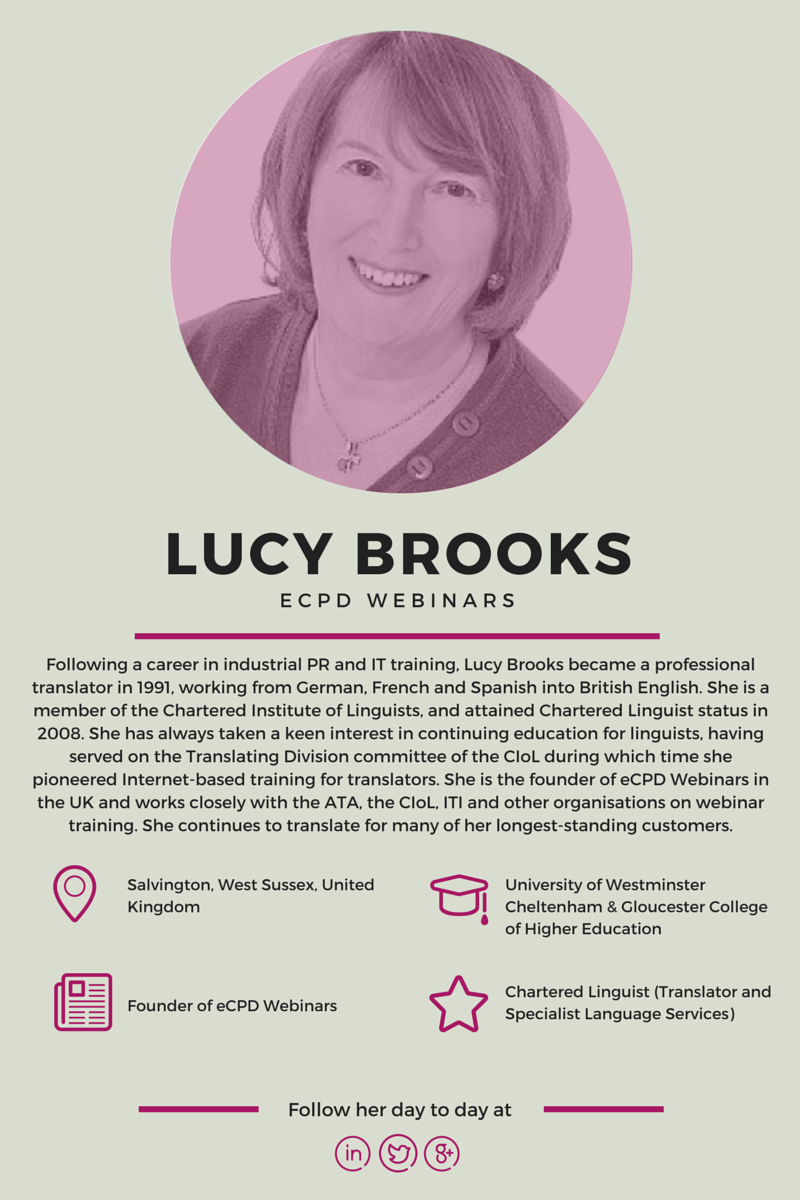
It’s with a great pleasure that I introduce to you our first interviewee nominated by our very first lovely interviewee, Marta Stelmaszak: Lucy Brooks. Who guessed right? Well, I certainly didn’t!

You know what I’m loving about this series? I get to know other determined, inspiring and sophisticated women I didn’t know (or at least not that well). I get to find out other wonderful influencers who are worth following and also learn more about them on the process. It is a pleasure to research about the person in order to find more about their personal and professional backgrounds to ask relevant questions. I’m loving it, and I hope you are too.

Now let’s hear from our second Greatest Woman in Translation.

Welcome, Lucy!

Lauryn born 1986 is an accomplished

1. Why don’t you start telling us more about your background and what caused you to create the eCPD Webinars?

Before I start, I’d like to thank you for inviting me here, and Marta Stelmaszak for nominating me – though I am sure I don’t deserve it. I’m just an ordinary person who has adapted as life has happened – and I made quite a few mistakes along the way.

I started my working life as a bilingual secretary, having trained at a commercial college in London. I studied German and French to a pretty high level – I would say it was degree level but without the literature – and also learned law, commerce, and shorthand and typing (that was a very good skill to have). After college I had many jobs: in law firms, in a London news bureau, in advertising, tourism, a secretarial bureau. All of them gave me valuable experience. In 1991 I decided to become a freelance translator and worked hard at developing this new turn in my career. During that time I was a volunteer for my professional body (CIOL) and was involved in organizing seminars and workshops for fellow translators. They were all based in London and we used to receive complaints from members that we were too London-centric. It was hard for us volunteers to arrange events outside London, so I investigated the idea of holding webinars – a new idea at the time. And that, briefly, is how eCPD Webinars was born.

 2. Speaking of which, I saw you have presented two webinars for eCPD and you also have contact with a wide variety of presenters there. I know all of them are great and the topics useful, but is there one webinar/course/video in particular you highly recommend?

As you say I have personally presented two webinars for eCPD, and hosted several other events. I have also moderated over a hundred of our presentations and courses that are tailored especially to translators or interpreters. I actually recommend them all – well, I would, wouldn’t I? – but the thing I am proudest of at eCPD is our expansion into more in-depth courses. We started in 2013 with Marta Stelmaszak’s Business School for translators, but since then have offered many other courses such as creating corpora, using Excel, writing clear English, IntelliWebSearch, and even a course for Italian translators about translating tourism texts. Trainers on the courses can take the time to delve a little more deeply into a subject and I am proud that we started this trend in professional development. Our current courses are available at this link.

3. You have more than 30 years of experience – practically my entire existence! Back then things were totally different from what they are today. What mistakes (big or small) have you made over these 30 years that you suggest other women small translation business owners avoid? Or, if you prefer, what lessons have you learned?

My entry into the freelance life came about because I was hating having to commute a long distance to work, leaving my small son in the care of someone else. I started a secretarial business from my home, and shortly after I began, was invited to look after the affairs of a local Council, which I could also do at home. This was the time that computers were really coming on the scene and I was already trained in the use of the word processors of the day. A part of my business soon developed into training people on the new-fangled technology. I found myself literally taking newly purchased computers out of the box, plugging them together, and setting up their owners’ office systems on them. I got quite good at it!

As you say, after about seven years of this I launched into translation – something I had always wanted to do but never had the confidence or the contacts to try.

The main thing to remember when you become a freelance translator is that you are an entrepreneur. You are the boss, you set your rates, you decide the direction in which you wish to develop your business. For my first client I did the worst thing you can ever do and ask them (an agency) how much they pay. Of course they will try to trick you into the lowest rate they can get away with.

It’s really hard when you are starting out, but you have to ditch the low payers as fast as you can and gradually move up the scale until you are earning what you are worth.

I believe you should say “no” to a job if you think it’s going to be outside your comfort zone, or is going to be mind-numbingly boring. Boring jobs pay the rent, but if you are trying to develop a niche for yourself, probably best avoided. Mind you, having said that, one person’s boring job may be another’s idea of heaven. I like translating terms and conditions of business and other business contracts! But I am often a pushover and even today, sometimes find myself translating something I am hating.

4. Only after 7 years you decided to start your own small translation business. What was the most intimidating difficulty you encountered?

At the time (1991 or thereabouts) there was no Internet to speak of. There were no networks of fellow translators to help you get started. The two main professional bodies in the UK were finding their feet with helping their members to run their businesses. I was pretty much alone. I used to consult my own library of reference books and often visited the library because Internet research was not an option. I think some of my early translations were less than perfect. But gradually I gained confidence, knowledge and expertise. When CAT tools came along, my working life changed for the better. CAT tools and the Internet. I don’t really know how I managed before they came along.

5. You work from three languages (German, French and Spanish) into British English. Most people I know work with an average of two, so that is a differential. How did you end up learning them? And do you (want to) learn any others?

I learned French and German to A-level (that’s school-leaving standard at 18 years of age) – continuing them both to a much higher level at college. But I also did a course of Spanish at school, taking that to O-level (a slightly lower school-leaving standard). After I left college and had worked for a few years in London, I decided to go to Spain to live and work. It was logical really, because I was given the job on the basis of my German, French and English. Of course I had a good start with my O-level Spanish and quickly became fluent in my new language.

In recent years I have tended to buy a teach-yourself book before visiting a country where I don’t speak the language. So I attempted Russian before a visit to St. Petersburg, but I am afraid I dropped it after our holiday there was over. More recently I decided to learn Greek. But languages really need to be learned when young. My brain no longer absorbs vocabulary like it once did. Still – at least I can now decipher words in Russian and Greek, now that I have almost mastered the alphabets.

6. Freelance translators tend to either fiercely compete or generously collaborate with one another. What is your approach?

I am a bit of a loner and don’t often ask advice. I am happy to give it if I can though.

7. Now it’s your turn to nominate an amazing woman in translation who you think should be interviewed next.

There’s a lady I used to work with at eCPD. Before we worked together I had been following her on social media and already admired her from afar (she’s in Australia). Working with her made me admire her even more. She was an inspiration to me during our time together. Her name is Sarah Dillon.


Thank you, Lucy, for promptly accepting Marta’s nomination and my invitation, and kindly taking the time to answer the interview questions. It was lovely to get to know a bit more about you and your great experience.

Sarah Dillon has also kindly accepted Lucy’s nomination and my invitation, so she will be our third interviewee in early September. Stay tuned.

You can already access Sarah Dillon’s interview here.
Greatest Women in Translation: Marta Stelmaszak

^3BD2FAACEAC897D21BE68030808476304DC722B6E37A1C22D8^pimgpsh_fullsize_distr

Hey, I hope you are excited as I am with the launch of this series! 😀

For those who missed it yesterday, I wrote a post telling all about the series. If you haven’t read it yet, check it out in order to understand how it works. 😉

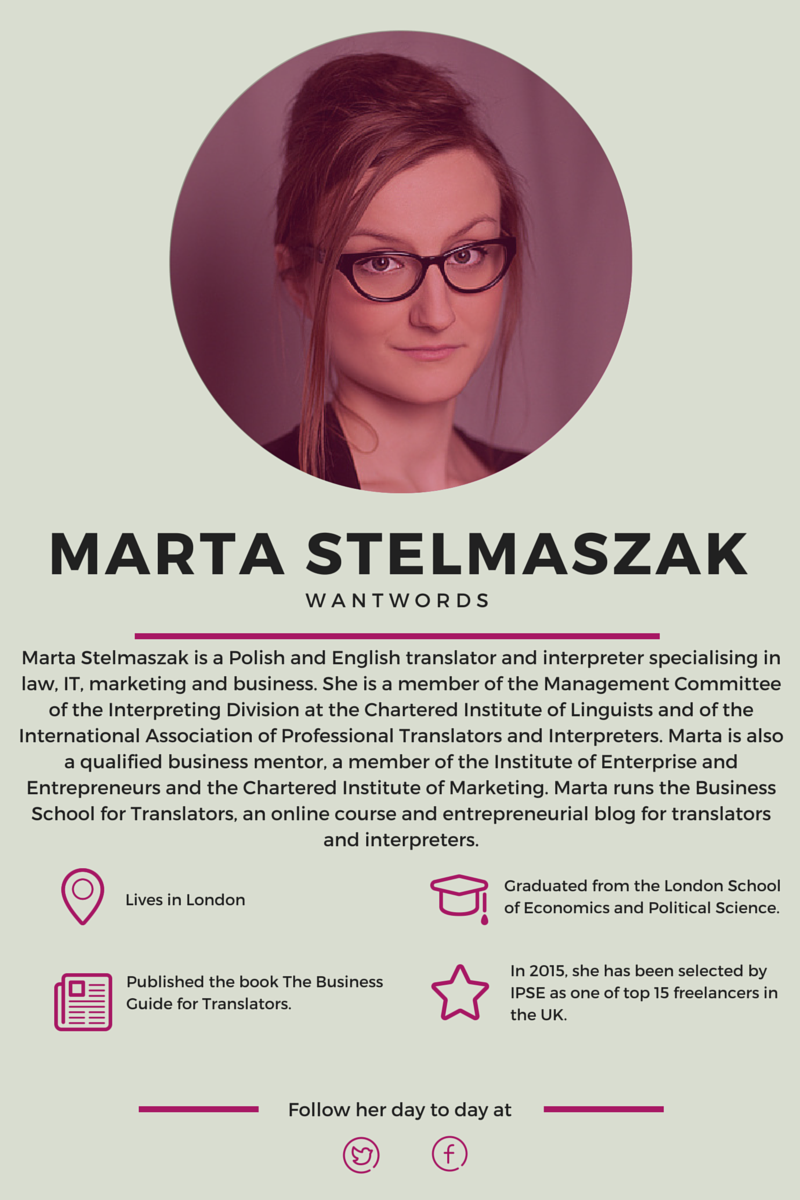
Surprise, surprise! The first interviewee is Marta Stelmaszak. Some of you were indeed right on your guesses, so we probably share the same opinion. The reason I chose Marta is because she is one of my role models since my early days as a freelance translator, when I decided to dedicate part of my time to the internet as well, especially Twitter. I don’t remember how exactly I came across her, but she always inspired me, and still does. Her passion, professionalism and dedication to all her projects motivates and stimulates me to always be better and reach higher.

So let’s hear from her!

Welcome back, Marta!


marta stelmaszak

1. You are an incredibly diverse woman, Marta! You are a translator; you give speeches all around the world; you run a blog, a YouTube channel and your other social media channels; you and Valeria Aliperta run The Freelance Box; you are the Business School for Translators course tutor; you have just written a book — just to name a few! Tell us more about what you do and how you first got started.
I think you covered it quite well! Of course, I spend the most of my time translating and, more occasionally now, interpreting. Indeed, in the past few years I’ve been active on a variety of media, from my own YouTube channel (still out of my comfort zone) to publishing a book. It was all part of a plan to give back and pay forward. I’ve received some excellent advice throughout the years and I know I wouldn’t be where I am now without meeting and speaking to some of the most wonderful colleagues, often not in the limelight at all.
However, diversity and multi-passion approach has its price. It took me time to realize that I have to focus and concentrate and this explains why 2015 is the last year where you’ll see plenty of me. Part of being a responsible business owner is to decide what’s best for you and your business at any given time. I’ve already planned my last conference presentation for a while, and decided to scale down on my blog.
How did I get to this point? Since I first started, some 8 or 9 years ago, I’ve always been working at full pace, giving it 100%. I was a very determined student (I left my whole country behind to study translation in London – lots at stake, you see!), then a very determined business person (working against the odds) and I’ve always been striving to be a resourceful colleague.
Don’t get me wrong, though. Giving it 100% is the only way forward, but it’s important to make sure you give 100% of yourself to the right thing.

2. The impression I personally have is that your day has way more than 24 hours – or that you are a superwoman who can do magic with the time you have. How do you do that?
I’m no Hermione, I wish! I think it’s a mix of a couple of personal characteristics I’ve grown over time with careful business planning. I learned that time is the scarcest of all resources and I’m very disciplined by nature. Add some time-management tricks to this, like time boxing or backwards-planning and there you go, you’ll see that you can fit in more things than before.
To be fair, I do have a virtual assistant and I can’t imagine running my business without her. I think I get some 3-4 extra hours a day thanks to her dedication and hard work. I can definitely recommend having a VA to any freelancer. You’ll see how much time you can save by outsourcing non-core tasks.

3. Break down a typical working day for us.
Don’t judge me, but I do get up quite early. On a typical day in July, I’d get up around 4-4.30 and dedicate the first bit of the day to reading or studying. Then I go to the gym to be back before 8 am. I take about an hour to reply to emails and send proposals, do a bit of business development, prospecting, active marketing and reach out. I work from 9 to 4 or 5, depending on workload, with a lunch break in between. I often have meetings or events in the afternoon, so that requires a trip to central London. I use travel time to catch up with social media. If I don’t go anywhere, I spend this time blogging, writing, or doing other hobby-like bits. By the end of the day, I usually read or study. This year it’s Norwegian that’s keeping me busy at night.
All in all, I do go to bed early. It’s been a going joke at conferences: I’m a very bad conversation partner after 10 pm.

4. What is the biggest challenge you face on a day-to-day basis running your own business?
Finding balance. I think it’s extremely easy to go overboard as a freelancer and just work all the time. All work no play makes Marta… you know how the saying goes. Working 12, 14 or 16 hours a day should never be the norm, but it’s just all too tempting if you’re doing it for your own business. Saying no, saying stop, saying enough – this is the biggest challenge.

5. Besides your computer and the internet, what could you never, ever, in a million years run your business without?Purpose. There’ve been so many occasions where I’ve been that close to thinking that it would just be so much easier to find a job and let all worries and insecurities and problems go. But the feeling of purpose is what keeps me going. I know what I’m doing and why I’m doing it and I can’t imagine running my business without having a clear idea of my mission. Purpose is the thing that keeps you going though the hardships and you need it even more than wifi.

6. You usually like to ask “Why do you translate?” to translators in your presentations. Now I’m the one who ask you,“Why do you do what you do?”
I’ve always liked riddles, quizzes and puzzle. I learned English doing crosswords and reading Agatha Christie. My passion for problem solving in business made me do a whole degree in it (“to learn the causes of things”, that is). Enigma has always inspired me (not only because it was “solved” by a team of Polish mathematicians).
Recently, I read a thought somewhere on Twitter that perfectly captured why I do what I do: translation is a problem-solving exercise. Every word, every phrase, every sentence gives me the chill of a puzzle, of a quiz or a problem that needs solving – here, now and only I can do it. Translation makes me feel a bit like a language detective, investigating all possible solutions, looking up traces in books and dictionaries, checking linguistic fingerprints here and there. And when the case is solved, the next one is right there on my desk.

7. As I have already said, you were and still are my role model in translation. You are a great inspiration! Now who has influenced you the most?
Thank you, it really is an honour! Without the slightest doubt I can say that every colleague I’ve ever interacted with has left a mark. Every person has taught me something. But there are three role models in my life that have influenced me the most and really contributed to career-changing moments. I’ll let you guess based on short descriptions.
First, it’s my lecturer from my BA degree who has taught me the basics of professional translation and also – maybe even more importantly – humbleness when working with language.
Second, it’s someone I’ve been working closely with and who actually came up with the idea of creating the Business School for Translators course. It was – and still is – one of the best things I’ve done in my life and I wouldn’t be here without this person’s contribution.
Third – don’t laugh – is a translation scholar. I’ve been really influenced by her books and research and I wish I can meet her in person one day. She’s a German translator and in 2008, she’s been named Profesora Honoraria da Facultade de Filoloxía e Tradución, Universidade de Vigo.
You have all the tips you need to find out who they are!

8. Lastly, nominate an amazing woman in translation who you think should beinterviewed in our series.
Now, this is a puzzle to solve for you, Caroline! I nominate woman number 2 from my previous answer.


I got two of them wrong and one right. Marta gave the fun idea of letting you guess as well. Do you have any idea who her role models are and who she nominates as the next interviewee (I’ve already talked to the person and s/he accepted it)? Let the guesses begin.

Marta has also written a guest post for us a while ago: Freelance translator as a sole breadwinner: opportunities and challenges.

Here’s the link to the second interview.

Who run the world? Girls!

New month, new editorial calendar, new series… Great times are coming indeed!

The time has come to disclose our new editorial calendar with the special feature of our brand new interview series: Greatest Women in Translation.

So here it is:

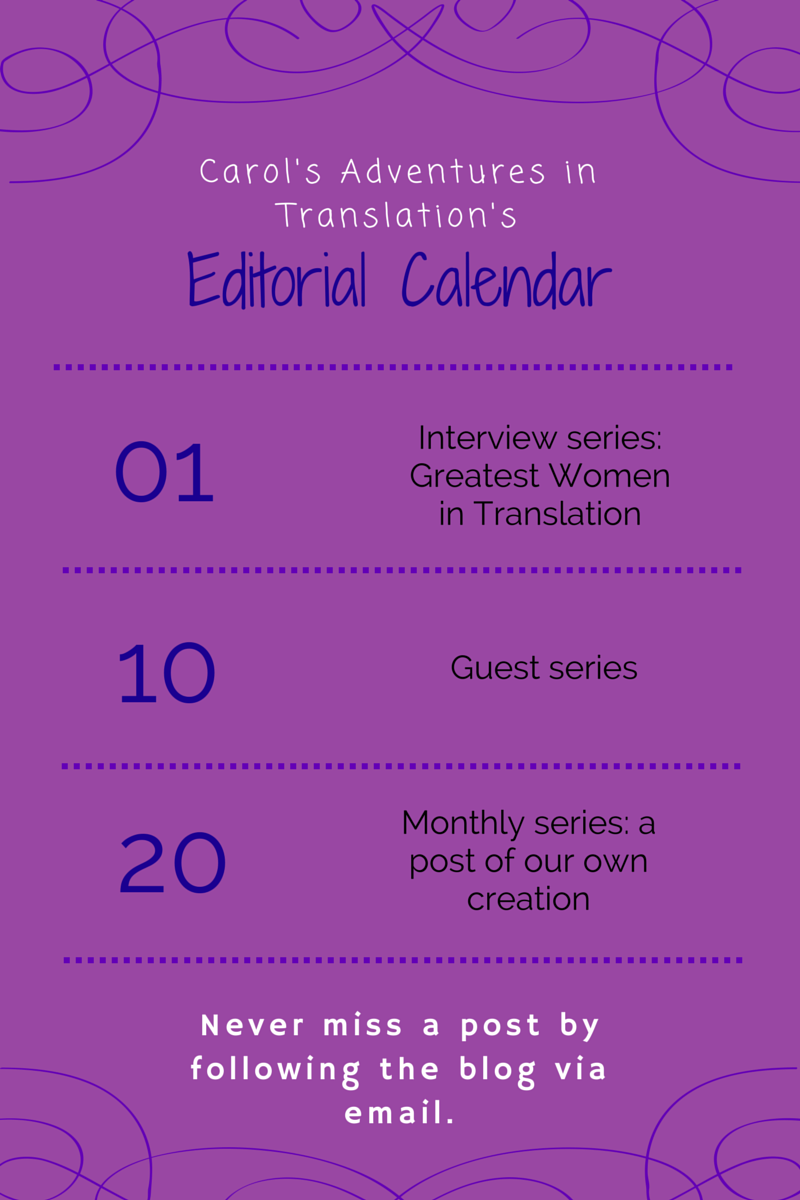
Editorial calendar

On the 1st of every month, we’ll have the brand new interview series, starting tomorrow. On the 10th of every month, we’ll keep having guests writing about diverse and interesting topics on translation (our next guest will be Tess Whitty, from the Marketing Tips for Translators podcast). And on the 20th, we’ll keep having our now monthly posts (previously weekly), written by yours truly, Carol. 😉

If any of those days falls on a holiday or on the weekend, I may anticipate for the previous day or postpone it for the next day.

Since the interview series is new, I’ll explain how it will work.

^3BD2FAACEAC897D21BE68030808476304DC722B6E37A1C22D8^pimgpsh_fullsize_distr

The idea is to feature women translators who are someone’s role model because they inspire and motivate us to reach higher and be better. Since this is a very personal opinion, my role model may not be yours, I’ll let the interviewees themselves choose the subsequent translator to be featured on the series. At the end of the day, we’ll have a group of professionals who are among the greatest women in translation. And I say “among” because the world is pretty large and it would be impossible to feature all the amazing translators who inspire and who are great role models out there.

That being said, tomorrow, the first interviewee will be someone who inspired me, since the beginning of my career, and who keeps being my inspiration. However, I won’t say another word, because it’s still a surprise.

The questions won’t be the same for every interviewee. I’ll try to make them as personal as possible, so we can have a customized interview. If you have any suggestions of questions or if there’s something you’d like to know about a translator, please let me know. I’m open to suggestions.

Last but not least, the hashtag of the series is #gr8testwomenxl8. So feel free to use it whenever you like.

“See” you tomorrow!

P.S.: June is the blog’s 2-year birthday. Stay tuned because there will be something to celebrate soon. 😉

Greatest Women in Translation

photo-1431986229655-9ca60378f77d

It does feel good to be back at writing posts for the blog, especially when there are announcements to be made – good ones, of course. Don’t you worry!

But first I’d like to thank you, my dearest readers, for always being so kind and active on the blog! Seriously, you are amazing! And, because of that, while I was giving some thoughts to the changes I’d make to the blog, you were crucial to the decisions I made. After all, let’s be honest, this blog is for you, so why would I not listen to you, right? So, THANK YOU! I hope you like the changes I’ll announce today and that you keep supporting the blog as you already do.

By the way, have you already voted for it as the Top Professional Blogs 2015? If not yet, please do on the button on your right, and fingers crossed!

Now let’s move on to what matters: the news! As you know, I’ve been more absent than ever from writing posts myself. Besides, I also had a couple of issues with the guest posts. This situation made me feel terrible, because I know I have an editorial calendar to follow and I was letting you down on it. Therefore, I decided it was time for a change! I thought of ending the guest posts altogether, but, as I said, you give me such a great feedback on them, that I really felt it would be a shame to end them. That being said, I declare the guest posts stay! As do my own posts, of course. However, their frequency will change. We’ll have both of them once a month, solving my lack of time issues and leaving me more time to plan the guest posts.

Now the great news is we’ll also have, from now on, an interview series, with which I’m really excited about! 😀 It will be called Greatest Women in Translation (#gr8estwomenxl8). As the name clearly says, I’ll be interviewing women only. I have already invited the first interviewee, and she has accepted the invitation! Yay! She’ll answer the questions I made up especially for her and will be responsible for nominating the second interviewee. That’s right! On this series, I’m not the one who gets to invite guests, the interviewees themselves will be the ones to do so. The idea is that each interviewee nominates a woman they look up to and admire in translation. If, for any reason, the nominee is not able to accept the invitation, I’ll invite another one and start the thread again. Are you as excited as me with this? 😀 Everybody has someone who inspires them, right? And isn’t it just lovely to learn more about the person?

Stay tuned, adventurers! I’ll soon disclose the monthly publication dates and when they start.

Meanwhile, how about trying to guess who the first Greatest Woman in Translation is? 😉